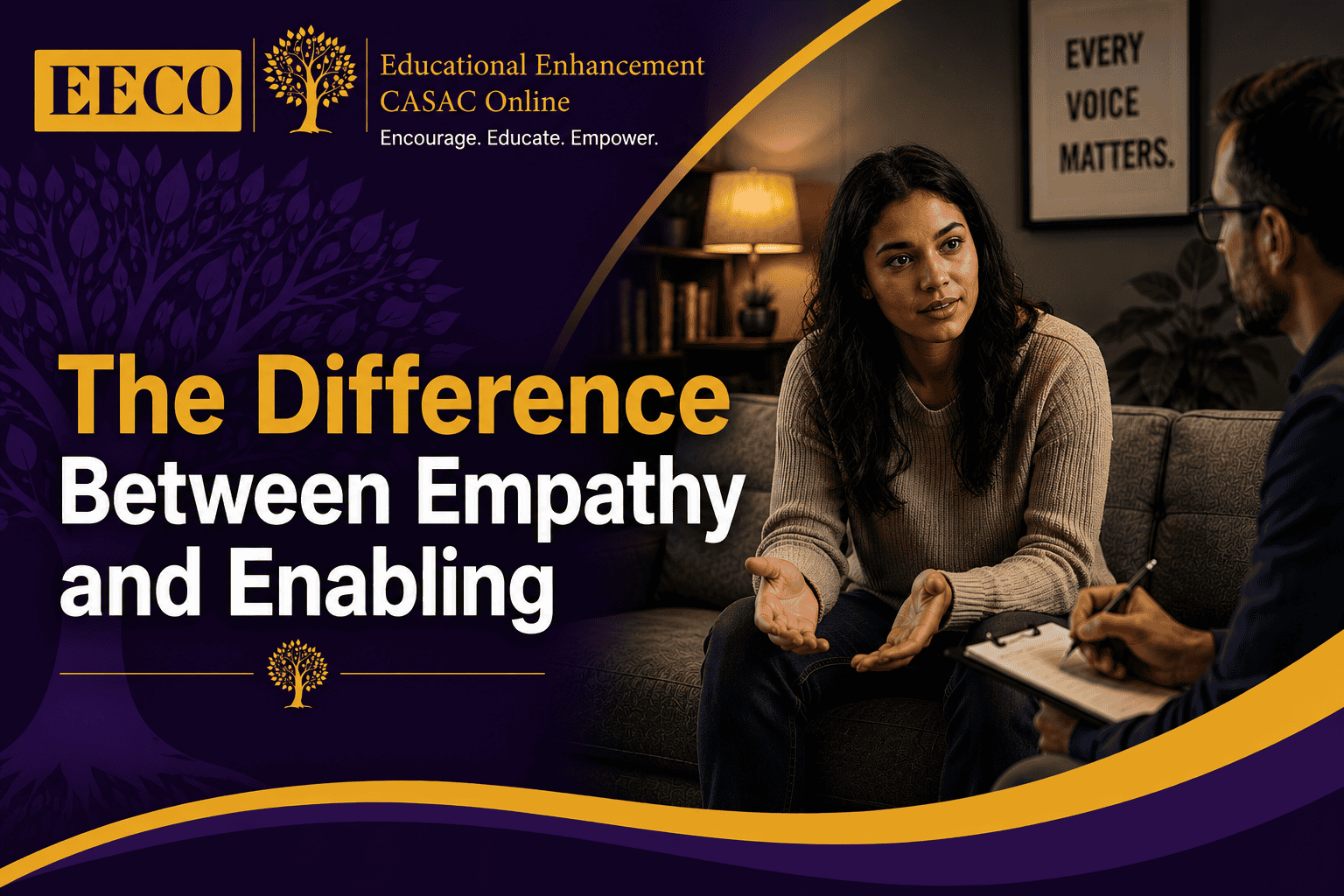
Understanding the Critical Difference Between Compassion and Codependency in Addiction Counseling
Most people become counselors because they genuinely care about others.
You want to reduce suffering. You want people to feel heard. You want to help someone who has spent years believing they are beyond help finally experience acceptance.
Those qualities make you human. They also make you vulnerable to one of the most common mistakes new counselors make.
They confuse empathy vs enabling.
At first glance, the two can look remarkably similar. Both involve kindness. Both involve understanding. Both involve supporting another person through difficult circumstances.
Yet the outcomes could not be more different.
Empathy empowers people to grow.
Enabling behavior keeps people stuck.
Understanding this distinction is one of the most important clinical skills you will ever develop. Whether you are beginning addiction counseling, pursuing your CASAC in NYS, working toward your CADC in Georgia, or earning your CAC in Florida, learning how to balance compassion with accountability will shape every relationship you build with clients.
Why New Counselors Often Confuse Empathy With Enabling
Few counselors begin their careers wanting to confront people.
Most enter the profession because they want to help.
When clients cry, describe traumatic experiences, or explain why they relapsed, the natural instinct is to comfort them. Sometimes that instinct becomes so strong that counselors unintentionally avoid difficult conversations altogether.
That is where the confusion between empathy vs enabling begins.
Many new professionals believe challenging a client will damage the therapeutic relationship.
The opposite is often true.
Clients usually recognize authenticity. They know when someone is avoiding uncomfortable conversations. Respect grows when counselors remain compassionate while also helping clients examine the choices keeping them from reaching their goals.
True empathy in counseling does not mean agreeing with every explanation a client offers. It means understanding the emotions behind those explanations while helping clients discover healthier ways forward.
Carl Rogers described empathy as seeing the world through another person’s eyes without losing your own perspective. That final part is often forgotten.
You enter the client’s world.
You do not abandon your clinical judgment once you arrive.
What Empathy Really Looks Like
There is a reason empathy in counseling sits at the center of nearly every evidence-based counseling model.
People change when they feel understood.
Empathy communicates something every client needs to hear, even if it is never spoken aloud.
“You matter.”
When a client says they relapsed after losing their job, empathy sounds like this:
“It sounds like everything felt overwhelming, and using seemed like the only way to escape for a while.”
Notice what happened.
The counselor acknowledged the emotional experience.
The counselor did not excuse the behavior.
That distinction defines empathy vs enabling.
Effective addiction counseling begins with curiosity instead of judgment.
Instead of asking:
“Why would you do that?”
An empathetic counselor asks:
“What was happening right before you decided to use?”
That question invites exploration instead of defensiveness.
It also creates opportunities to identify triggers, thinking patterns, emotional states, and environmental influences that can become part of future treatment planning.
This approach aligns naturally with person-centered care, where the client’s experiences are respected without losing sight of clinical goals.
When Compassion Quietly Becomes Enabling
Few counselors wake up intending to reinforce unhealthy behaviors.
Most enabling behavior begins with good intentions.
A counselor avoids discussing missed appointments because they do not want the client to feel criticized.
A counselor minimizes repeated relapses because they fear creating shame.
A counselor repeatedly lowers expectations until treatment becomes little more than supportive conversation.
None of these decisions come from a lack of compassion.
They come from discomfort.
Unfortunately, enabling behavior often protects clients from the very experiences that create motivation for change.
Recovery requires learning.
Learning often requires discomfort.
When counselors remove every uncomfortable moment, they may also remove valuable opportunities for growth.
This does not mean becoming harsh.
It means recognizing that accountability and compassion can exist together.
That principle is fundamental to excellent addiction counseling.
Whether you are completing your CASAC in NYS, preparing for a CADC in Georgia, or pursuing a CAC in Florida, developing this balance will influence every assessment, treatment plan, and counseling session you conduct.
Empathy Supports Growth. Enabling Protects Avoidance
One helpful way to understand empathy vs enabling is by asking a simple question.
“What happens after this interaction?”
Does the client leave believing they can solve problems?
Or do they leave believing someone else must solve them?
Empathy increases confidence.
Enabling behavior increases dependence.
Empathy validates feelings.
Enabling validates excuses.
Empathy helps clients understand consequences.
Enabling removes consequences.
Empathy strengthens responsibility.
Enabling weakens responsibility.
Notice that none of these comparisons suggest empathy requires being cold or distant.
In fact, the opposite is true.
Clients are often more willing to accept difficult feedback from someone who has demonstrated genuine compassion.
Trust creates openness.
Openness creates insight.
Insight creates change.
That sequence is at the heart of effective addiction counseling.
Foundations of Counseling
Recertifying as a CASAC, CAC, or CADC? Strengthen the counseling skills every effective session depends on.
Foundations of Counseling is a 20-hour, self-paced course designed for substance use counselors and counselors-in-training. It helps you build practical skills in communication, client engagement, ethics, therapeutic relationships, and responding to ambivalence.
You will examine the role of the substance use counselor while strengthening the skills needed to listen carefully, build rapport, recognize barriers to treatment, and support meaningful change. The course may be used toward initial CASAC education or qualifying CASAC and NAADAC renewal requirements.
Perfect for CASAC, CAC, and CADC professionals, this course offers:
- Stronger active listening and communication skills
- Practical strategies for building therapeutic rapport
- Guidance for responding to ambivalence and resistance
- Clear instruction on ethics and professional conduct
- Twenty hours of approved self-paced education
Build the foundation your clients can stand on.
Motivational Interviewing Demonstrates Compassion Without Rescue
One reason motivational interviewing has become one of the most respected approaches in behavioral health is that it models empathy in counseling without encouraging enabling behavior.
Rather than arguing with resistance, counselors become curious about it.
Rather than convincing clients to change, counselors help clients discover their own reasons.
Instead of saying:
“You need to stop using.”
A motivational interviewing response might sound like this:
“What concerns you most about continuing to use?”
That single question shifts ownership back to the client.
The counselor becomes a guide rather than a rescuer.
This approach respects autonomy while still encouraging accountability.
It also reminds clients that lasting recovery belongs to them, not to the counselor.
That is one of the clearest examples of empathy vs enabling in everyday clinical practice.
Boundaries Are One of the Greatest Expressions of Empathy
Many new counselors worry that setting boundaries will make them seem uncaring.
The opposite is true.
Healthy therapeutic boundaries create safety, consistency, and trust. Clients know what to expect, which helps reduce anxiety and creates a predictable therapeutic environment.
Without clear therapeutic boundaries, the counseling relationship can slowly shift away from treatment and toward dependency.
Consider these examples.
A client repeatedly asks for personal favors outside of session.
A counselor begins answering late-night text messages because they do not want the client to feel abandoned.
A counselor frequently extends sessions well beyond the scheduled time because saying no feels uncomfortable.
Each decision may appear compassionate in the moment. Over time, however, those actions blur professional roles and reduce the client’s opportunity to develop independence.
Strong therapeutic boundaries do not communicate rejection.
They communicate reliability.
Clients recovering from substance use disorders have often experienced relationships filled with inconsistency, broken promises, or unclear expectations. Consistent boundaries show clients that healthy relationships can be predictable, respectful, and trustworthy.
Accountability Is Not Punishment
One of the greatest myths in addiction counseling is that accountability creates shame.
Poorly delivered accountability certainly can.
Compassionate accountability does the opposite.
It communicates belief.
When counselors hold clients accountable, they are sending an important message.
“I believe you are capable of something better.”
That message is empowering.
Imagine a client who has missed three consecutive group sessions.
An enabling response might sound like this.
“I’m sure you had your reasons.”
An empathetic response sounds different.
“I noticed you’ve missed several groups. Help me understand what has been getting in the way, because attending is an important part of reaching the goals you told me matter to you.”
One response removes responsibility.
The other invites reflection.
This is another example of empathy vs enabling behavior in action.
What Great Counselors Listen For
Experienced counselors hear much more than words.
They listen for fear.
They listen for shame.
They listen for hopelessness.
They listen for ambivalence.
A client may say,
“I don’t think treatment works.”
What they may actually mean is,
“I’m afraid of failing again.”
This is where empathy in counseling becomes a powerful clinical skill.
Rather than arguing, the counselor explores.
“Tell me about what makes you feel that way.”
That single sentence creates space for insight instead of defensiveness.
Great counselors understand that behavior often protects deeper emotional pain.
When that pain is understood, healthier choices become possible.
Trauma Changes the Conversation
Many individuals entering treatment have experienced significant trauma.
That history changes how counselors should respond.
Being trauma-informed care does not mean avoiding accountability.
It means understanding why certain behaviors developed in the first place.
Clients who have survived abuse, neglect, violence, or chronic adversity often learned coping strategies that once protected them.
Those strategies may no longer serve them, but they deserve to be understood before they are challenged.
This is why a trauma-informed care approach combines empathy with collaboration rather than confrontation.
When clients feel physically and emotionally safe, they become more willing to examine difficult experiences and begin developing healthier coping skills.
Documentation Should Reflect Respect
The language counselors use should not change once they begin writing progress notes. Progress notes should reflect the empathy in counseling extended to the client, the note, and the documentation process.
Clinical documentation should reflect the same respect demonstrated during counseling sessions.
Instead of writing,
“Manipulative client refused treatment.”
A stronger clinical statement might read,
“The client expressed ambivalence regarding treatment recommendations and explored concerns about previous treatment experiences.”
The facts remain accurate.
The judgment disappears.
Respectful documentation improves communication among treatment providers while reinforcing a person-centered approach to care.
Every note becomes another opportunity to reduce stigma.
Five Questions Every Counselor Should Ask
Before ending a difficult session, ask yourself these questions.
- Did I validate the client’s feelings without validating unhealthy behavior?
- Did I encourage responsibility instead of rescuing?
- Did I maintain healthy therapeutic boundaries throughout the session?
- Did my response increase the client’s confidence or increase their dependence on me?
- Did I leave the client with hope and a practical next step?
If you answer yes to those questions, you are likely practicing empathy rather than enabling.
Becoming the Counselor Clients Remember
Clients rarely remember every intervention. However, they will remember the empathy in counseling during the intervention or addiction counseling process.
They remember how counselors made them feel.
They remember who believed in them when they struggled.
They remember who treated them with dignity while refusing to lower expectations.
That combination changes lives.
Whether you are pursuing your CASAC in NYS, preparing for your CADC in Georgia, or working toward your CAC in Florida, your ability to distinguish empathy vs enabling behavior will shape every counseling relationship you build.
The most effective counselors understand that kindness and accountability are not opposites.
They are partners.
Empathy says,
“I understand your struggle.”
Clinical excellence adds,
“And I believe you are capable of something more.”
That is where recovery begins.
Continue Building the Skills That Change Lives
Learning the difference between empathy and enabling is only one part of becoming an exceptional addiction professional. Effective counselors also develop strong assessment skills, motivational interviewing techniques, treatment planning, documentation practices, ethics, and trauma-informed clinical approaches that help clients achieve lasting recovery. Mastering empathy in counseling allows professionals to build trust, foster openness, and tailor interventions more effectively, ultimately improving client outcomes and supporting a healing environment.
Whether your goal is earning your CASAC in NYS, becoming a CADC in Georgia, or pursuing a CAC in Florida, building a strong clinical foundation in addiction counseling is essential.
Educational Enhancement CASAC Online’s CASAC 350 Education and Training program prepares future counselors with the knowledge and practical skills needed to work confidently with individuals and families affected by substance use disorders. Through a combination of self-paced learning and live instructor-led training, students gain real-world counseling competencies that extend far beyond passing a credentialing exam. If you are ready to begin a meaningful career helping others rebuild their lives, CASAC 350 Education and Training is an excellent place to start.
Join Our Newsletter!
Join today. Stay current with news about addiction counselors, interventions, trends, and statistics.
STOP THE STIGMA