
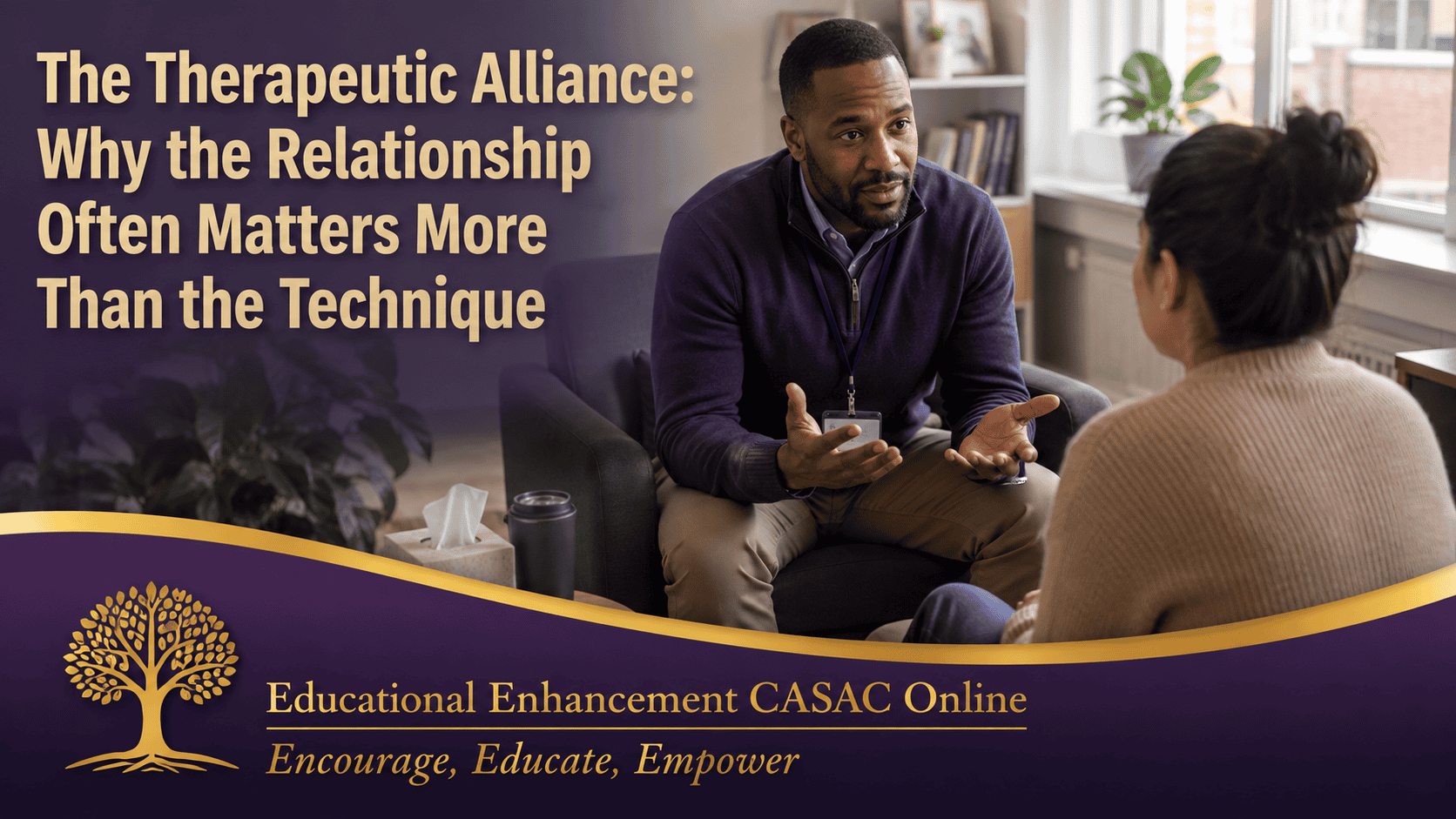
Trust is not a bonus skill in substance use counseling. It is the foundation that allows every assessment, intervention, and treatment plan to work. Learn how to build a therapeutic alliance that
keeps clients engaged from the very first conversation.
A counselor spends hours preparing for a first appointment. They review the referral, organize assessment forms, and plan which interventions to use if the client is ready for change. The session goes smoothly. Every required question is answered. The documentation is complete. Yet the client never returns. Situations like this remind us that the therapeutic alliance, the therapeutic relationship, rapport building in counseling, client engagement, and the counselor-client relationship often determine whether counseling continues long enough for any technique to make a difference. Before clients decide whether they believe in treatment, they decide whether they trust the person sitting across from them.
That decision begins quickly.
Sometimes within the first few minutes.
- Long before treatment goals are written.
- Long before coping skills are discussed.
- Long before recovery begins to feel possible.
People seeking counseling often arrive carrying years of disappointment.
- Some have been judged.
- Some have been misunderstood.
- Some have repeated their story so many times they no longer believe anyone is truly listening.
The first conversation tells them whether this experience will be different.
Every counselor remembers clients who seemed guarded at first but gradually became more open as trust developed.
The opposite happens too.
A technically perfect assessment means very little if the client never returns for a second appointment.
Clinical skill still matters.
The relationship determines whether those skills have an opportunity to work.
Postgraduate CASAC Training: Choose Your Path
Earn your CASAC online with Educational Enhancement. New to the field? Our CASAC 350 Hybrid Training Online delivers all 350 OASAS-approved hours, self-paced with live instructor sessions. Already a licensed clinician? Our Postgraduate CASAC training gives Master's Level social workers, LMHCs, or licensed behavioral health professional, get the CASAC credential on a shorter 135-hour track that builds on the graduate education you already have. Both are 100% online, self-paced, and OASAS-approved.
What is the therapeutic alliance?
The therapeutic alliance is the working relationship between counselor and client.
It is built on:
- trust.
- Respect.
- Collaboration.
- Honesty.
- Shared goals.
It is not about becoming friends.
It is not about agreeing on everything.
It is about creating a relationship where difficult conversations become possible because both people are working toward the same purpose.
Psychologist Edward Bordin described the therapeutic alliance as three connected elements.
- A shared agreement about treatment goals.
- Agreement on the work needed to reach those goals.
- A trusting bond between counselor and client.
Remove any one of those elements and the relationship becomes weaker.
Clients may trust the counselor but disagree with the treatment plan.
Or they may understand the goals but never feel emotionally safe enough to participate honestly.
Strong counseling requires all three.
The therapeutic relationship is not something counselors establish once and then forget.
- It develops throughout treatment.
- It grows stronger through consistency.
- It weakens when trust is broken.
Like every important relationship, it requires attention.
Research over several decades has repeatedly shown that the quality of the counseling relationship predicts participation and retention across many treatment approaches. The work of Bruce Wampold and John Norcross consistently demonstrates that the relationship itself is one of the strongest contributors to successful psychotherapy, regardless of the specific counseling model being used.
Techniques matter.
Relationships determine whether those techniques are accepted.
Why the relationship predicts client engagement
Counselors sometimes search for the perfect intervention.
The perfect worksheet.
The perfect treatment model.
Clients usually want something much simpler.
They want to know whether someone understands them.
That is why client engagement begins with human connection rather than clinical technique.
Think about the clients who remain engaged in treatment despite setbacks.
Many describe having at least one counselor who listened without rushing:
- Who remembered details from previous sessions.
- Who followed through on promises.
- Who admitted mistakes.
- Who treated them like people instead of diagnoses.
- Those moments create trust.
- Trust encourages honesty.
- Honesty improves assessment.
- Better assessment supports better treatment planning.
The relationship influences every step that follows.
The American Psychological Association has published extensive work on psychotherapy relationships showing that empathy, collaboration, and respect consistently contribute to stronger engagement across diverse client populations. Likewise, the SAMHSA Treatment Improvement Protocol on Enhancing Motivation for Change explains that people participate more actively in treatment when counselors create collaborative relationships instead of relying on confrontation or persuasion.
These findings are not surprising.
People are far more willing to discuss painful experiences when they believe they will be heard rather than judged.
The strongest counselor-client relationship often develops one conversation at a time.
Not through dramatic breakthroughs.
Through consistent respect.
Rapport begins before treatment
Many counselors think rapport begins after the assessment.
It actually begins before the first clinical question.
It starts with how you greet someone.
Whether you introduce yourself clearly.
Whether you explain what today’s appointment will involve.
Whether you describe confidentiality in language the client understands.
Whether your attention remains focused on the person instead of the computer screen.
These small moments communicate something important.
“You matter.”
That message encourages rapport building in counseling more effectively than any scripted opening.
A thorough biopsychosocial assessment gathers valuable clinical information, but clients are far more likely to share meaningful details when trust develops before the formal assessment begins.
Simple communication habits make a difference:
- Learn the client’s preferred name.
- Maintain appropriate eye contact.
- Allow enough silence for thoughtful answers.
- Acknowledge difficult emotions instead of immediately moving to the next question.
- Explain why sensitive information is being collected.
Those behaviors strengthen the therapeutic alliance because they demonstrate respect before asking clients to discuss the most difficult parts of their lives.
- Documentation matters.
- Assessment matters.
- Treatment planning matters.
None of them happen effectively until the client believes the relationship is worth investing in.
That investment begins with the first interaction.
Not the first intervention.
Trust grows through consistency
Many counselors believe trust is established during the first session.
The first session is only the introduction.
Trust develops through consistency.
Clients notice whether you remember details they shared the week before.
They notice whether you begin sessions on time.
They notice whether you follow through after promising to make a referral or locate a resource.
They notice whether your mood changes from one session to the next.
Most of all, they notice whether your actions match your words.
Those moments strengthen the therapeutic alliance because they create predictability. People living with a substance use disorder often have long histories of relationships marked by broken promises, disappointment, or inconsistency. Counseling becomes different when the counselor-client relationship demonstrates reliability instead.
Professional boundaries support that consistency.
Being dependable does not mean becoming a friend.
It means becoming someone clients know they can count on.
Documentation also plays a role. Accurate records preserve continuity from one session to the next and demonstrate that the client’s concerns matter enough to be recorded thoughtfully. Our article on the importance of reports and record-keeping in substance use counseling explains how good documentation supports communication while reinforcing accountability between counselor and client.
Trust grows one interaction at a time.
Rarely all at once.

Counselor Client Relationships
Strengthen your substance use counseling skills with our OASAS-approved online course offering 15 clock hours of expert instruction for certification and renewal.
Are you a CASAC, CADC, or CAC who wants to build stronger therapeutic relationships, improve client engagement, and create the trust that supports lasting change?
Features of our Counselor Client Relationships course:
Designed for substance use counselors who want stronger clinical skills and more effective client interactions
- OASAS-approved 20 -hour course for certification and renewal
- Examines the foundations of effective counselor-client relationships
- Teaches practical communication, rapport building, and therapeutic boundary skills
- Explores trust, empathy, professionalism, and ethical relationship building
- 100% online and self-paced for flexible learning
- Meets the needs of both counselors in training and experienced professionals seeking renewal hours
Listening creates connection
Many counseling students spend years learning what to ask.
They spend far less time learning how to listen.
Listening is more than remaining quiet while another person speaks.
It means becoming fully interested in what the client is trying to communicate.
- Sometimes that message appears in words.
- Sometimes it appears in hesitation.
- Sometimes it appears in what the client chooses not to say.
The strongest therapeutic relationship often develops because clients feel understood instead of analyzed.
New counselors sometimes become uncomfortable with silence.
A client stops talking.
- Five seconds pass.
- The counselor immediately asks another question.
- The moment disappears.
Experienced counselors understand something different.
- Silence often creates room for reflection.
- Clients pause.
- Think.
Then continue with information they had not planned to share.
Those moments cannot be rushed.
You do not have to fill every quiet moment.
Listening also involves reflecting what you hear.
- “It sounds like you’ve been carrying this alone for a long time.”
- “You’re trying to decide whether treatment is worth another attempt.”
- “That experience still affects you today.”
Simple reflections communicate understanding without changing the subject.
Clients who feel heard become more willing to continue talking.
That willingness strengthens the therapeutic alliance and encourages honest conversations that improve assessment, documentation, and treatment planning.
Collaboration keeps clients engaged
Counselors bring clinical knowledge.
Clients bring lived experience.
Neither is complete without the other.
The strongest client engagement occurs when treatment becomes something counselors and clients develop together instead of something one person directs.
Simple questions encourage collaboration.
- “What feels most important for us to work on first?”
- “What has helped you before?”
- “What concerns you most about treatment?”
Those conversations shift the focus from compliance to partnership.
Clients begin participating instead of simply responding.
That collaboration should continue after the session ends. Our article on collaborative documentation that actually helps substance use counselors and clients explains how reviewing goals, progress, and session summaries together strengthens both the counselor-client relationship and ongoing client engagement.
People are far more likely to support a plan they helped create.
That principle applies to counseling as much as any other relationship.
Cultural humility strengthens every relationship
Every client enters counseling with experiences that shape how they understand trust.
- Family.
- Culture.
- Language.
- Religion.
- Military service.
- Economic hardship.
- Disability.
- Recovery experiences.
No counselor shares every one of those experiences.
Recognizing that fact strengthens the therapeutic alliance.
Curiosity becomes more valuable than assumptions.
Our article on the impact of cultural diversity in addiction counseling explains how culture influences communication, treatment expectations, and recovery. Counselors who remain open to learning from each client’s lived experience naturally improve rapport building in counseling because clients feel respected as individuals rather than categorized by stereotypes.
One sentence often changes the direction of a conversation.
“Help me understand what this experience has been like for you.”
That question communicates humility.
Humility strengthens trust.
What damages the therapeutic alliance?
The same relationship that takes months to build can weaken surprisingly quickly.
Often the damage comes from ordinary habits rather than major mistakes.
Common examples include:
- Interrupting before clients finish speaking.
- Asking questions without responding to the answers.
- Giving advice before understanding the problem.
- Spending more time looking at the computer than the client.
- Becoming defensive when clients disagree.
- Making assumptions instead of asking questions.
- Ignoring emotional responses while focusing only on paperwork.
- Failing to follow through after making a commitment.
None of these behaviors automatically end the therapeutic relationship.
Repeated consistently, they slowly weaken trust.
The encouraging news is that the opposite is also true.
- Consistent respect.
- Careful listening.
- Honest communication.
- Curiosity.
- Reliability.
These everyday behaviors strengthen the therapeutic alliance far more than impressive counseling techniques ever could.
Repairing the relationship after mistakes
Every counselor makes mistakes.
- You will misunderstand a client.
- Interrupt someone at the wrong moment.
- Ask a question that feels insensitive.
- Miss the meaning behind a comment.
The goal is not avoiding every mistake.
The goal is repairing the relationship when one occurs.
Many counselors worry that admitting a mistake will weaken the therapeutic alliance.
The opposite is often true.
Clients rarely expect perfection.
They do expect honesty.
Simple statements can repair trust.
- “I think I misunderstood what you meant.”
- “Thank you for correcting me.”
- “I’d like to understand your perspective better.”
Those responses communicate humility instead of defensiveness.
Research by Jeremy Safran and Christopher Muran on alliance ruptures has consistently shown that recognizing and repairing relationship strains often strengthens the counseling relationship rather than weakening it. Clients frequently remember how counselors responded after a difficult moment more than the mistake itself.
Repair is a clinical skill.
Like listening, it improves with practice.
The therapeutic alliance changes throughout treatment
The therapeutic alliance is not static.
It changes as counseling progresses.
During intake, clients often want reassurance that they are being heard.
During assessment, they want confidence that their experiences are being understood accurately.
As treatment develops, collaboration becomes increasingly important.
Later, during relapse or other setbacks, the relationship may become the primary reason a client continues returning.
Even discharge reflects the strength of the therapeutic relationship.
Clients who feel respected throughout treatment are more likely to return if they need services again rather than waiting until problems become overwhelming.
Relationships continue influencing care long after the final session.
Common mistakes new counselors make
Every experienced counselor can look back and recognize early mistakes.
Most were not caused by a lack of caring.
They were caused by inexperience.
Common examples include:
- Trying to impress clients instead of understanding them.
- Asking too many questions without reflecting on the answers.
- Rushing through paperwork before building rapport.
- Talking more than listening.
- Offering solutions before fully understanding the problem.
- Confusing friendliness with professional boundaries.
- Feeling responsible for fixing every problem immediately.
These habits improve with supervision, feedback, and experience.
The strongest rapport building in counseling comes from slowing down.
Listening carefully.
Remaining curious.
Allowing trust to develop at the client’s pace.
Professional development strengthens relationships
Some counselors naturally communicate well.
Every counselor can become better.
Communication is not simply a personality trait.
It is a clinical skill.
Clinical supervision, consultation, continuing education, recorded session reviews, and honest self-reflection all strengthen the counselor-client relationship by helping counselors recognize habits they may not notice on their own.
Sometimes supervision is less about finding the right intervention and more about examining how your communication influenced the session.
Did you interrupt too quickly?
Did you ask enough open questions?
Did you spend more time documenting than listening?
Those conversations improve future sessions because they improve the relationship itself.
Professional development is not only about learning new techniques.
It is also about becoming more intentional in how you communicate with every client who walks through your door.
Conclusion
Counselors often spend years studying assessment tools, treatment models, documentation standards, and counseling techniques. Those skills matter. They become far more effective when they exist within a strong therapeutic alliance. A respectful therapeutic relationship, thoughtful rapport building in counseling, consistent client engagement, and a trustworthy counselor-client relationship create the conditions where honest conversations, meaningful assessments, and lasting clinical work become possible. Clients may not remember every intervention you used. They almost always remember whether they felt respected, understood, and heard. That is why the relationship so often matters more than the technique.
One action to take today
During your next session, pay attention to how much time you spend talking compared to listening.
Before asking another question, pause for five seconds.
Give the client space to continue.
You may discover that the most important part of the conversation begins after the silence.
Continue strengthening your counseling skills
Building a strong therapeutic alliance takes practice, supervision, and ongoing education. Whether you are beginning your career through our CASAC Training, expanding your knowledge with our addiction counselor courses, completing your education for the CADC in Georgia, or earning your CAC in Florida, strengthening communication, trust, and clinical relationships will improve every assessment, counseling session, and treatment plan you develop.
Join Our Newsletter!
Join today. Stay current with news about addiction counselors, interventions, trends, and statistics.
STOP THE STIGMA