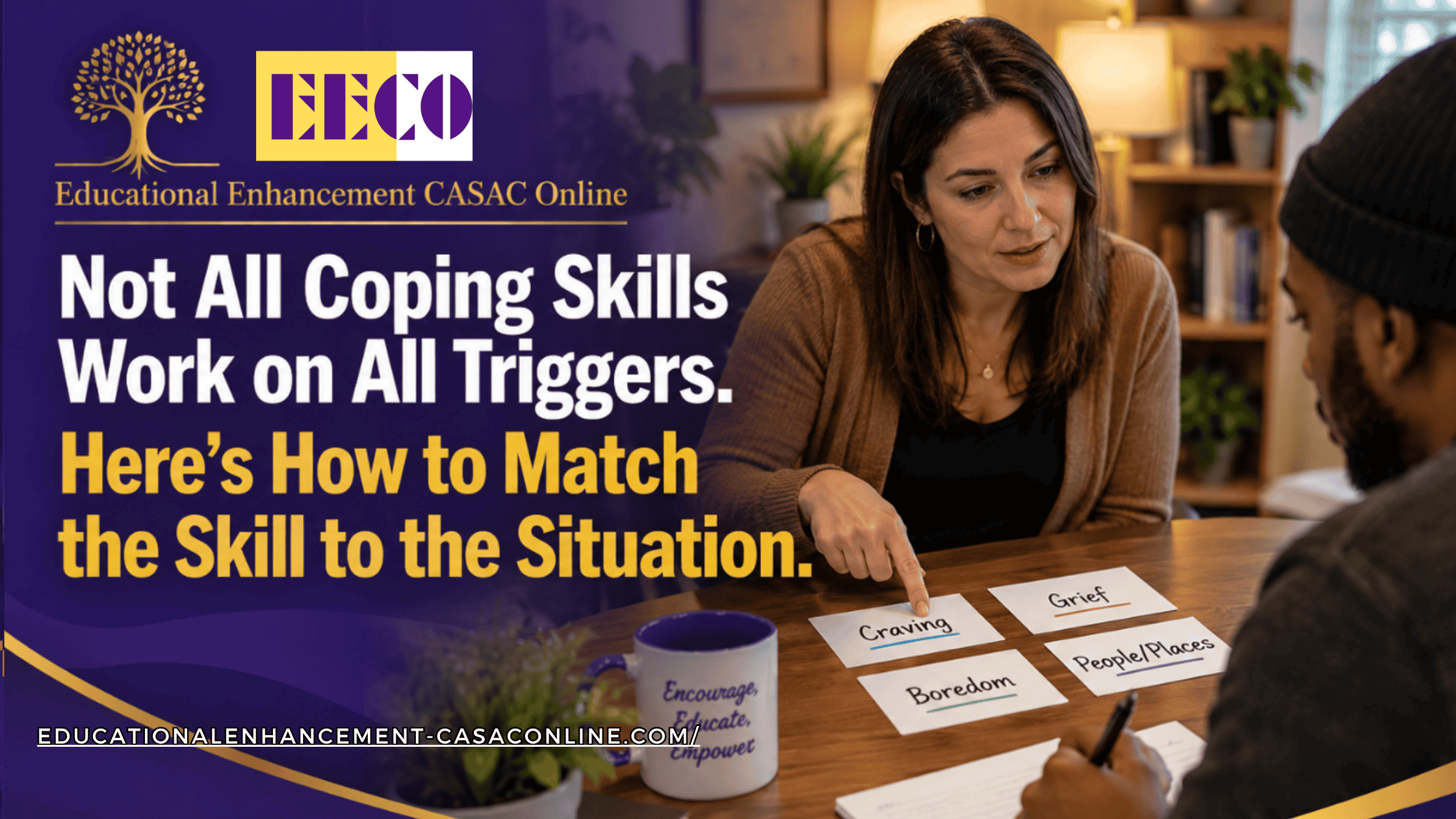
Not All Coping Skills Work on All Triggers. Here’s How to Match the Skill to the Situation.
Handing a client a breathing exercise for acute grief is not coping skills work. It is filling time. The skill has to match the situation.
A generic coping skills list is a starting point at best. Coping skills for cravings and triggers: substance use counselors know this in practice, even when training materials do not say it directly. A physical craving and an argument with a family member and the numbness of an empty Sunday afternoon are not the same clinical problem. Each has a different neurological profile, emotional texture, and window of intervention. High-risk situations: substance use counseling work is built on that distinction: knowing which situation you are actually dealing with, and matching the response to the mechanism. Coping with triggers in substance use treatment requires a more precise framework than “breathe and call your sponsor.” Boredom, relapse risk, and substance use counselor conversations almost never happen at the right moment. Usually after a relapse. Rarely before. Situational coping strategies: SUD counseling is the clinical competency of building situation-specific plans before the high-risk moment arrives, not during it. This post covers four situations that come up most consistently in SUD treatment, what is happening at the neurological and emotional level in each one, and which skills match.
Why a Generic Coping Skills List Is Not Enough
Coping skills for cravings and triggers in substance use treatment settings share a common failure pattern. The field has defaulted for decades to a general toolkit: breathe, call someone, go for a walk, play the tape forward, attend a meeting. These are not bad tools. They are just not situation-specific tools. In high-risk situations, substance use counseling requires more precision than a list provides.
The clinical problem is what happens when the wrong skill meets the wrong trigger. A client in the middle of acute grief does not need cognitive restructuring. That is problem-solving applied to something that cannot be solved. A client in a physical craving does not need to journal. The window for a cognitive skill is too slow for what the nervous system is doing. Using the wrong skill at the wrong moment does not just fail. It can confirm for the client that coping skills do not work, which is a clinical setback that persists past the session.
Situational coping strategies: SUD counseling work starts by naming what type of situation is actually occurring. Not all triggers are the same. Not all distress is the same. Four profiles come up across nearly every caseload in SUD treatment. Four come up across nearly every caseload in SUD treatment: cravings, external triggers, grief and loss, and boredom. Each one requires its own clinical response.
Cravings: Skills That Work at the Neurological Level
Cravings are not thoughts. They are neurological events with a physical dimension. The research on craving neuroscience is consistent: a craving activates reward circuitry in ways that temporarily suppress the prefrontal cortex’s ability to override behavior. This is why reasoning with a craving rarely works. The reasoning system is the one getting outcompeted.
Coping skills for cravings and triggers and substance use interventions that work at the physiological level interrupt the craving cycle from a different angle. The DBT skill TIPP addresses this directly:
Temperature. Cold water on the face or wrists activates the dive reflex, slowing heart rate and shifting physiological state. Simple, fast, available almost anywhere.
Intense exercise. Brief, vigorous movement redirects blood flow and neurochemistry. A five-minute run or a set of jumping jacks is not about fitness. It is about changing the body’s state faster than the craving can peak.
Paced breathing. Slow exhale-focused breathing activates the parasympathetic nervous system and interrupts the sympathetic arousal that accompanies a craving. It works better when the exhale is longer than the inhale. A 4-count inhale with a 6-count exhale is a reasonable starting point.
Progressive muscle relaxation. Works best when practiced in advance so it is available under pressure. A client who has practiced PMR outside of cravings can access it during one.
ACT’s urge surfing belongs here, too. The skill is to observe the craving as a wave with a peak and a natural decline, without acting on it or fighting it. Fighting a craving is exhausting and usually unsuccessful. Observing it costs less and works with the neurological reality that cravings do not persist indefinitely.
What does not work well: distraction (temporarily useful, not sustainable), reasoning (“I shouldn’t want this”), or trying to eliminate the want. The goal with a craving is not resolution. It is delay and ride-through.
Coping with triggers in substance use treatment at the craving level is physiological first. Coping skills for cravings and triggers: substance use counselors who understand this distinction stop reaching for cognitive tools at the peak of a craving and start reaching for body-based ones instead.
External Triggers: People, Places, and Things
The PPTS framework (people, places, things, situations) is well-known. Most clients can name their external triggers within a few minutes of being asked. The clinical work is not the list. It is building a behaviorally specific plan for what happens when one of those triggers shows up.
The distinction between avoidance and coping matters here. Avoidance means not going to the place, not spending time with the person. Coping means having a plan for when avoidance is not possible or has already failed. Both have a role. Neither one alone is a complete high-risk situations substance use counseling strategy. Coping with triggers in substance use treatment that relies on avoidance alone will break down the first time the person ends up somewhere they did not plan to be.
Some external triggers cannot be avoided: a family member who uses, a coworker who drinks at every office event, a neighborhood the client still lives in. For these, the clinical work shifts to the skills needed when you don’t have the option to leave. That looks different than it does for avoidable triggers. It includes things like entry rules (I will not go in without knowing my exit), behavioral rehearsal for likely moments, and a clear decision point: a named internal signal that tells the client to leave.
Situational coping strategies: SUD counseling for high-risk relationships specifically; a client who is regularly exposed to a family member who is actively using needs more than a coping card. The family system itself is part of the clinical picture. The pressure that comes from within a family (enabling, minimizing, enabling disguised as support) requires its own skill set.
Family Systems Theory: The Person with Substance Use Disorder and Family Pressure covers that clinical territory in more depth.
Postgraduate CASAC Training: Choose Your Path
Earn your CASAC online with Educational Enhancement. New to the field? Our CASAC 350 Hybrid Training Online delivers all 350 OASAS-approved hours, self-paced with live instructor sessions. Already a licensed clinician? Our Postgraduate CASAC training gives Master's Level social workers, LMHCs, or licensed behavioral health professional, get the CASAC credential on a shorter 135-hour track that builds on the graduate education you already have. Both are 100% online, self-paced, and OASAS-approved.
Grief and Loss: the Trigger Most Counselors Underestimate
Grief in recovery is layered in ways that do not resolve quickly. There is the loss of the substance itself, and that is real grief, not metaphor. People in early recovery have lost the primary relationship in their life, whatever else it was doing. Losses also occur during active use: relationships that did not survive, years of time, and versions of themselves they cannot get back. There are losses that become clear only in sobriety, because substance use made them invisible while it was happening.
None of this follows a predictable timeline.
High-risk situations: substance use counseling around grief requires a clinical adjustment that the rest of skills work does not make: the goal is not always reduction of distress. Situational coping strategies: SUD counseling for grief looks different than it does for cravings or external triggers, and conflating them is one of the most common clinical errors in this domain. Some grief needs to be present, not managed. A client who is being moved through a breathing exercise every time they express loss is learning that their grief is a problem to be solved rather than a state to be witnessed.
Skills that reduce distress rapidly (distraction, regulation exercises, behavioral activation) have a role when distress is escalating into crisis. They are the wrong tool for grief that is simply present.
Coping with triggers in substance use treatment around grief means the counselor’s clinical judgment is central. When to reduce distress, when to stay in it, and when to name that grief does not require fixing. These are not automatic. They require reading the moment.
The counselor’s role in a grief-focused session is often to witness rather than to intervene. That is a clinical skill. Grief does not require filling the space. It requires tolerating it alongside the client, which is harder than offering a technique. In high-risk situations, substance use counseling for grief is slower work than craving intervention or trigger planning. Boredom relapse risk substance use counselor training materials often skip this distinction entirely. Grief needs its own section of the treatment plan, not a footnote.
Boredom: the Relapse Risk Nobody Talks About Seriously
Boredom is consistently named as a relapse trigger in retrospective accounts of SUD relapse. Almost no clinical training addresses it with any depth. The standard advice (“find a hobby,” “stay busy,” “get involved in recovery activities”) misses the mechanism entirely. Boredom-related relapse risk: substance use counselor conversations that actually help the client need to start at the neurological level, not the motivational one.
Recovery involves a reward system that was organized around a substance. That system does not reset immediately. Natural rewards, including food, conversation, exercise, and creative work, produce dopamine responses that feel flat by comparison to what the substance produced, not because the person lacks interests or willpower, but because their dopamine system was literally calibrated to a different input. Boredom in early recovery is often a symptom of reward deficiency. It is not a character flaw.
This matters clinically because the standard framing is motivational: “You just need to find something meaningful.” When the client finds something meaningful and it still feels flat, they conclude something is wrong with them. The honest framing is different: “This may not feel rewarding yet. That is a symptom of how your reward system works right now, not a sign that things will not get better.”
Boredom relapse risk substance use counselor work should happen before a client reaches the moment of boredom-driven risk, not after. Initiate the conversation. Do not wait for the client to bring it up.
Boredom relapse risk substance use counselor practice that waits for the client to name boredom as a problem usually waits too long. By the time a client brings it up, they have often already been in the risk window for weeks. Initiate the conversation in the first month of treatment, not after a close call.
Situational coping strategies: SUD counseling for boredom specifically:
Behavioral activation with honest expectations. The client starts activities not because they will feel good immediately, but because they are the mechanism by which the reward system recalibrates. Lying about this (“this will feel great once you try it”) destroys trust and sets the client up to see themselves as broken when it does not feel great.
Low-threshold rewarding activities first. A client who cannot access high-complexity reward (new career, creative project) can often access lower-threshold reward (a specific food, a short walk to a particular place, a conversation with someone they actually like). Start there. Build.
Social connection as a bridge. Other people who have been through the same reward recalibration period can provide something a counselor cannot: proof that it passed. Peer support in early recovery has a specific mechanism around boredom that clinical contact does not replicate.
Meaningful structure. Not “staying busy.” A schedule the client actually wants to be part of, even partially. The difference between structure that feels like a cage and structure that reduces the unstructured time when boredom-driven risk peaks is specificity: what they are doing, when, and with whom.
Coping skills for cravings and triggers in substance use work are more precise than a general toolkit suggests. Coping with triggers in substance use treatment across four distinct situation types requires four distinct clinical responses. When the session target is a specific high-risk situation, the skill has to match the situation’s neurological and emotional profile. A craving needs physiological intervention. An external trigger needs a behavioral plan. Grief needs a counselor who knows when not to problem-solve. Boredom needs honesty about how recovery actually feels and a realistic path through it.
The Trigger Map and Coping Plan workbook, which maps each client’s personal high-risk situations to situation-specific skills, is coming through the Beacon AI recovery product line. When it is available, it is the companion tool for every clinical conversation in this post.
If you are a substance use counselor building or renewing your credential and want to reduce boredom-related relapse risk, the addiction counselor courses renewal program at Educational Enhancement CASAC Online covers high-risk situations, substance use counseling content, coping skills for cravings and triggers, substance use treatment, and situational coping strategies across the full competency domain. Coping with triggers in substance use treatment is a core clinical skill, and the training covers it with the depth and specificity this work requires.
Before You Teach a Single Coping Skill, Do This First covers the coping assessment that should precede this kind of situational planning, starting with what the client already has before deciding what to build next.
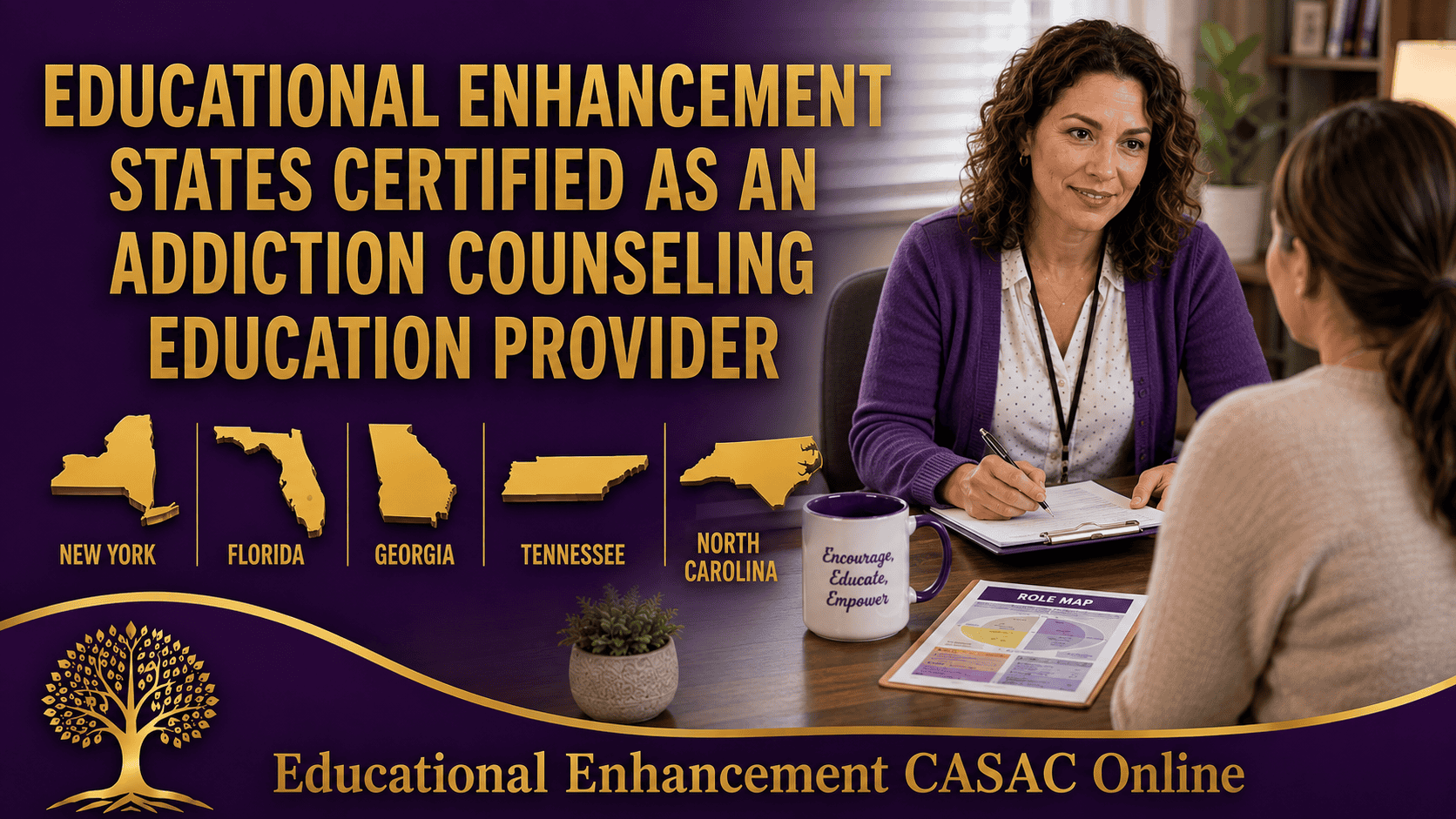
Educational Enhancement States Certified as an Addiction Counseling Education Provider
Find approved addiction counselor education for your state.
Educational Enhancement CASAC Online provides approved addiction counseling education for counselors and counselors-in-training in New York, Florida, Georgia, North Carolina, and Tennessee.
Whether you are working toward your first credential or completing education for certification, our state-approved programs offer flexible online learning built around real-world substance use counseling practice.
Educational Enhancement offers approved education for:
- New York CASAC
- Florida CAC
- Georgia CADC
- North Carolina CADC
- Tennessee LADAC
Choose your state and start your certification journey today.