Documenting Coping Skills in Treatment Plans and Progress Notes
Every counselor has written it. Nobody reads it and learns anything useful.
Documenting coping skills in substance use treatment plan work is one of the most consistently underdone parts of SUD clinical practice. Not because counselors do not care about documentation. Because most training on documentation focuses on format and compliance requirements, not on how to capture clinical reasoning in plain language. Coping skills progress notes in SUD counseling documentation that say “client was educated on coping skills” do not record what the counselor covered. It does not record what the client received, practiced, resisted, or used. Treatment plan goals, coping skills, and substance use treatment writing are where this problem starts. A goal that says “client will learn coping skills” is not measurable or behaviorally defined. It describes a delivery, not an outcome. Substance use counselor clinical documentation coping competency means being able to write the clinical story of a session in language a future provider, supervisor, or auditor can use to understand what happened and why. This post covers how to write coping skills in progress notes in a way that shows actual clinical work.
What “Client Was Educated on Coping Skills” Actually Tells Anyone
Almost nothing.
It tells the reader that a counselor was in a room and said something about coping skills. It does not tell the reader whether the client understood the skill, engaged with it, practiced it, resisted it, or can use it at 11pm on a Tuesday when the situation they have been preparing for finally arrives.
This is not a compliance problem. Every format requires documentation. The problem is clinical communication. The note is how you tell the story of the session to everyone who reads it after you leave the room. A supervisor reading it should understand the clinical rationale for the session, what the client actually did during it, and the plan going forward. “Client was educated” gives them none of that.
The good news: coping skills progress notes in SUD counseling that tell the clinical story are not harder to write than the ones that don’t. They are just more specific. They answer three questions instead of none: what skill was worked on and why, what happened in the session, and what comes next.
Documenting coping skills substance use treatment plan entries that start from those three questions produces notes that are readable, auditable, and clinically honest. Writing coping skills in progress notes is a teachable skill. It does not require a different clinical session. It requires a different clinical lens on the same session.
Writing Treatment Plan Goals for Coping Skills
A measurable coping skills goal has three parts. What the client will do, stated as a behavior (not “learn” or “understand,” neither of which can be observed). The context in which they will do it, tied to the specific high-risk situation identified in their treatment. And how progress will be tracked.
Here is what the difference looks like.
Weak goal: Client will learn coping skills to support recovery.
This goal cannot be measured. “Learn” is not a behavior. There is no context. There is no progress marker. If a client leaves treatment after attending ten sessions on coping skills, this goal is technically met whether or not the client can use a single skill outside the clinical setting.
Precise goal: Client will identify and demonstrate use of two regulation skills (paced breathing and progressive muscle relaxation) in response to identified cravings, as reported in weekly check-in and observed in session skill demonstration, within 60 days.
This goal is auditable. It names the skills. It names the trigger context. It names the measurement method. A provider reading this six months later knows exactly what was being worked toward and can assess whether it was achieved.
Treatment plan goals, coping skills, substance use treatment, writing gets easier once the structure is internalized. Substance use counselor clinical documentation: coping starts at the goal level, not the note level. Here is that structure in standard goal language:
Goal 1: Client will identify three high-risk external triggers (specific people, places, or situations) and develop a behaviorally specific coping plan for each, reviewed in session monthly.
Goal 2: Client will demonstrate use of an emotion regulation skill during a session when emotional activation is present, within 45 days.
Goal 3: Client will report use of at least one coping skill between sessions in 3 of 4 weekly check-ins, tracked via client self-report and counselor follow-up.
Goal 4: Client will complete a written trigger map identifying high-risk situations across external, emotional, physical, and cognitive domains, to be used as the foundation for relapse prevention planning.
OASAS Part 822 documentation standards require that progress toward goals be captured in progress notes, not only in a separate plan document. The goal language has to be precise enough to appear in a note and make sense without the full plan in front of the reader. Documenting coping skills substance use treatment plan goals this way means the note and the plan are not two separate worlds. They are the same clinical narrative written at different moments in the session cycle. Treatment plan goals for coping skills substance use treatment that are measurable at the goal-writing stage are also measurable at the note-writing stage. That alignment is what makes audits survivable.
Trauma-Informed Treatment Plans for Substance Use Counseling covers how coping skills goals integrate with trauma-informed planning when trauma is part of the clinical picture.
Postgraduate CASAC Training: Choose Your Path
Earn your CASAC online with Educational Enhancement. New to the field? Our CASAC 350 Hybrid Training Online delivers all 350 OASAS-approved hours, self-paced with live instructor sessions. Already a licensed clinician? Our Postgraduate CASAC training gives Master's Level social workers, LMHCs, or licensed behavioral health professional, get the CASAC credential on a shorter 135-hour track that builds on the graduate education you already have. Both are 100% online, self-paced, and OASAS-approved.
Writing the Progress Note When Skills Work Was the Session
Three things. That is what a coping skills progress note needs. If you miss any of them, the note is incomplete.
1. What skill was worked on and why. This is the clinical rationale. Not “coping skills were discussed,” but which skill, connected to which identified need. “Paced breathing was introduced as a physiological response to acute cravings identified in the client’s trigger map as the primary high-risk state.” That sentence tells the reader why this skill was chosen and where it fits in the overall plan.
2. What happened in session. This is the clinical observation. What did the client actually do? Did they practice the skill? What was their response? Did they engage fully, engage reluctantly, resist, or have a breakthrough? “Client practiced paced breathing for three cycles. Initially reported skepticism that the skill would help with cravings. After the third cycle, reported noticeable reduction in tension and agreed to practice before the next identified high-risk period.”
That is coping skills progress notes: SUD counseling language that tells the clinical story. Substance use counselor clinical documentation: coping work that captures actual client behavior in session is what separates a clinical record from an attendance log.
3. What comes next. This is the follow-up plan. What will the next session build on? When and where will skill use be reviewed? “Client will attempt paced breathing during anticipated high-risk commute on Thursday. Skill use will be reviewed at next session. If not used, session will focus on identifying barriers and adjusting plan.”
Writing coping skills in progress notes using this structure produces documentation useful to every stakeholder. Documenting coping skills, substance use treatment plan, and progress notes in the same clinical framework creates continuity. The plan and the note in the chart should tell the same story in different registers. The supervisor can see the clinical reasoning. The auditor can see that specific, measurable work occurred. The next provider can pick up where this session left off.
Substance use counselor clinical documentation coping notes that answer all three questions are no longer than the ones that don’t. They are the same length, with the right content in the right order.
Documenting Progress, Stagnation, and Skill Regression
Skill development in SUD treatment is not linear. Treatment plan goals, coping skills, and substance use treatment tracking require the counselor to document the full arc, not just the sessions where things went well. A client who demonstrated solid use of a skill three sessions ago may not be able to access it this week. That is clinical data. It belongs in the note, clearly and without minimizing.
Documenting progress: “Client reported spontaneous use of the thought-defusion skill during a high-risk moment at work this week. Described the process unprompted and accurately. Progress toward goal 2 noted.”
Documenting stagnation: This note is harder to write and more important to write honestly. “Paced breathing has been introduced, practiced in session, and followed up across four sessions. Client reports no use between sessions in three of four weeks. Barrier appears to be perceived inaccessibility during high-stress moments. Plan is to add a physical cue (cold water) that does not require the same access window. Approach will be adjusted at next session.”
That note matters because it shows the counselor recognized something wasn’t working and changed course. A supervisor reading a string of notes that say “skill was practiced, client will continue to work on it” with no adjustment signal has a documentation problem in front of them, even if the clinical work was good.
Documenting regression: “Client had previously demonstrated consistent use of urge surfing technique across weeks 6 through 9 of treatment. After returning to contact with a high-risk relationship, the client reports the skill is no longer accessible in the moment. Session focused on identifying what changed. Plan updated to include modified trigger map for this relationship context.
Treatment plan goals, coping skills, and substance use treatment documentation that captures regression honestly does not pathologize the client. It reflects the clinical reality and sets up the next phase of intervention.
Group Note vs. Individual Note When Skills Are Covered in Group
When a coping skills session happens in group, two different notes are required, and they should not say the same thing. Coping skills progress notes in SUD counseling in the group context require the counselor to hold two levels simultaneously: the group as a clinical unit, and each member as an individual with their own engagement, history, and progress toward their specific goals. Many counselors default to copying the group summary into every chart when writing coping skills in progress notes at the individual level in a group context. That is not individualized documentation.
The group note captures the session: what skill was covered, how the group engaged as a whole, and whether the session met its stated clinical objective. It is a single note that covers the entire group.
The individual progress note for each member captures that member’s specific engagement with the skill. Did they participate in the practice? Did they share? Did they resist? Did they have a moment that is clinically significant? A member who challenged the skill in a way that opened a useful group conversation has a different individual note than a member who was present but withdrawn. How do you write coping skills in progress notes at the individual level when the session was a group? Individualization is the whole point of the note.
A group topic summary is not a progress note. Copying the group note into every member’s chart is not progress notes. Substance use counselor clinical documentation that individualizes at the note level is what separates skilled documentation from a log entry that confirms attendance. Treatment plan goals, coping skills, and substance use treatment at the individual level require individual notes. The fact that the session was a group does not change that clinical obligation.
Collaborative Documentation That Actually Helps Substance Use Counselors and Clients covers a note-writing approach that involves the client directly, producing better information and reducing the time counselors spend alone at a keyboard recreating what happened in the session.
Documenting coping skills substance use treatment plan work accurately is a clinical skill, not an administrative one.
Coping skills progress notes in SUD counseling that tell the whole story, including the rationale, the session observation, and the next step, create a record that is useful to every person who reads it. Writing coping skills in progress notes is not a separate skill from doing the clinical work well. It is documenting that work honestly and specifically. Documenting coping skills and substance use treatment plan goals, alongside consistent, individualized progress notes, completes the loop. Coping skills progress notes in SUD counseling that capture client behavior, counselor rationale, and follow-up plan in every entry produce a chart that tells the real clinical story.
If you are a substance use counselor, clinical documentation coping practitioner building this competency, the addiction counselor courses at Educational Enhancement CASAC Online cover clinical documentation with the depth and specificity this work requires.
The My Trigger Map and Coping Plan workbook is the companion tool for this post. It maps all five trigger domains from this post — external, emotional, physical, cognitive, and boredom — with write-in space for your specific triggers and coping responses. Section 6 pulls everything into a one-page summary to carry.
16.99
Download it here.
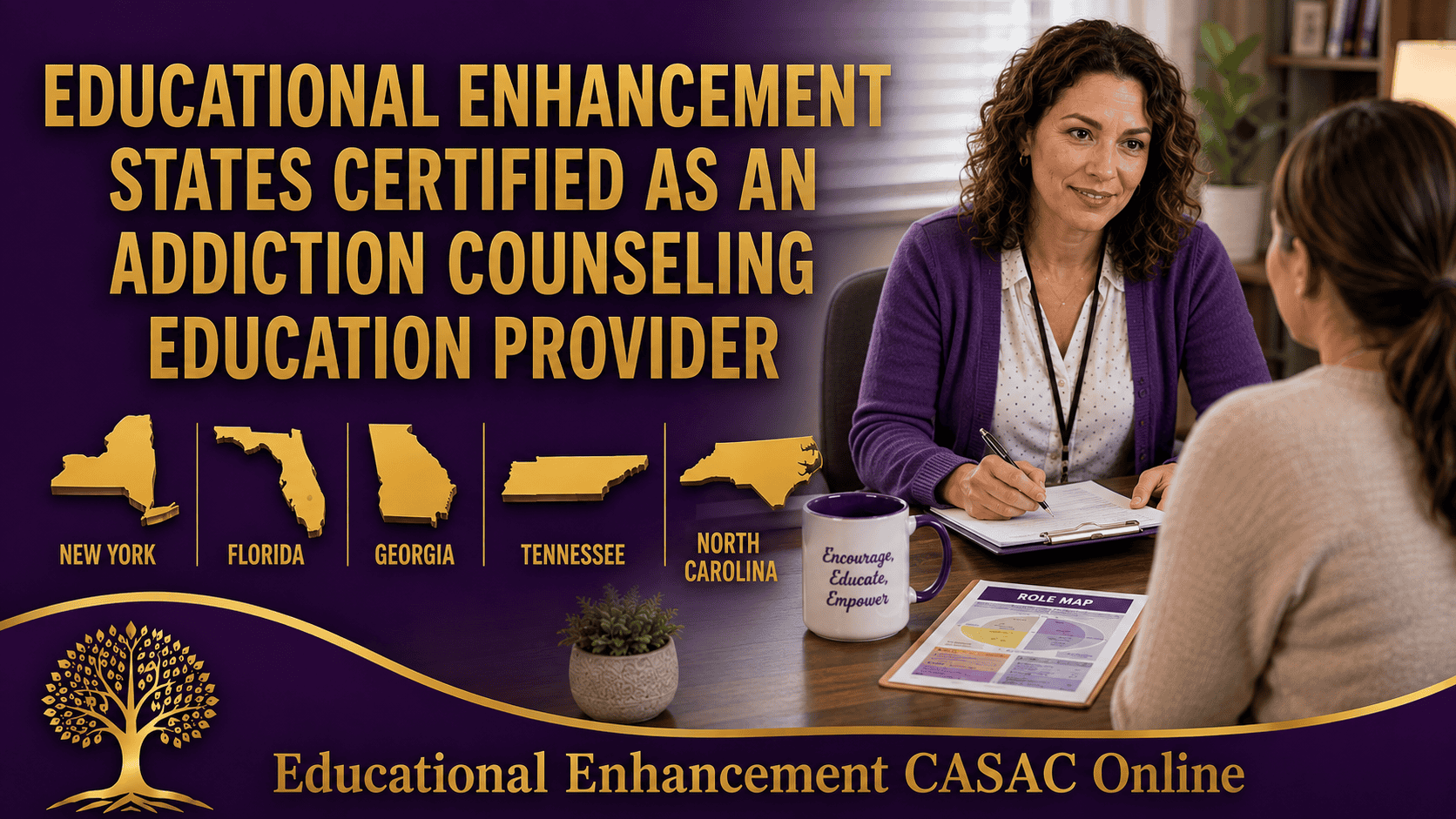
Educational Enhancement States Certified as an Addiction Counseling Education Provider
Find approved addiction counselor education for your state.
Educational Enhancement CASAC Online provides approved addiction counseling education for counselors and counselors-in-training in New York, Florida, Georgia, North Carolina, and Tennessee.
Whether you are working toward your first credential or completing education for certification, our state-approved programs offer flexible online learning built around real-world substance use counseling practice.
Educational Enhancement offers approved education for:
- New York CASAC
- Florida CAC
- Georgia CADC
- North Carolina CADC
- Tennessee LADAC
Choose your state and start your certification journey today.
Join Our Newsletter!
Join today. Stay current with news about addiction counselors, interventions, trends, and statistics.
STOP THE STIGMA