How to Facilitate a Substance Use Treatment Coping Skills Group That Actually Practices Skills
The group discussed the skill for forty minutes. Nobody practiced it. That is not group therapy. That is group processing, and the two are not the same thing.
Coping skills group therapy substance use treatment settings run across the country every day. Most of them follow the same arc: the counselor introduces a skill, the group discusses it, someone says it will not work for them, someone else shares a related story, and the skill disappears into the conversation before anyone has done it. How to facilitate skills group substance use treatment in a way that keeps practice at the center requires a structure the counselor holds deliberately, because human nature will pull every group toward narrative processing if the format does not hold it back. Group counseling coping strategies SUD work depends on the group room being a practice environment, not a discussion circle. Substance use counselor group coping skills facilitation is a specific clinical competency, and it is different from general group facilitation. Running a coping skills group in substance use counseling means holding a structure every session, knowing exactly what to do when the group resists, and using the group dynamics themselves as the practice material. This post covers all three.
Why Most Skills Groups Become Discussion Groups
The pattern of how to facilitate skills group substance use treatment poorly is predictable. A counselor introduces a skill. One member asks a clarifying question. Another member says something that connects to their week. A third member shares a story about why that skill would not have helped in their situation. The counselor, trained to follow the group’s energy, responds to the content. Twenty minutes pass. Nobody has practiced anything.
This is not a facilitation failure. It is an unstructured group responding to human nature.
People process emotion through narrative. Most people make sense of what happened by telling a story. In a general process group, that is the whole point. In a coping skills group therapy substance use setting, narrative is what happens when there is no competing structure strong enough to keep practice at the center.
The counselor’s job in a skills group is not to stop people from talking. It is to hold a structure that makes practice inevitable. Without that structure, discussion will fill every available minute, the skill will be talked about rather than done, and members will leave with zero reps under their belt.
The structure is not complicated. It is just non-negotiable.
Coping skills group therapy substance use sessions that hold a consistent format outperform discussion-based groups in every measure that matters: skill retention, between-session use, and member satisfaction. The format is the clinical tool. It does not happen by accident.
The Format That Works
A reliable group counseling coping strategies SUD session runs in six steps. Each one has a time limit. The facilitator holds the limit.
Step 1: Check-in with a brief mood rating (2 minutes). Each member rates their current state on a 0-10 scale. No elaboration. The rating is data, not an opening to process. “I’m a 6” and move on. This calibrates the room and tells the facilitator who may be outside their window of tolerance before practice begins.
Step 2: Review of the skill from last session (5-10 minutes). Not “how was everyone’s week.” Specifically: “Last week we worked on [skill]. Who tried it? What happened?” This is the single most important structural move in running a coping skills group for substance use counseling, and the one most often cut when time gets short. Do not cut it. It signals that skills carry across sessions, that follow-through is tracked, and that the group is building something cumulative, not starting from zero each week.
Step 3: Introduction of the new skill (5 minutes). Brief. Experiential. No lecture. Name what the skill does, when to use it, and what the first step is. Then stop talking and move to practice. A substance use counselor group coping skills introduction should take no longer than five minutes. Every minute past five is a minute of practice that will not happen. If it runs past that, the counselor is delivering psychoeducation, not setting up practice.
Step 4: In-group practice, facilitator models first (10-15 minutes). Every member does the skill. The facilitator goes first, out loud, in real time. Not “let me explain what this looks like.” Do it. A counselor who models paced breathing in front of the group, counting out loud, eyes closed, for three full cycles, removes the social risk from doing something that might feel strange. Members who watch the facilitator go first are significantly more likely to participate. This is the core of facilitating skills group substance use treatment that produces real learning rather than observed learning.
Step 5: Debrief (10 minutes). What happened? What did you notice in your body? What got in the way? Would you use this in a real situation? This is where the clinical work actually happens. The debrief is not a recap of the skill. It is a guided reflection on the group’s live experience of practicing it. Specific, concrete, grounded in what just occurred in the room.
Step 6: One commitment statement per member (2 minutes). Each member says one sentence: when and where they will use this skill before the next session. Not “I will try it.” A named context. “I will use this on the drive home on Thursday when the traffic gets bad.” That sentence is a clinical intervention disguised as a closing ritual. Running a coping skills group substance use counseling program through this six-step format, session after session, builds a cumulative repertoire rather than a collection of things the group once discussed.
Postgraduate CASAC Training: Choose Your Path
Earn your CASAC online with Educational Enhancement. New to the field? Our CASAC 350 Hybrid Training Online delivers all 350 OASAS-approved hours, self-paced with live instructor sessions. Already a licensed clinician? Our Postgraduate CASAC training gives Master's Level social workers, LMHCs, or licensed behavioral health professional, get the CASAC credential on a shorter 135-hour track that builds on the graduate education you already have. Both are 100% online, self-paced, and OASAS-approved.
Using the Group Itself as the Practice Environment
The group room is not a neutral classroom. It is a live social environment with real dynamics: anxiety about being seen, comparison to other members, status hierarchies, trust that has not been fully established. Those dynamics are not obstacles to coping skills group therapy substance use work. They are the practice environment.
A member who gets activated during group, whose voice tightens or whose affect shifts, is not a disruption to the session. That is a live opportunity. The group can watch the facilitator help one member use the skill in real time. That demonstration teaches everyone else more than any modeled exercise would, because the emotion is real and the skill use is genuine rather than performed.
The limit: do not use a member’s distress as a teaching moment without their consent. Ask directly. “I notice you seem activated right now. Would it be okay if we tried [skill] together, with the group watching?” A yes produces one of the most powerful learning moments available in group counseling coping strategies SUD work. A no produces a brief pivot back to the group exercise, and the moment is respected rather than exploited.
When the group is cohesive enough, members will begin facilitating each other through skill use without prompting. That is the goal. A counselor running a group where members remind each other to check their breathing before reacting has built something worth more than any individual session could produce. How to facilitate skills group substance use treatment at that level of cohesion is not about curriculum. It is about the relationship the group has with practice itself.
What to Do When the Group Resists
Running a coping skills group substance use counseling means meeting resistance as a clinical event, not a personal one. It is predictable. It comes in a few specific forms. Each one has a response.
Resistance in a skills group is predictable. It comes in a few specific forms. Each one has a response.
“That skill is too simple.” Normalize it and redirect. Simple skills work under pressure in ways complex skills often do not. The question is not whether the skill is sophisticated. The question is whether it is accessible when the person needs it. Invite the skeptic to try it and report back next session. Skeptics who follow through often become the group’s most credible advocates for the skill.
“I already know this.” Validate the knowledge. Then ask: “When did you last use it?” Knowledge and use are different things. A member who knows a skill but has not used it in the past week has not integrated it. That distinction is the whole point of substance use counselor group coping skills work.
“This doesn’t apply to me.” Individualize immediately. “How would you use this specific skill in the situation you described two minutes ago?” Do not defend the skill generically. Apply it to the member’s actual life. Generic resistance dissolves when you connect the skill to a specific, named situation the person already cares about.
General withdrawal or silence. Don’t call out members who aren’t engaging. Lower the stakes. “You do not have to share. Just try the practice quietly.” Participation often follows a private rep that was not required to be public. Substance use counselor group coping skills facilitation is not performance management. The goal is practice, not participation theater.
Tracking Member Progress Across the Group Series
Running a coping skills group substance use counseling across multiple sessions only produces compounding skill development if each session builds on the one before. That requires tracking. Running a coping skills group substance use counseling without a tracking system means starting fresh every week, which defeats the cumulative purpose of a skills series entirely.
Keep a simple log: member name, skill introduced, date, whether they reported using it at the next session. That data tells you who consistently follows through and who doesn’t. It also shows which skills are landing and which aren’t. Group counseling coping strategies SUD programs that track individual skill use across the group series generate better clinical data than those that document only what happened in the room.
Two members who have never once reported using a skill between sessions are telling you something. That information belongs in an individual session, not ignored because it happened in a group context. Coping skills group therapy substance use work does not replace individual treatment. It generates information that makes individual sessions more targeted.
On documentation: facilitating skills group substance use treatment well creates two separate documentation needs. Group counseling coping strategies SUD programs that do not separate group notes from individual skill notes lose clinical information that belongs in the treatment record. The group note captures what happened in the session for all members. Individual progress notes capture what a specific member demonstrated, reported, or worked through. Skills follow-up belongs in the individual note, not only in the group note. A substance use counselor group coping skills practitioner who documents both levels has a clinical record that actually tracks progress rather than attendance.
Collaborative Documentation in Substance Use Counseling covers how to document skills work in a way that builds the treatment plan over time rather than producing notes no one reads.
Clients Don’t Need a Lecture on Coping Skills covers the same practice-over-explanation framework applied to individual sessions, which runs parallel to everything in this post.
Coping skills group therapy substance use facilitation is a learnable clinical skill.
The structure is not complicated. Holding it consistently is the work. How to facilitate skills group substance use treatment in a way that produces real skill development rather than weekly discussion comes down to three decisions: commit to the format, model practice before asking for it, and treat resistance as clinical data rather than a management problem.
Substance use counselor group coping skills competency is built the same way every other clinical skill is: by doing the work repeatedly, reflecting on what happened, and adjusting. If you are building this competency and want structured training, the addiction counselor courses at Educational Enhancement CASAC Online cover group counseling coping strategies and SUD facilitation with the depth and specificity this work requires.
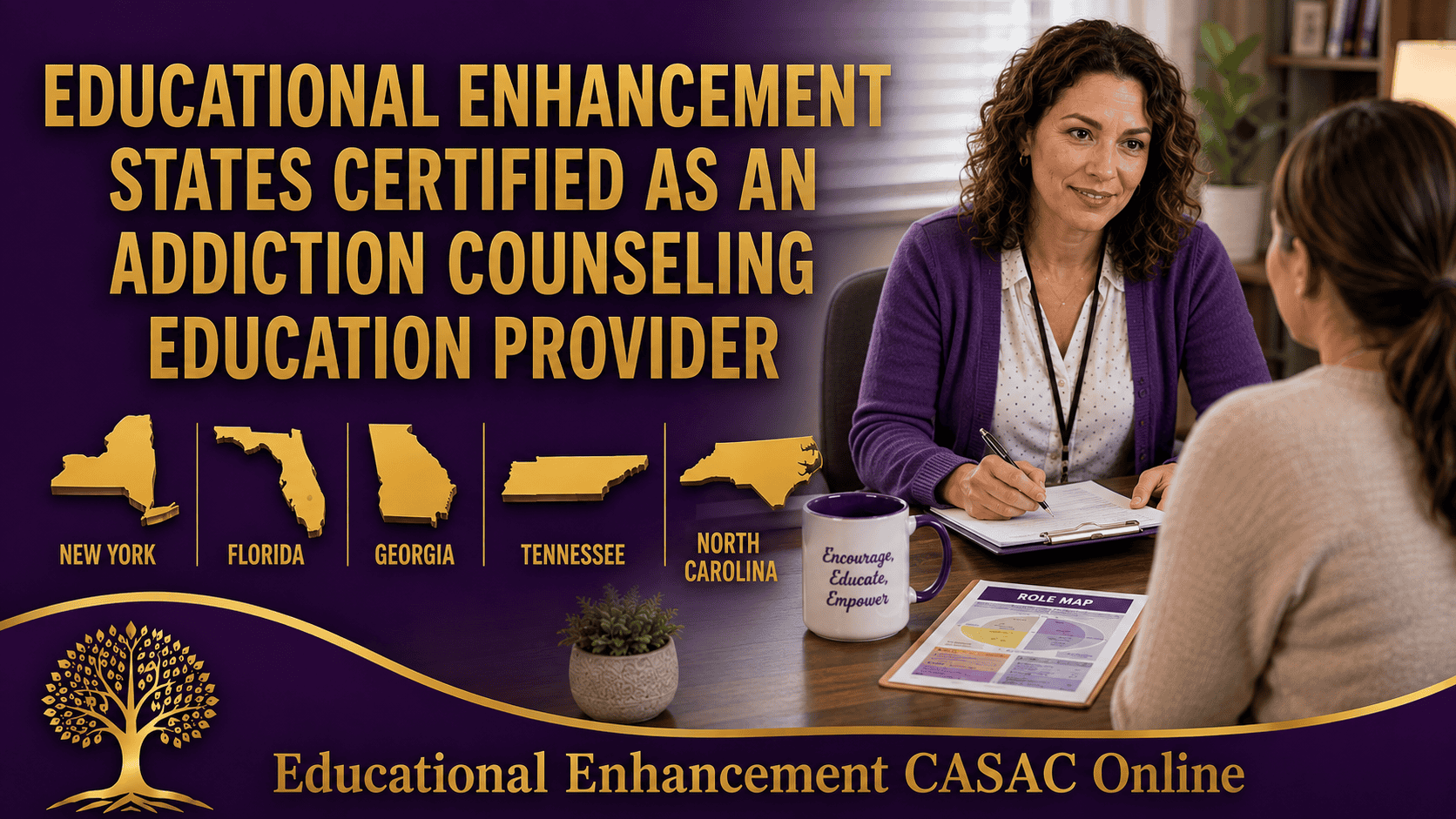
Educational Enhancement States Certified as an Addiction Counseling Education Provider
Find approved addiction counselor education for your state.
Educational Enhancement CASAC Online provides approved addiction counseling education for counselors and counselors-in-training in New York, Florida, Georgia, North Carolina, and Tennessee.
Whether you are working toward your first credential or completing education for certification, our state-approved programs offer flexible online learning built around real-world substance use counseling practice.
Educational Enhancement offers approved education for:
- New York CASAC
- Florida CAC
- Georgia CADC
- North Carolina CADC
- Tennessee LADAC
Choose your state and start your certification journey today.
Join Our Newsletter!
Join today. Stay current with news about addiction counselors, interventions, trends, and statistics.
STOP THE STIGMA