
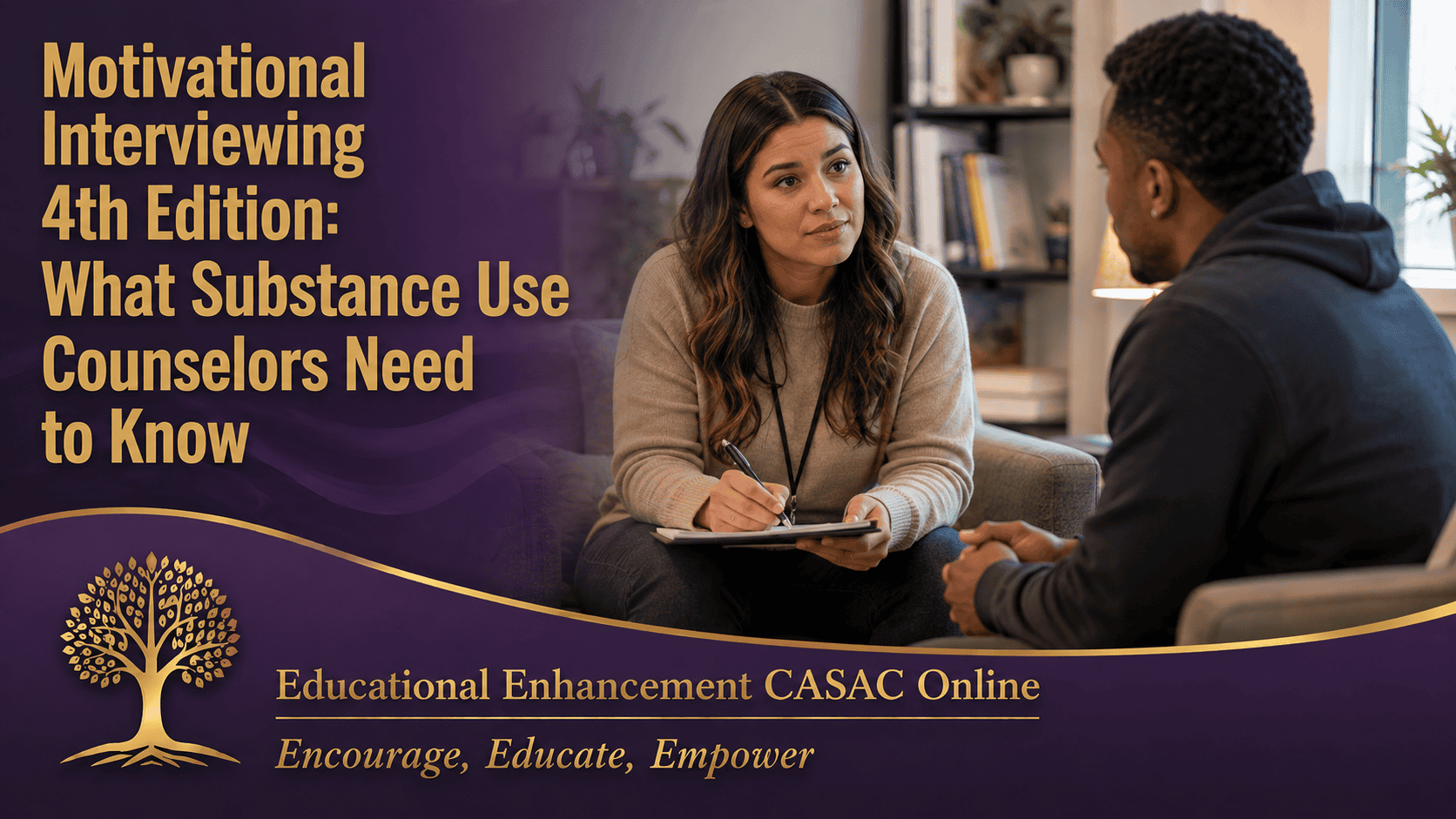
MI-4 keeps the core method intact, but changes its language, expands its scope, and gives counselors clearer ways
to support autonomy, change talk, and practical planning.
A client says, “I know my substance use is causing problems. I am still not ready to stop.” The counselor feels the familiar pull to explain risks, offer advice, and make the case for change. That fixing response often produces more reasons not to change. Motivational Interviewing 4th Edition gives counselors a cleaner way to handle that moment. The updated model keeps the core of motivational interviewing while refining motivational interviewing techniques, strengthening attention to change talk, and expanding motivational interviewing for substance use disorder beyond early engagement alone.
The fourth edition does not replace MI.
It sharpens it.
William R. Miller and Stephen Rollnick published the fully rewritten fourth edition in 2023. The new version presents MI as a way of talking with people about change and growth while strengthening their own motivation and commitment. It still uses engaging, focusing, evoking, and planning, but now calls them tasks instead of processes. The language is plainer. The clinical direction is clearer.
That matters in substance use treatment.
Counselors now work across outpatient care, residential programs, medications for substance use disorder, peer services, primary care, telehealth, harm reduction programs, and recovery housing. MI needs to travel across those settings without becoming another script that sounds good during training and disappears during actual work.
Why a fourth edition was needed
Motivational interviewing has never been limited to persuading someone to enter treatment.
The fourth edition makes that point harder to miss.
The new subtitle, Helping People Change and Grow, signals a broader scope. MI can support someone who is uncertain about treatment. It can also help someone clarify recovery goals, continue medication, repair relationships, reduce risk, or maintain changes already underway. The publisher describes the book as a fully rewritten and streamlined practitioner guide covering diverse settings, remote work, ethical questions, advice giving, and assessment of MI quality.
That wider scope fits substance use counseling.
A person may feel ready to reduce alcohol use but uncertain about group treatment. Someone may want buprenorphine while resisting residential care. Another person may want safer substance use without choosing abstinence.
Motivation is rarely one clean decision.
- It changes by topic.
- It changes by day.
- It changes as consequences, supports, health, housing, and relationships change.
The SAMHSA advisory on using motivational interviewing in substance use disorder treatment describes MI as a practical method for increasing participation and helping people examine their own reasons for change. SAMHSA’s full TIP 35 guidance on enhancing motivation also places motivation inside an ongoing treatment process rather than treating it as a hurdle that must be cleared before counseling begins.
MI-4 makes that ongoing role more explicit.
The biggest change sits inside the spirit of MI
The spirit of MI once used four terms:
- Partnership
- Acceptance
- Compassion
- Evocation
Motivational Interviewing 4th Edition replaces evocation with empowerment. The authors’ summary of what changed in MI-4 explains that empowerment now joins partnership, acceptance, and compassion as the fourth element of MI spirit.
That word change carries clinical weight.
Evocation focuses on drawing out the person’s own reasons, strengths, and ideas.
Empowerment keeps that work but widens it. It asks counselors to recognize that people already possess abilities, values, knowledge, and decision-making power. The counselor does not install motivation. The counselor helps create conditions where motivation can become clearer and more usable.
This matters in substance use treatment, where systems often strip autonomy away.
- Court mandates.
- Child welfare involvement.
- Probation requirements.
- Agency rules.
- Family pressure.
- Medication stigma.
Repeated assessments that ask the same questions without changing the help offered.
People arrive carrying enough pressure already.
Adding more pressure rarely creates honest change talk.
Empowerment sounds different.
Instead of:
“You need to stop using before this gets worse.”
Try:
“You have several options in front of you. Which change feels possible enough to discuss today?”
Instead of:
“You should start medication.”
Try:
“What have you heard about medication, and what concerns would you want addressed before deciding?”
Instead of:
“You need to attend more meetings.”
Try:
“What kind of support has felt useful before, and what has not?”
- These are not passive questions.
- They are directional without becoming controlling.
- They preserve autonomy while keeping the conversation focused on change.
That is MI.
Our article on the therapeutic alliance explains why trust, collaboration, and consistency determine whether counseling continues long enough for techniques to matter. MI-4’s empowerment language strengthens that same relationship by treating the person as an active decision maker rather than a problem waiting to be corrected.
The four processes are now four tasks
The familiar structure remains:
- Engaging
- Focusing
- Evoking
- Planning
MI-4 now calls them tasks.
That may sound minor.
It is useful.
The word task reminds counselors that each part requires clinical attention. You do not complete engaging once and move on forever. You return to it when trust weakens. You revisit focusing when the conversation becomes scattered. You return to evoking when commitment fades. You delay planning when the person is not ready.
The tasks move back and forth.
They are not four boxes.
The official publisher description confirms that engaging, focusing, evoking, and planning remain the organizing structure of the fourth edition. citeturn149357search1turn149357search2
Each task now carries a practical guiding question.
Engaging: Can we walk together?
Engaging asks whether a working relationship exists.
Does the person feel heard?
Do they believe the counselor respects their choices?
Are you listening to understand, or waiting to correct?
Before evoking change talk, you need enough trust for honest disagreement.
A clinically useful intake can support engagement, but only when the intake remains a conversation. Rapid questions, unexplained forms, and early advice weaken partnership before treatment begins.
Focusing: Where are we going?
Focusing identifies a shared direction.
A client may want to discuss sleep, alcohol use, housing, depression, medication, family conflict, and employment during the same hour.
All matter.
You still need a focus.
Focusing does not mean choosing for the client. It means choosing a useful path together.
Our article on stages of change and motivational interviewing explains why readiness differs across behaviors. A person can be ready to carry naloxone, unsure about medication, and unwilling to discuss abstinence during the same session.
Good focusing respects that complexity.
Evoking: Why would you go there?
Evoking draws out the person’s own language for change.
Why would this matter?
What concerns have started to grow?
What would improve?
What confidence already exists?
This is where change talk becomes central.
Counselors listen for desire, ability, reasons, need, commitment, activation, and steps. They reflect that language carefully instead of immediately turning it into a plan.
Planning: How will you get there?
Planning turns motivation into a next step.
Not a perfect plan.
A workable one.
The person may agree to carry naloxone, call a prescriber, attend one group, remove substances from the home, or contact a recovery support. The plan should match the person’s readiness and current capacity.
Our article on trauma-informed treatment plans explains why plans work better when they reflect client priorities, current safety, personal strengths, and realistic pacing.
Planning without evoking creates compliance language.
Planning after change talk creates traction.
That difference is the point.
New language counselors should start using
One of the most noticeable changes in Motivational Interviewing 4th Edition is the updated terminology.
None of these changes alter the underlying principles of motivational interviewing.
They make those principles easier to teach, remember, and apply.
Miller and Rollnick intentionally replaced several technical terms with language that sounds more natural in everyday clinical conversations. The result is a model that feels more approachable for new counselors while remaining familiar to experienced practitioners.
| Earlier terminology | Motivational Interviewing 4th Edition |
|---|---|
| Agenda Mapping | Choosing a Path |
| Developing Discrepancy | Planting Seeds |
| Elicit–Provide–Elicit | Ask–Offer–Ask |
| Righting Reflex | Fixing Reflex |
| Formulation | Clarifying |
| Running Head Start | Pendulum Technique |
These updates are described in the authors’ overview of the fourth edition available through the Motivational Interviewing Network of Trainers (MINT) and the official MI website.
Several deserve closer attention.
Choosing a Path
“Agenda Mapping” often sounded like something counselors did to clients.
“Choosing a Path” sounds collaborative.
That matters.
Instead of deciding what today’s session should cover, the counselor and client choose the direction together.
For example:
“We’ve talked about your drinking, your anxiety, and the conflict at home. Which feels most important to work on today?”
That single question strengthens motivational interviewing techniques because it reinforces autonomy while keeping the conversation focused.
Planting Seeds
“Developing discrepancy” has always been one of the hardest MI concepts for new counselors to understand.
The fourth edition replaces it with “Planting Seeds.”
The new phrase captures the clinical goal more clearly.
Counselors are not trying to convince people they are wrong.
They are helping clients notice differences between their current behavior and the life they want.
Those observations grow over time.
Like seeds.
The counselor does not force insight.
The counselor creates conditions where insight can develop naturally.
Ask–Offer–Ask
Many counselors struggle with giving information without taking over the conversation.
MI has always addressed this through Elicit–Provide–Elicit.
The new name, Ask–Offer–Ask, immediately communicates what should happen.
Ask permission.
Offer concise information.
Ask what the client thinks.
Consider a conversation about naloxone.
Instead of launching into a lecture:
“What have you heard about naloxone?”
The client answers.
You briefly explain how it works.
Then ask,
- “What stands out to you?”
- “What questions do you have?”
- “What do you think about carrying it?”
Information becomes part of a conversation instead of ending one.
This communication style fits naturally with motivational interviewing for substance use disorder, where counselors frequently discuss medications, overdose prevention, safer substance use strategies, infectious disease prevention, and recovery supports.

Embrace Effective Change!
Enhance your professional development with our Individual Counseling Training.
Are you a substance use counselor dedicated to making a real difference in the lives of your clients?
Unlock your full potential with our cutting-edge Individual Counseling Course. The training features these counseling interventions:
- Cognitive Behaviorial Therapy
- Motivational Interviewing
- Person-Centered Care
- Trauma Informed Care
- Harm reduction,
- and more.
Complex affirmations strengthen confidence
Many counselors confuse affirmations with praise.
They are not the same.
Praise evaluates.
Affirmations recognize strengths.
The fourth edition places greater emphasis on the difference between simple and complex affirmations because each serves a different purpose.
A simple affirmation acknowledges effort.
- “I’m glad you came today.”
- “That took courage.”
Those statements have value.
Complex affirmations go further.
They connect behavior to values, strengths, or personal identity.
For example:
Simple affirmation:
“You made your appointment.”
Complex affirmation:
“Even after a difficult week, you still chose to come today. That tells me your recovery remains important to you.”
Another example.
Simple affirmation:
“You’ve stayed on your medication.”
Complex affirmation:
“You’ve continued taking your medication even when life became stressful. That shows you’re willing to keep working toward the future you described.”
Notice the difference.
The second response does not simply congratulate.
It reflects:
- resilience.
- Identity.
- Values.
- Commitment.
Those reflections encourage more change talk because clients begin hearing themselves described as capable of change rather than simply successful or unsuccessful.
Direction matters more than technique
One of the strongest themes running through Motivational Interviewing 4th Edition is directionality.
MI is not passive.
It is not simply listening.
It is purposeful listening.
Counselors intentionally guide conversations toward healthier choices without arguing or persuading.
That happens through directional questions.
- Directional reflections.
- Directional summaries.
Suppose a client says,
“I hate what alcohol is doing to my family, but drinking is the only thing that helps me relax.”
Several responses are possible.
One reflection emphasizes sustain talk.
“So drinking helps you cope.”
Another reflection highlights change talk.
“You’ve started wondering whether alcohol is costing you more than it’s giving you.”
Both statements are accurate.
Only one gently moves the conversation toward change.
That is directional listening.
It does not ignore sustained talk.
It acknowledges it while giving greater attention to the client’s own reasons for change.
Miller and Rollnick continue using DARN-CAT to organize change talk.
Preparatory language includes:
- Desire
- Ability
- Reasons
- Need
Mobilizing language includes:
- Commitment
- Activation
- Taking steps
Learning to recognize these patterns remains one of the most valuable motivational interviewing techniques a counselor can develop.
Our article on Empowering Clients Through Motivational Interviewing: The Transformative Approach to Behavior Change explores reflective listening, autonomy, and OARS in greater depth. Combined with the updates found in Motivational Interviewing 4th Edition, those skills help counselors guide conversations without becoming confrontational or directive.
MI belongs throughout treatment
Another misconception continues to limit good counseling.
Many clinicians use motivational interviewing only during intake.
Once treatment begins, they shift into education.
Advice.
- Relapse prevention.
- Treatment planning.
- Problem solving.
The fourth edition reminds us that motivational interviewing belongs throughout care.
Clients continue experiencing ambivalence.
Long after treatment starts.
Someone may fully commit to counseling while remaining uncertain about medication.
They may stop substance use while struggling to repair relationships.
They may succeed at abstinence while feeling unprepared for employment or independent housing.
Motivation continues changing.
Counselors should continue responding with curiosity rather than assumptions.
Our article on Case Conceptualization: Making Sense of Complex Client Stories explains why counselors should continually update their understanding of clients as new information emerges. Motivational interviewing supports that ongoing process by helping clients clarify what matters most as their recovery develops.
The conversation evolves.
Motivational interviewing evolves with it.
Applying MI-4 in today’s substance use treatment settings
The updates in Motivational Interviewing 4th Edition are not limited to counseling offices.
They fit naturally across today’s substance use treatment system.
- Outpatient programs.
- Residential treatment.
- Medications for substance use disorder.
- Peer recovery programs.
- Recovery housing.
- Integrated behavioral health.
- Primary care.
- Telehealth.
The conversation changes slightly in each setting.
The spirit does not.
A counselor working in an outpatient clinic may use motivational interviewing techniques to explore a client’s uncertainty about reducing alcohol use.
A nurse in a primary care practice may use Ask–Offer–Ask while discussing naloxone or medications for opioid use disorder.
A peer specialist may use complex affirmations to reinforce recovery strengths after a difficult week.
A case manager may use Choosing a Path while helping someone prioritize housing, employment, or counseling appointments.
- The same principles apply.
- Listen first.
- Collaborate.
- Support autonomy.
- Strengthen change talk.
Allow clients to become active participants in their own recovery.
That flexibility is one reason motivational interviewing continues to be recommended across behavioral health disciplines. The Case Western Reserve University Center for Evidence-Based Practices notes that MI is used effectively by counselors, physicians, nurses, peers, social workers, and other helping professionals because the communication style adapts well across different clinical settings and populations.
Postgraduate CASAC Training: Choose Your Path
Earn your CASAC online with Educational Enhancement. New to the field? Our CASAC 350 Hybrid Training Online delivers all 350 OASAS-approved hours, self-paced with live instructor sessions. Already a licensed clinician? Our Postgraduate CASAC training gives Master's Level social workers, LMHCs, or licensed behavioral health professional, get the CASAC credential on a shorter 135-hour track that builds on the graduate education you already have. Both are 100% online, self-paced, and OASAS-approved.
Updating supervision and training
The publication of Motivational Interviewing 4th Edition creates an opportunity for agencies to update more than their bookshelves.
Training materials should reflect the new terminology.
Clinical supervision should incorporate the new language.
Role plays should include Ask–Offer–Ask.
Complex affirmations.
Choosing a Path.
Planting Seeds.
Directional reflections.
Supervisors can strengthen counselor development by reviewing recorded sessions and asking questions such as:
- Where did the client express change talk?
- Which reflections strengthened motivation?
- When did the conversation shift toward problem solving too quickly?
- Did the counselor begin planning before the client was ready?
- How often did the counselor ask permission before providing information?
Those discussions improve more than technical proficiency.
They strengthen clinical judgment.
The fourth edition also includes new learning resources, self-assessment tools, and expanded case examples designed to support supervision, coaching, and skill development across behavioral health settings.
For agencies in New York, Georgia, Florida, and North Carolina, updating supervision tools to reflect MI-4 terminology creates consistency across orientation, continuing education, and clinical practice. Whether counselors are working toward a CASAC, CADC, CAC, or another state credential, using a shared language makes supervision more meaningful and easier to apply in daily practice.
Common mistakes MI-4 helps counselors avoid
The fourth edition does not eliminate common counseling mistakes.
It makes them easier to recognize.
One of the most common remains the Fixing Reflex.
A client expresses uncertainty.
The counselor immediately begins solving the problem.
- Offering advice.
- Providing education.
- Explaining consequences.
- Trying to persuade.
Those responses usually come from genuine concern.
Unfortunately, they often reduce change talk instead of increasing it.
Another common mistake is confusing praise with affirmation.
Praise evaluates.
“You did a great job.”
Affirmations recognize strengths.
“You kept your appointment even after a difficult week. That says something about how important recovery has become to you.”
Clients generally respond more openly to observations than evaluations.
Another mistake is treating motivational interviewing as something counselors use only during intake.
Ambivalence does not disappear after admission.
Clients continue weighing choices throughout treatment.
That is why motivational interviewing for substance use disorder remains valuable during assessment, treatment planning, relapse prevention, discharge planning, and long-term recovery support.
Finally, counselors sometimes become so focused on following the model that they stop listening.
Motivational interviewing has never been about memorizing techniques.
It has always been about understanding people.
The techniques support the relationship.
They never replace it.
Conclusion
Motivational Interviewing 4th Edition does not replace the principles that made motivational interviewing one of the most respected communication methods in behavioral health. It refines them. By emphasizing empowerment, simplifying terminology, strengthening the four tasks, expanding the use of complex affirmations, and sharpening attention to change talk, the fourth edition makes motivational interviewing techniques easier to learn, supervise, and apply in modern motivational interviewing for substance use disorder. Whether you work in outpatient counseling, residential treatment, medications for substance use disorder, harm reduction, or integrated behavioral health, these updates provide practical ways to strengthen collaboration while respecting each client’s autonomy. The language may be new. The goal remains the same. Help people discover their own reasons for change and support them as they move toward recovery.
One action to take this week
Choose one counseling session this week and focus on a single MI-4 skill.
Practice Ask–Offer–Ask before giving advice.
Replace one compliment with a complex affirmation.
Listen for one additional example of change talk before moving into planning.
Small changes in your communication often produce the biggest changes in your clients’ conversations.
Continue strengthening your motivational interviewing skills
Learning Motivational Interviewing 4th Edition is only one step toward becoming a stronger counselor. Developing effective motivational interviewing techniques, recognizing change talk, and confidently using motivational interviewing for substance use disorder requires practice, supervision, and continuing education. Whether you are beginning your career through our CASAC Training, expanding your knowledge with our addiction counselor courses, completing your education for the CADC in Georgia, or earning your CAC in Florida, continued practice with motivational interviewing will strengthen every counseling conversation you have.
Join Our Newsletter!
Join today. Stay current with news about addiction counselors, interventions, trends, and statistics.
STOP THE STIGMA