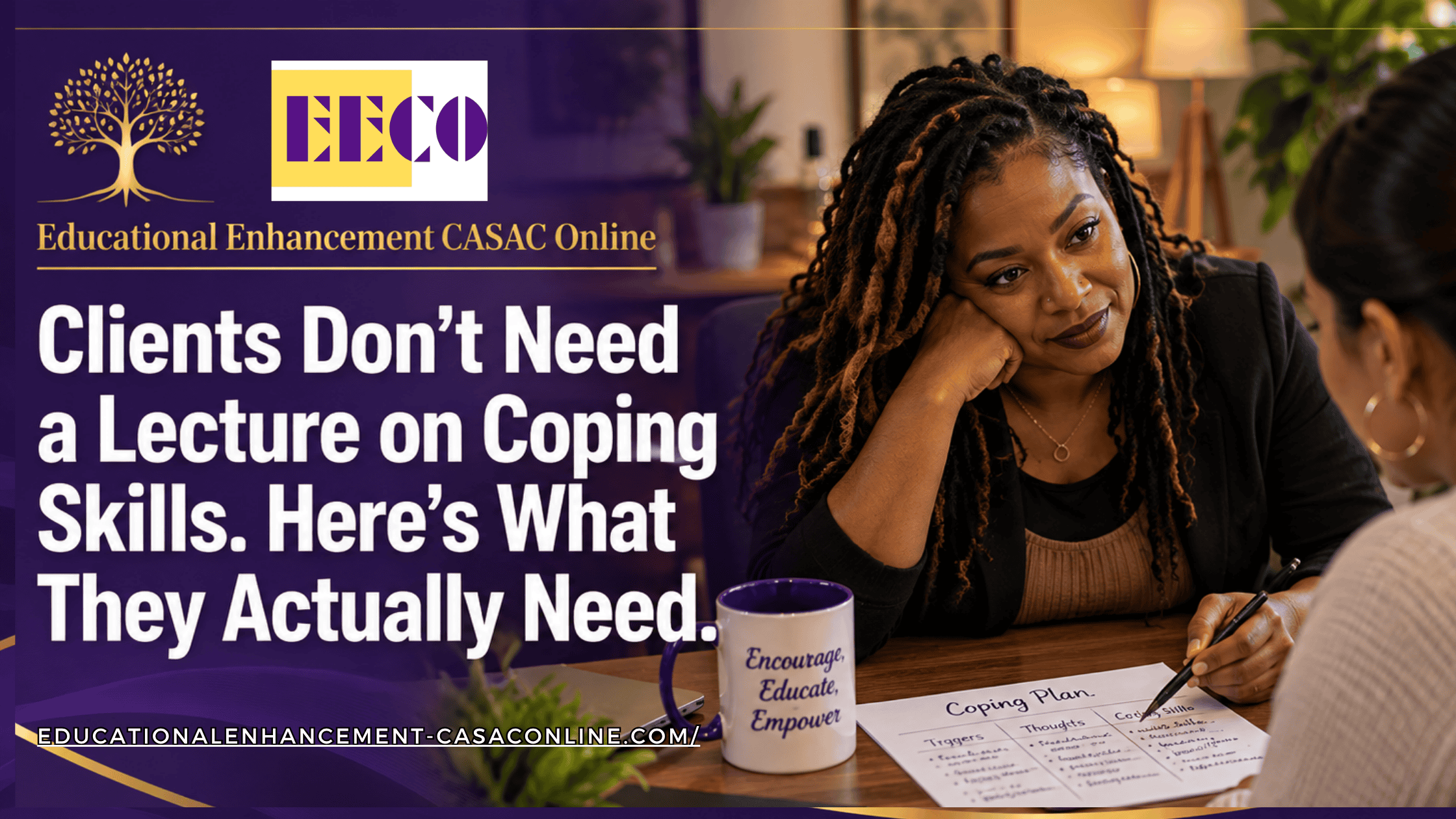
Clients Don’t Need a Lecture on Coping Skills. Here’s What They Actually Need.
The gap between knowing a skill and using it at 11 pm on a Friday has nothing to do with how good the explanation was.
The format most teaching coping skills in individual substance use counseling has followed for decades goes like this: introduce the skill, explain how it works, hand over a worksheet, assign it as homework. The client comes back the following week and did not use it. Not because they forgot. Because information does not become behavior under stress. Coping skill introduction: SUD session delivery almost always stops at explanation and calls that skill work. It is not. Motivational interviewing coping skills frameworks offer a different entry point: ask before you tell, tie the skill to what the client already said matters to them, and make sure they have practiced the skill in the room before the session ends. In-session coping practice in substance use counseling is the step most individual sessions skip entirely. Individual counseling coping strategies substance use work that transfers to a parking lot on a Friday night is built on repetition and practice, not on a well-delivered explanation. Here is what the difference looks like in practice.
The Psychoeducation Trap
Psychoeducation has a place in teaching coping skills in individual substance use counseling sessions. A brief, targeted explanation of why a skill works earns its place when it frames what the client is about to do and connects it to something they already care about. Good coping skill introduction: SUD session work uses psychoeducation as a setup, not a main event. That is not the problem.
The problem is when explanation takes over the session.
A counselor who spends twenty minutes on the neuroscience of cravings, the rationale for paced breathing, and the research behind cognitive restructuring has not taught a coping skill. They have delivered a lecture. The client leaves knowing more. They have not practiced anything.
Here is the ceiling on psychoeducation-only delivery: the prefrontal cortex that processes a clinical explanation in a calm office is not the same system that retrieves a skill when stress peaks on the drive home. Information gets stored in explicit memory. It requires deliberate recall under conditions that are often unavailable when a skill is most needed. Practice, repeated across varied conditions, begins to shift execution toward something less effortful. That shift requires reps. Not explanations.
The alternative is experiential delivery: keep psychoeducation to three minutes or less, then move directly into practice. The rule is simple. The client should leave having done the skill, not having heard about it.
Ask Before You Tell
Motivational interviewing coping skills introduction starts with a question, not a recommendation.
“I have something that has helped other people in situations like this. Would it be okay if I shared it?”
That one question does something the directive approach misses: it keeps the client in the role of decision-maker rather than recipient. A skill introduced without permission lands as another thing someone is telling them to do. A skill introduced with permission lands as a choice they made.
Before describing the skill, find out what the client already knows.
“Have you ever tried anything like this before? What happened?”
A client who has used paced breathing informally already has a foothold. A client who tried it once and felt ridiculous needs that experience named and addressed before the skill gets a fair chance. Coping skill introduction SUD session work that skips this step will run into resistance that could have been predicted and prevented.
When resistance shows up anyway, don’t push and don’t abandon. Explore directly.
“What would get in the way of trying this?” “What would it take for it to feel worth a try?”
Resistance is usually not about the skill. It is about past experience, a mismatch between the skill and the function the client needs it to fill, or a working assumption that nothing will stick anyway. Any of those is clinical information. Work with it.
Connect the skill to something the client has already named. A client who identified anxiety at family events as a high-risk situation can hear a regulation skill as something designed for that specific moment, not as a generic technique the counselor likes. That connection is what motivational interviewing coping skills delivery produces that directive delivery does not.
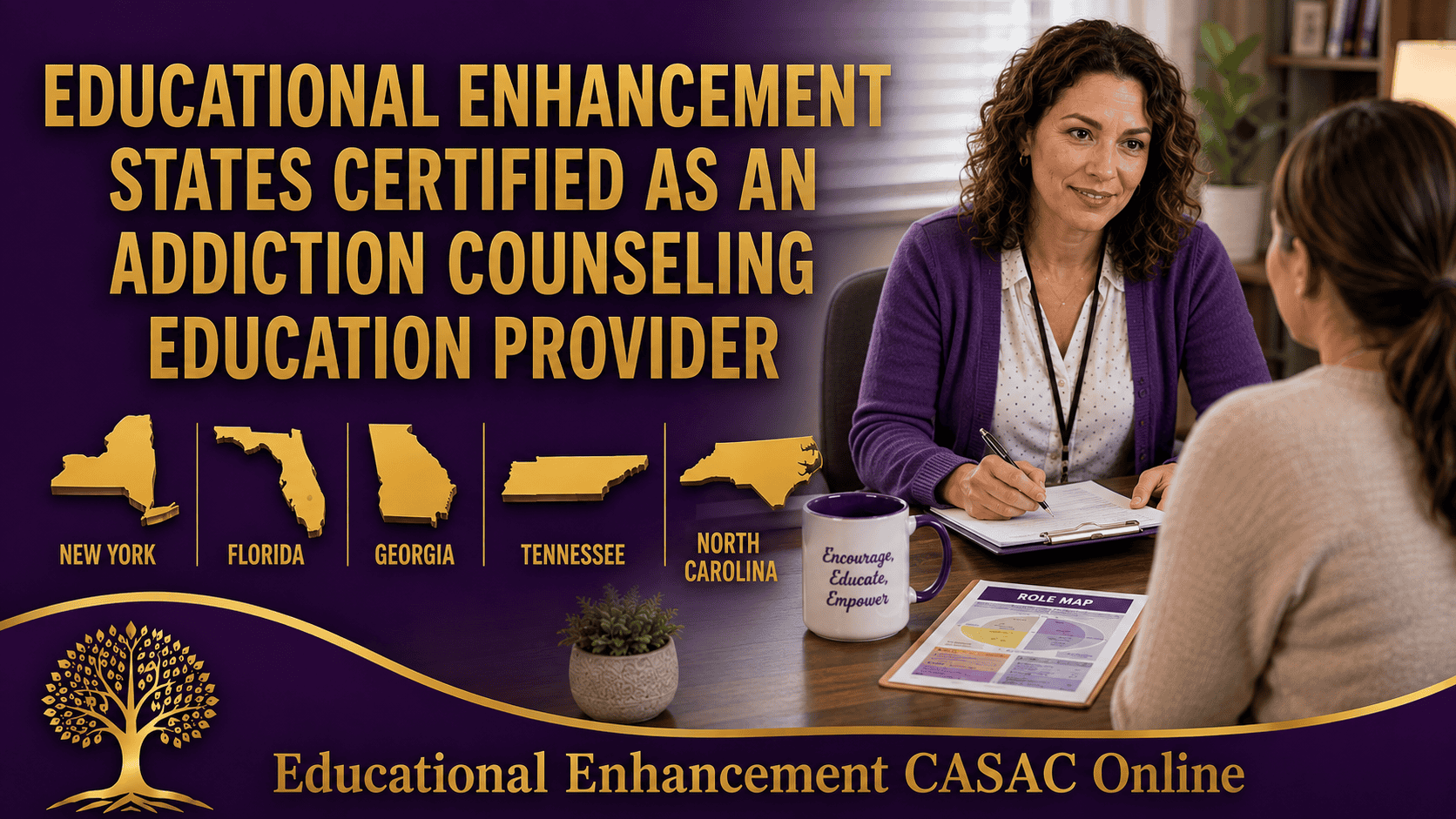
Educational Enhancement States Certified as an Addiction Counseling Education Provider
Find approved addiction counselor education for your state.
Educational Enhancement CASAC Online provides approved addiction counseling education for counselors and counselors-in-training in New York, Florida, Georgia, North Carolina, and Tennessee.
Whether you are working toward your first credential or completing education for certification, our state-approved programs offer flexible online learning built around real-world substance use counseling practice.
Educational Enhancement offers approved education for:
- New York CASAC
- Florida CAC
- Georgia CADC
- North Carolina CADC
- Tennessee LADAC
Choose your state and start your certification journey today.
What In-Session Practice Actually Looks Like
The standard for in-session coping practice in substance use counseling is this: if the client hasn’t done the skill in the room at least once, they haven’t learned it yet. Not discussed. Done.
Cognitive skills (thought records, restructuring, defusion): use a real thought the client brings in, not a hypothetical from a handout. Ask what went through their mind in a specific difficult moment this week. Build the exercise on that. A thought record completed on a real automatic thought produces different learning than one filled out on a generic example. The client leaves with a memory of having worked through something real, not a worksheet they might get to.
Breathing and regulation skills: do it together in the room. The counselor breathes with the client, counts out loud if that helps, and stays in the exercise for the full length. Not “try this at home.” Now, together, three full cycles. Then debrief: what did you notice? Where did you feel it in your body? This is in-session coping practice in substance use counseling that gives the client something to reference from memory rather than from a card.
Behavioral activation: do not assign an activity. Build the plan in the session, including the specific day, time, location, and what gets in the way. A client who leaves with “try to exercise more” has a vague intention. A client who leaves with “Wednesday at 6 pm, walk the park on Elm for 20 minutes, backup plan is the YouTube video I bookmarked” has a plan with a built-in fallback. The difference in follow-through is not motivation. It is specificity.
ACT and defusion skills: demonstrate with real content. If the client has an intrusive thought that keeps returning, use that thought. “I am worthless” worked through defusion as “My mind is telling me I am worthless” is more useful than a demonstration on a neutral example. The strangeness of defusion only lands when you apply it to something that actually carries weight.
Individual counseling coping strategies substance use sessions that build in this kind of practice consistently will look different from sessions that default to discussion. They will also produce different outcomes when the client returns to the world.
The Generalization Problem: How to Solve It
A skill practiced in a calm clinical office does not automatically show up in a parking lot at 11 pm.
The system running a skill during a quiet session is not the system that is activated during a craving. Generalization does not happen on its own. It requires deliberate planning, done before the client leaves the room.
Walk through four steps together at the end of every skills-focused session.
Identify the specific context. Not “when things get hard.” Name it: “The drive home after a shift that runs long, when it is late, and there is no one to call.” The more specific the context, the more useful the plan.
Run through the skill mentally in that context. Ask the client to close their eyes and walk through the moment of arriving. What do they notice first in their body? What does the first second look like? Now: what happens next? What is the first step of the skill?
Name the cue. What signals that the skill should start? Not “when I feel bad.” Something specific and early: “When I notice my hands are tight on the steering wheel, and I am already building a reason to stop somewhere.”
Name one concrete barrier. What is most likely to get in the way? “I will tell myself I can handle it without the skill.” Naming it in advance gives the client something to push back against when it surfaces.
Motivational interviewing coping skills thinking applies directly here: ask the client to rate, on a 0-10 scale, how confident they are that they can use this skill in that specific context before the next appointment. A 4 is useful information. It tells you exactly what to problem-solve in the next session.
Generalization planning questions for session close:
- “Where specifically is this skill most likely to need to show up before we meet again?”
- “What is the first thing you will notice that tells you it is time to use it?”
- “What is most likely to get in the way? What will you do when that happens?”
- “On a 0-10 scale, how confident are you that you can use this in that moment?”
__________________
The companion workbook for this post is available now.
The Skill-Building Session Guide is an 8-page PDF that walks through one coping skill at a time using the same three-part structure covered in this post: understand the skill, practice it in a real situation, and build a specific transfer plan for when you will use it next. It includes a three-entry practice log, a full transfer plan with a confidence rating, and a long-run tracking table for building a record of the skill over time. Works on its own or in session with a counselor or coach. Download it for $6.99 and start the first practice entry today.
_________________
Following Up in the Next Session
The session after a skills-focused one is for clinical data. Use it.
Open with the skill, not with an open-ended check-in.
“Last week we worked on [skill]. I want to hear what happened with that before we get into anything else.”
The client used it: debrief what worked, what did not, and what they would adjust. Refining a skill the client has already tried is the most efficient way to introduce coping skills in SUD session follow-up. It also reinforces that skill work is ongoing, not a one-time event.
The client did not use it: stay with it. “Walk me through the week. When did the moment show up where it might have helped?” This is not accountability enforcement. It is clinical tracking. What got in the way tells you what step in generalization planning needs more work.
A missed rep is not a failure. It is information about where the plan broke down. In-session coping practice, substance use counseling, and follow-up: treat it exactly that way. Teaching coping skills in individual substance use counseling well means treating skill follow-up as an ongoing clinical process across sessions, not a homework check at the start of the appointment.
Before You Teach a Single Coping Skill, Do This First covers the coping inventory that precedes this work: knowing what a client already has before deciding what to introduce next.
Collaborative Documentation in Substance Use Counseling covers how skill work and follow-up get captured in session notes in a way that builds the treatment plan over time rather than producing paperwork that no one reads.
Teaching coping skills in individual substance use counseling requires clinical skill that goes beyond knowing the techniques. The full competency includes introducing a skill with an MI frame, running in-session practice, planning for generalization, and following up on skill use across sessions.
The individual counseling coping strategies substance use training at Educational Enhancement CASAC Online covers the full domain with the depth this work requires.
Join Our Newsletter!
Join today. Stay current with news about addiction counselors, interventions, trends, and statistics.
STOP THE STIGMA