

Before You Teach a Single Coping Skill, Do This First.
The client sitting across from you is not an empty vessel. They have been coping for decades.
The assessment determines whether the skills you introduce actually fill the gaps.
Every client arrives with a coping system already in place. Most coping skills assessment substance use counseling training jumps past this and goes straight to what to teach next. That is where the clinical process breaks down. The client’s coping repertoire, which addiction treatment too often skips, is the most important information available at the start of treatment. Functional coping strategies in substance use work depend on knowing what is already there before adding anything new. Assessing coping in SUD counseling isn’t complicated, but it requires asking different questions than standard intakes include. A thorough coping inventory in substance use counseling practice can run in a single session and change the direction of the entire treatment plan. What you find determines where to start. And where you start is rarely where a generic skill list would send you.
Every Client Already Has Coping Strategies
No one walks into treatment with an empty coping system. They have been managing stress, discomfort, boredom, grief, pain, and fear for years. Some of those strategies work reasonably well. Some create secondary harm. Some created the secondary harm that brought them through your door.
Substance use sits in a specific place in that picture. For a period of time, it worked. Alcohol quieted social anxiety before a difficult conversation. Opioids managed pain that had no other relief. Stimulants carried someone through exhaustion that sleep could not fix. Substances were coping tools before they became a problem, and functional coping strategies in substance use work have to account for that fact rather than treating it as irrelevant or uncomfortable.
This is not a justification for past use. It is a clinical fact. A coping skills assessment/substance use counseling approach that ignores what function the substance was serving leaves a hole in the treatment plan. New skills do not automatically fill that hole. They fill it only if they match what the old strategy was doing.
The client’s coping repertoire in addiction treatment planning does not start from a blank slate. It is a complete system with working parts, weak spots, and gaps. Teaching new skills without knowing what is already there means working blind. You might introduce a technique the client already uses under a different name. You will almost certainly miss the specific deficit the new skill actually needs to address.
Assessing coping in SUD counseling before introducing anything new is the clinical foundation the rest of the work builds on. Without it, skill-building is generic. With it, skill-building is targeted.
How to Run a Coping Inventory in Session
The coping inventory substance use counselor practice needs does not require a formal instrument, though structured tools like the Brief COPE can supplement it. At minimum, a solid inventory covers three domains: behavioral, cognitive, and relational.
Behavioral coping: what does the client do when stress rises?
These are the first questions. Not what they think they should do. What they actually do when things get hard.
- “When you feel overwhelmed, what do you do with your body or your environment?”
- “When a craving hits, what happens next? What do you do first?”
- “When you are angry and cannot leave the situation, what do you do?”
Behavioral strategies include exercise, cleaning, going for a drive, sleeping, eating, scrolling, working longer, and dozens of other responses people use without ever labeling them as coping. Functional coping strategies: substance use work has to account for these first. Behavioral repertoire is usually the easiest domain to build on. Reinforce what already works before introducing what does not exist yet.
Cognitive coping: what does the client tell themselves?
- “What goes through your mind when things start going sideways?”
- “Is there anything you say to yourself that actually helps?”
- “What does the internal monologue sound like right before you get triggered?”
Many clients answer “nothing” or “I don’t know.” That is not an absence of coping. It is coping without awareness, and the absence of a conscious cognitive strategy is a clinical target in itself. It tells you exactly where to start. How to assess coping in SUD counseling that takes this seriously does not move past “I don’t know.” It slows down and asks: “Walk me through the last time things got hard. What happened in your head?”
Relational coping: who does the client reach for?
- “Who do you call when things get hard?”
- “What happens when you reach out to that person?”
- “Is there anyone you tend to pull away from when you are struggling?”
The relational picture tells you whether a safety net exists, whether the client uses it, and whether the relationships themselves are part of the risk. A client whose only relational coping is one sponsor is at risk the moment that relationship hits friction. A client who isolates every time things get difficult has a pattern that needs to be named as a coping behavior, not a character trait.
Do not lead the intake with substance use. Let it come up as part of the full picture. The coping inventory substance use counselor runs before asking about use patterns is not avoiding the subject. It is getting the complete clinical picture before narrowing to the presenting problem. Substance use will surface. And when it does, you will already have the context to place it correctly.
Person-Centered Care in Substance Use Disorder Treatment: Why Real Counseling Starts With Respect covers the collaborative intake stance that makes this kind of assessment a conversation rather than a checklist.
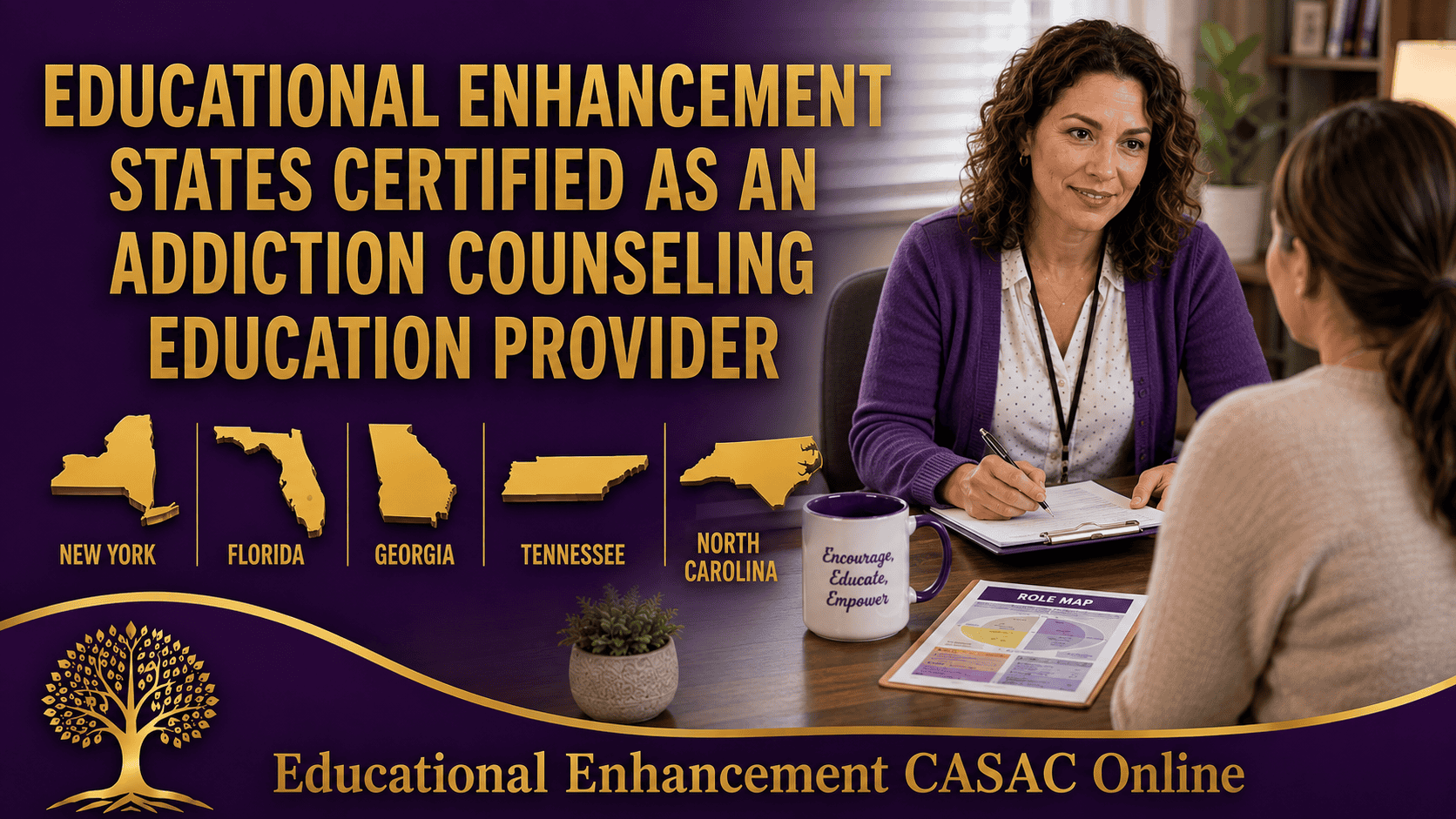
Educational Enhancement States Certified as an Addiction Counseling Education Provider
Find approved addiction counselor education for your state.
Educational Enhancement CASAC Online provides approved addiction counseling education for counselors and counselors-in-training in New York, Florida, Georgia, North Carolina, and Tennessee.
Whether you are working toward your first credential or completing education for certification, our state-approved programs offer flexible online learning built around real-world substance use counseling practice.
Educational Enhancement offers approved education for:
- New York CASAC
- Florida CAC
- Georgia CADC
- North Carolina CADC
- Tennessee LADAC
Choose your state and start your certification journey today.
Mapping Functional vs. Dysfunctional Coping
Functional coping reduces distress without creating secondary harm. Dysfunctional coping reduces distress in the short term but creates secondary harm or increases long-term distress. The distinction matters, but the line is not always sharp.
Functional coping strategies: substance use places substance use in a specific category: highly effective short-term relief with severe long-term costs. It does not belong in the same clinical bin as avoidance or rumination. It belongs in its own category, understood as a mechanism that solved a real problem before it became a bigger one.
Name the function before assigning the replacement. These are the functions substances most commonly serve:
- Anxiety management: social anxiety, performance anxiety, generalized worry before difficult situations
- Physical pain relief: chronic pain with no adequate medical management, acute physical discomfort
- Sleep: alcohol as the only reliable path to sleep onset for years before treatment
- Social belonging: substance use as the organizing activity around a social network
- Emotional numbing: using to stop feeling grief, shame, or rage that had no other container
- Shame management: getting through interactions the client could not otherwise tolerate
Coping skills assessment: substance use counseling that maps these functions produces a treatment plan with a specific target. Cognitive restructuring does not replace the function alcohol served for social anxiety the same way a relational skill or an exposure-based approach does. A paced breathing technique does not fill the role opioids played for chronic pain. The client coping repertoire addiction treatment planning should address not just what the client was using but what it was doing.
Some coping patterns also signal trauma history without the client naming it directly. Dissociation. Avoidance as the primary strategy across all domains. Hypervigilance organized around other people’s moods and behavior. These are not random dysfunctional choices. They are adaptive responses to earlier environments that have not updated to current conditions. Assessing coping in SUD counseling with attention to these patterns helps you catch them and adjust the clinical approach before introducing skills the client cannot yet access.
Trauma-Informed Treatment Plans for Substance Use Counseling covers the clinical approach for clients whose coping patterns are rooted in trauma response rather than skill deficit.
__________________________________________________________________
If you want a structured tool to take this work off the page and into your hands, the Understanding Triggers and Cravings Workbook is a 20-page PDF you can download today for $12. It walks through emotional, environmental, and social triggers, pairs each with a coping strategy, and builds toward a personalized action plan you can actually use between sessions.
__________________________________________________________________
What the Assessment Tells You About Where to Start
A coping skills assessment in substance use counseling produces more than a history. It produces a clinical map.
A client with strong behavioral coping but no cognitive tools needs targeted cognitive skill-building. Thought records, cognitive restructuring, defusion techniques: not because those are the standard SUD skill set, but because they are what this client is actually missing. A client with solid individual strategies but no relational coping may benefit more from a skills group than from more individual-session skill work. A client whose coping repertoire is built primarily on avoidance and dissociation needs a pace of skill introduction that respects the window of tolerance, not a front-loaded list of techniques.
Assessing coping in SUD counseling that produces a specific map also changes treatment plan language. “Client will learn and use coping skills” says nothing. “Client will identify and practice two cognitive coping strategies in response to rumination, applying at least one outside of session within the next 30 days and reporting the outcome at the following appointment” came from an assessment. It is specific because the assessment was specific.
The client’s coping repertoire for substance use treatment planning builds on what the counselor mapped at the start, not what they assembled from a standard handout stack. The generic skills list every client receives- the TIPP card, the coping menu, the urge surfing worksheet- may or may not fit what this client actually needs. Coping inventory substance use counselor practice that is thorough produces treatment that is targeted. That is the difference between a plan the client recognizes as theirs and a form they are filling out for someone else.
The assessment makes the intervention specific, not generic. That is not a small distinction. It is the clinical work.
The client coping repertoire addiction treatment work requires does not start with skills. It starts with knowing what is already there.
Get your Coping Skills Assessment Worksheet Here
If you are building your clinical assessment foundation in coping skills assessment for substance use counseling, Educational Enhancement CASAC Online training programs cover the full intake and assessment competency domain with the clinical depth this work requires.
Join Our Newsletter!
Join today. Stay current with news about addiction counselors, interventions, trends, and statistics.
STOP THE STIGMA