
Educational Enhancement
Addiction Counseling News and Blog
Be the CHANGE we need!
Join Our Newsletter!
Join today. Stay current with news about addiction counselors, interventions, trends, and statistics.
STOP THE STIGMA
How to Document Coping Skills in Substance Use Treatment Plans and Progress Notes
Documenting Coping Skills in Treatment Plans and Progress Notes Every counselor has written it. Nobody reads it and learns anything useful. Documenting coping skills in substance use treatment plan work is one of the most consistently underdone parts of SUD clinical...
Coping Skills for High-Risk Situations — What Works Depends on What You’re Dealing With
Not All Coping Skills Work on All Triggers. Here's How to Match the Skill to the Situation. Handing a client a breathing exercise for acute grief is not coping skills work. It is filling time. The skill has to match the situation. A generic coping skills list is a...
Most SUD Treatment Coping Skills Groups Are Just Conversations. Here’s How to Run One That Actually Works.
How to Facilitate a Substance Use Treatment Coping Skills Group That Actually Practices Skills The group discussed the skill for forty minutes. Nobody practiced it. That is not group therapy. That is group processing, and the two are not the same thing. Coping...

Teaching Coping Skills in Individual Substance Use Counseling Sessions
Clients Don't Need a Lecture on Coping Skills. Here's What They Actually Need. The gap between knowing a skill and using it at 11 pm on a Friday has nothing to do with how good the explanation was. The format most teaching coping skills in individual substance use...

How to Assess Client Coping Skills in Substance Use Counseling Before Teaching New Ones
Before You Teach a Single Coping Skill, Do This First. The client sitting across from you is not an empty vessel. They have been coping for decades. The assessment determines whether the skills you introduce actually fill the gaps. Every client arrives with a...
Why Coping Skills Don’t Stick and What Changes When They Do
Your Client Can Name Every Coping Skill. They Still Relapsed. Here's Why. The gap is not in the list of coping skills your client can recite. It is in what happens to those skills when a craving hits at 9 p.m. on a Tuesday. Your client left last session with a...
Motivational Interviewing 4th Edition: What Substance Use Counselors Need to Know
MI-4 keeps the core method intact, but changes its language, expands its scope, and gives counselors clearer ways to support autonomy, change talk, and practical planning. A client says, “I know my substance use is causing problems. I am still not ready...
Counseling Clinical Skills Every Substance Use Counselor Should Master
Great counseling is built one clinical decision at a time. Learn the counseling clinical skills that strengthen trust, improve assessment, guide treatment, and keep clients engaged throughout recovery. A counseling session rarely succeeds because one question...

Cultural Humility and the Therapeutic Alliance: Building Trust Across Every Counseling Relationship
The strongest counseling relationships are not built by having all the answers. They are built by remaining curious, respecting each client’s lived experience, and allowing cultural humility to strengthen the therapeutic alliance from the very first conversation....

Don’t Enroll in Substance Use Counselor Online Training Until You Read This
Choosing the right online training can save months of frustration, prevent costly mistakes, and put you on the fastest path toward certification in New York, Florida, Georgia, North Carolina, and Tennessee. Search for substance use counselor online training,...
Triggers, Cues, and Cravings Explained: Understanding What Drives Substance Use
Cravings do not appear out of nowhere. Learn how triggers, conditioned cues, and brain learning shape substance use, and how counselors can teach practical craving management and relapse prevention strategies. A client says, “I was doing fine until I drove past...
A Counselor’s Guide to Substance Use Screening Tools: SBIRT, AUDIT, DAST-10, CAGE, CRAFFT, and TAPS
A Counselor's Guide to Substance Use Screening Tools: SBIRT, AUDIT, DAST 10, CAGE, CRAFFT, and TAPS: Understanding That a Positive Screen Is Not a Diagnosis A substance use counselor does not use screening tools to label people. They use them to start better...

Consultation and Scope of Practice: The Call That Protects Your Client and Your Credential
Know your scope of practice: when a case has crossed your training. Use consultation, supervision, referral, and clean documentation without abandoning the client. A client tells you that voices have started giving commands. Another asks you to process...
Conducting a Clinically Useful Intake | A Practical Guide for Substance Use Counselors
The most important part of an intake is not the paperwork. It is understanding who is sitting in front of you, recognizing immediate risks, and gathering the information that guides every clinical decision that follows. A new client sits across from you while...

Referral and Warm Handoffs: Connecting SUD Clients Without Losing Them
A referral should not end with a phone number. Learn how warm handoffs, thoughtful care coordination, and effective follow-through keep clients engaged and strengthen continuity of care. A client nods when you recommend counseling for trauma, psychiatric care,...
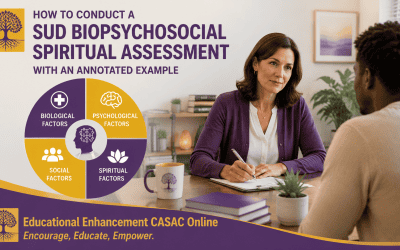
How To Conduct A SUD Biopsychosocial Spiritual Assessment With An Annotated Example
A biopsychosocial assessment is not a form. It is how you hear biology, psychology,social pressure, risk, and client strengths before you write the plan. A biopsychosocial assessment helps a substance use counselor see the full picture before writing a...
Using Person First Language Every Day: A Practical Guide for Substance Use Counselors
The words you use shape clinical judgment, documentation, trust, and treatment. Here is how to replace stigmatizing labels with language that accurately describes people and behavior. Most counselors never receive formal feedback about the words they...
The Therapeutic Alliance: Why the Relationship Often Matters More Than the Technique
Trust is not a bonus skill in substance use counseling. It is the foundation that allows every assessment, intervention, and treatment plan to work. Learn how to build a therapeutic alliance thatkeeps clients engaged from the very first conversation. A...
Case Conceptualization: Making Sense of Complex Client Stories
Assessment collects information. Case conceptualization explains what it means. Learn how strong clinical reasoning connects assessment findings to individualized treatment planning. A counselor completes a thorough assessment, gathers pages of notes, and finishes the...
Difficult Conversations During Clinical Supervision: The Conversations That Make Better Counselors
Difficult Conversations During Clinical Supervision:How Supervision Feedback Shapes Better Clinical Judgment You will not remember every supervision meeting. You will remember the ones that challenged your thinking. Difficult conversations during...