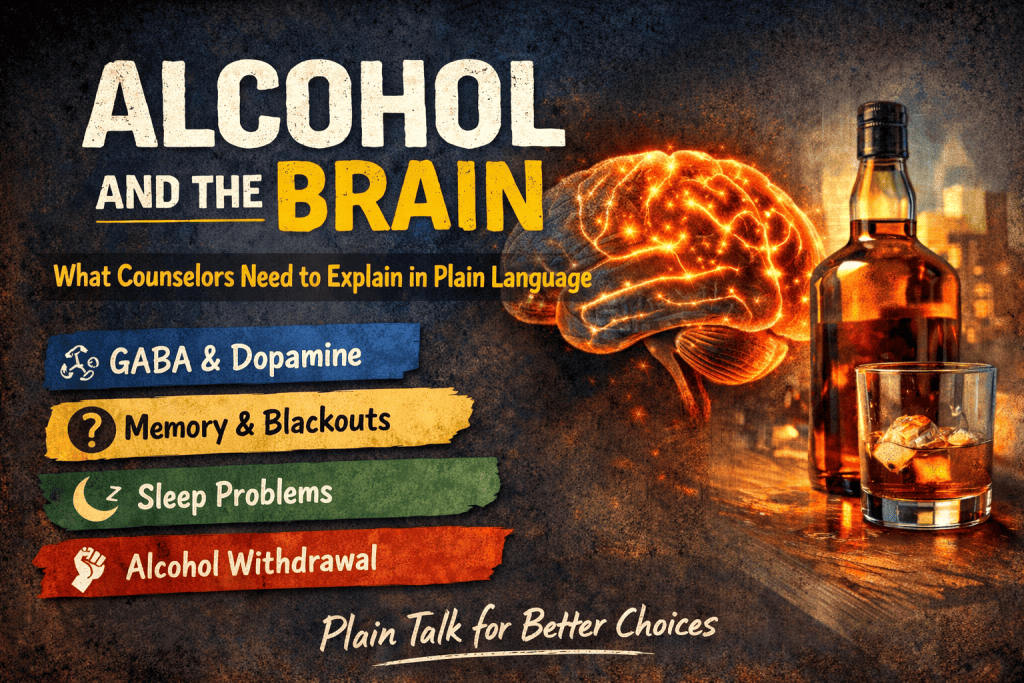
 Alcohol and the Brain: What Counselors Need to Explain in Plain Language
A client says, “I just drink. It is not like I am shooting dope.”
Then they show up foggy, snappy, sleeping four hours, and chasing the first drink by noon again.
You do not need a neuroscience lecture.
You need clean language that helps a person understand what is happening in their head, so they can make a different call.
I learned that lesson the hard way.
Back in my heroin days, alcohol looked harmless next to a needle. I told myself it was “just beer.” It kept me numb in shelters, kept me quiet in my own skin, and kept me stuck.
Here is the core message you want clients to hear.
Alcohol and the brain do not “agree” to casual terms. Alcohol changes signaling, learning, and stress response. Those changes can start in a single night, then build through repetition.
Start with what a drink really is
Most people do not track alcohol in standard drinks. They track it in “pours.”
In the United States, one standard drink holds about 14 grams of pure alcohol. That equals about a 12 ounce beer at 5 percent ABV, 5 ounces of wine at 12 percent ABV, or 1.5 ounces of spirits at 40 percent ABV. NIAAA+1
Ask one simple question.
What do you call one drink?
Then translate their answer into standard drinks.
That shift lowers arguments in session. It turns “I only had two” into real math.
Binge drinking has a definition, not a vibe
Public health uses a clear threshold. NIAAA defines binge drinking as a pattern that brings blood alcohol concentration to 0.08 percent or higher. For a typical adult, that lines up with five drinks for men or four drinks for women in about two hours. NIAAA
It sets a line for risk. It frames blackouts and injuries as predictable outcomes of dose and speed.
How alcohol affects the brain, in plain language
Alcohol reaches the brain through the bloodstream, then it pushes systems toward relief.
GABA and glutamate: the gas and the brake
Alcohol increases inhibitory signaling tied to GABA and reduces excitatory signaling tied to glutamate, including NMDA pathways. The net effect is slower brain activity, weaker coordination, and poor judgment. Frontiers+1
So the client feels calmer.
They talk more.
They take risks they swear they would never take sober.
The brain hates imbalance. It adapts.
Tolerance is the brain fighting back
After repeated drinking, the brain starts correcting for alcohol.
Over time, this adaptation can look like tolerance. AAFP describes alcohol as enhancing GABA effects, then repeated use leading to compensatory changes that reduce receptor response, which tracks with rising tolerance. AAFP
This is where alcohol and the brain create a trap.
The same dose feels weaker. The person drinks more to feel normal.
Then the brain expects alcohol to be present.
Withdrawal is rebound, not a character flaw
Use this counseling line.
Withdrawal is the brain trying to run without the thing it trained itself to expect.
Research describes alcohol withdrawal as a state with excessive glutamatergic signaling and reduced GABA functioning. Frontiers
NIAAA notes that medications like benzodiazepines target GABA to curb excitability during acute withdrawal. NIAAA
So the client feels alcohol withdrawal symptoms.
Anxiety spikes.
Sleep collapses.
Hands shake.
The body wants relief.
Name it. Do not shame it.
Alcohol and the brain built this pattern through learning. Your client can unlearn it through time, support, and better coping.
Dopamine and reward: why “just stop” sounds stupid
People do not keep drinking for the taste.
They keep drinking for brain payoff.
NIAAA describes alcohol as increasing activity in reward systems. Alcohol can drive dopamine signaling from the ventral tegmental area to the nucleus accumbens, part of the basal ganglia reward circuitry. NIAAA+1
Say it in client language.
Alcohol teaches your brain that drinking matters more than the rest of your life.
Sleep: the “I sleep fine” lie
You will hear it.
“I pass out fast. I sleep great.”
Research reviews describe REM suppression after drinking, with a rebound later in the night as blood alcohol levels drop, plus disrupted sleep quality. PMC+1
Use this question with clients.
Do you wake up tired and edgy after drinking, even with eight hours in bed? Yes. That is alcohol messing with sleep architecture.
For counseling, this matters.
Bad sleep fuels cravings.
Bad sleep raises stress.
Bad sleep makes therapy harder.
Memory and blackouts: “I was awake, so I remember”
Blackouts scare clients. They confuse families.
They get brushed off as jokes.
NIAAA explains that alcohol induced blackouts involve gaps in memory for events that occurred during intoxication, with increased risk of injury and other harms. NIAAA
Use plain language.
Your brain stopped saving the file.
That is alcohol and the brain interfering with new memory formation.
A client can look “fine” and still lose hours.
That is why blackout stories sound unreal.
Two long term brain risks worth naming
Thiamine deficiency and brain injury
NIAAA describes Wernicke Korsakoff syndrome as a serious brain condition often linked with chronic alcohol misuse and severe alcohol use disorder. NIAAA reports it may go undiagnosed in about 80 percent of patients. NIAAA
MedlinePlus links it to brain damage from lack of vitamin B1. MedlinePlus
Cancer risk, and why clients rarely hear it
The U.S. Surgeon General’s Advisory on Alcohol and Cancer Risk states alcohol increases risk for at least seven cancer types. It estimates 96,730 alcohol related cancer cases in 2019. HHS+1
WHO notes alcohol is a Group 1 carcinogen and states evidence does not show a safe threshold for cancer risk. World Health Organization+1
What you can say in session, without sounding clinical
Keep it short. Keep it respectful. Keep it real.
Alcohol and the brain learn fast. That is why cravings show up fast.
A standard drink is smaller than your pour. Let’s count your real dose. NIAAA
Binge drinking starts at four drinks for many women and five drinks for many men in about two hours. NIAAA
Withdrawal is brain rebound. It is not weakness. Frontiers
Blackouts mean memory did not record. Awake does not mean stored. NIAAA
Then give one action step.
Pick one change for seven days.
Track standard drinks.
Set a hard stop time.
Eat before the first drink.
Swap one drink for water.
Stop earlier, then protect sleep.
A harm reduction shift that works
I have sat with people who did not want sobriety.
I have sat with people who did.
Both groups deserved respect.
Make the next drink a choice, not a reflex.
For a client who drinks daily, start with timing.
Delay the first drink by thirty minutes for three days.
For a client who binge drinks, start with pace.
Add a full glass of water between drinks.
Limit the number of standard drinks in the first two hours. NIAAA
That is measurable. That builds trust.
What you should remember as a counselor
Alcohol and the brain is a topic that invites shame. Shut that down.
Talk about dose and speed.
Talk about sleep and withdrawal.
Talk about risk in a calm voice.
Then watch what happens.
Clients stop arguing.
Clients start noticing patterns.
That is the opening you want.