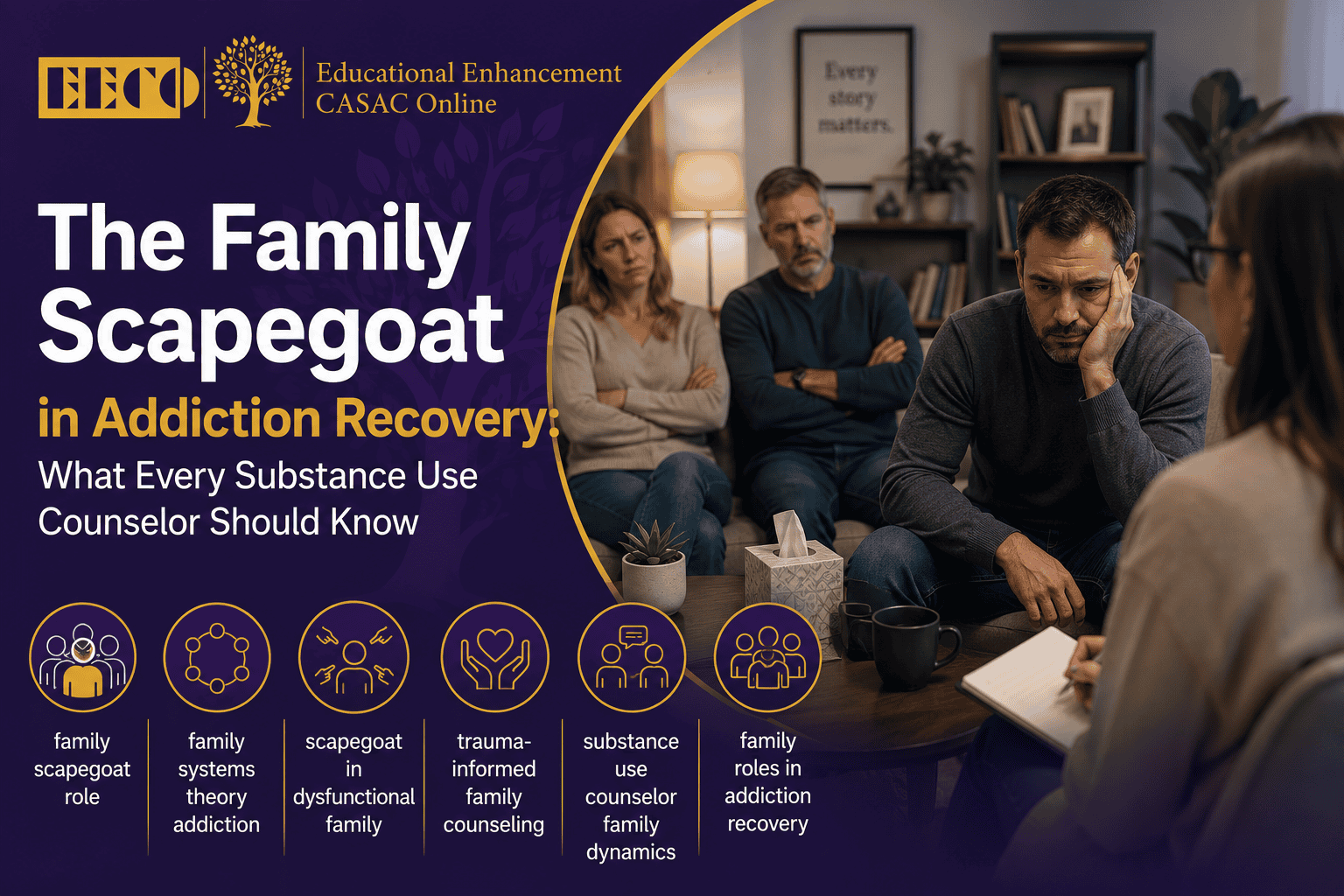
Learn how the scapegoat role develops in family systems, why it is often misunderstood, and how substance use counselors can respond with trauma-informed, family-centered interventions instead of blame.
The family scapegoat is rarely the real problem
Every family has a way of surviving stress.
Some families go silent. Some become loud. Some pretend everything is fine. Some organize themselves around the person who is struggling the most. And sometimes, one person becomes the emotional dumping ground for the entire system.
That person is often called the scapegoat.
In family systems theory addiction work, the family scapegoat role is one of the most important patterns a counselor can learn to recognize. The scapegoat is often the person who acts out, gets blamed, gets labeled, and becomes the visible evidence that something is wrong.
But here is the clinical truth.
The scapegoat in dysfunctional family systems is usually not the whole problem. They are often the ones who express what the family cannot say out loud.
For a CASAC in NYS, CAC in Florida, CADC in Georgia, or any substance use counselor working with families, this distinction matters. If you accept the family’s blame story too quickly, you may miss the real clinical picture.
What is the family scapegoat role?
The family scapegoat role develops when one person becomes the focus of blame for the family’s pain, conflict, or instability.
In family systems theory addiction treatment, we do not look only at one person’s behavior. We look at the pattern around the behavior. We ask what the behavior is communicating. We ask what the family keeps avoiding. We ask who benefits when all the attention stays on one person.
That does not mean the behavior is harmless.
Substance use, legal trouble, school refusal, aggression, or constant conflict can cause real damage. People still need boundaries. Families still need safety. Clients still need accountability.
But accountability without context often becomes punishment.
Trauma-informed family counseling asks a better question.
What is this behavior trying to say?
If you want a broader foundation for this topic, start with this EECO article on family systems theory and family pressure. It explains how families often reorganize around substance use long before anyone names the roles.
What the scapegoat often looks like
The scapegoat in dysfunctional family systems often appears to be the most obvious problem in the room.
They may be described as defiant, angry, manipulative, dramatic, immature, reckless, or impossible to help. Families may say, “Everything would be fine if they would just stop.” Schools may call them disruptive. Courts may call them noncompliant. Treatment systems may call them resistant.
Common signs include:
- Acting out at home, school, work, or in the community
- Conflict with parents, teachers, supervisors, or authority figures
- Substance use or increased risk-taking
- Legal involvement
- School refusal or poor attendance
- Being labeled the problem kid
- Explosive anger
- Family members focusing on them as the reason everything is bad
For a substance use counselor, this is where the work begins.
Anger may be a symptom. But anger can also be a map.
The family scapegoat role often carries emotional truth. The person may be angry because the family keeps pretending. They may be acting out because nobody listens when they speak calmly. They may use substances because the pain has become too heavy to carry without relief.
That does not excuse harm. It explains the work.
What is the role of protecting
Family roles in addiction recovery usually protect something.
The hero protects the family image. The caretaker protects everyone else from discomfort. The lost child protects themselves by keeping their distance. The scapegoat protects the family from facing the deeper central problem.
The family scapegoat role often protects the family from talking about pain openly.
It may protect a parent’s untreated substance use. It may protect unresolved grief. It may protect against domestic violence, emotional neglect, abuse, shame, or generational trauma. It may protect the family belief that “we are fine” even when everyone is hurting.
In family systems theory addiction work, the scapegoat becomes useful to the system because blame gives the family a place to put its fear.
If everyone can focus on one person, nobody has to face the whole pattern.
That is why the scapegoat in dysfunctional family systems often feels intense, rejected, and misunderstood. Deep down, many know they are carrying more than their own behavior. They may not have the words for it yet, but they feel the weight.
Why counselors must not collude with the blame story
One of the biggest mistakes a substance use counselor can make is joining the family’s blame story too quickly.
This can happen in subtle ways.
The family comes in exhausted. They describe the client’s behavior. The counselor sees the urgency. Everyone wants the person to stop using, stop yelling, stop lying, stop failing classes, stop getting arrested, stop creating crises.
Those goals may be valid.
But if the counselor focuses only on stopping the scapegoat’s behavior, the family system may remain unchanged.
Trauma-informed family counseling requires the counselor to slow the room down.
You can validate the family’s stress without making one person the container for every problem. You can address behavior without turning the client into the villain. You can support safety while still asking about the family context.
For example, instead of saying:
“You need to stop causing problems for your family.”
Try:
“Your behavior is creating real consequences, and I also want to understand what has been happening around you.”
That one shift changes the emotional temperature.
It tells the client, “I see more than the label.”
Knowledge of Substance Use Counseling for Families and Significant Others
Recertifying as a CASAC, CAC, or CADC? Learn How to Work With Families Without Getting Pulled Into the Chaos
Family systems can drive relapse risk or recovery momentum. This OASAS-approved training helps you work with loved ones in a clear, structured way, while protecting your client’s goals, confidentiality, and safety.
Perfect for CASAC, CAC, and CADC professionals, this course offers:
- Self-Paced, 100 Percent Online Learning
- Practical Skills For Family Roles, Boundaries, And Engagement
- Communication And Conflict Tools You Can Use In Sessions
- Stronger Support Planning For Loved Ones And Significant Others
- Strong Fit For Renewal And Professional Development Hours
Support the client. Guide the family. Keep the treatment plan steady.
Reframing behavior as communication
In family systems theory, addiction treatment, behavior is often communication.
Substance use may communicate pain. Anger may communicate fear. Defiance may communicate powerlessness. Withdrawal may communicate emotional overload. Legal trouble may signal a life shaped by chaos, survival, and unmet needs.
The family scapegoat role often develops when direct communication is unsafe or ignored.
So the client speaks through behavior.
This is why trauma-informed family counseling does not begin with shame. Shame shuts people down. Curiosity opens the door.
A substance use counselor can ask:
“What do you think your behavior is saying?”
“What do you wish your family would admit out loud?”
“What is one need you have that nobody is meeting?”
These questions do not remove responsibility. They create a path toward it.
Responsibility grows best in an environment where the person feels seen clearly.
Identifying unmet needs and trauma exposure
The scapegoat in dysfunctional family systems often has unmet needs that have been ignored for years.
They may need safety. They may need consistency. They may need emotional validation. They may need structure. They may need treatment for trauma, anxiety, depression, or substance use. They may need one adult who can hear the truth without panicking.
A strong assessment should explore:
- Trauma exposure
- Substance use history
- Family communication patterns
- Attachment injuries
- Grief and loss
- School or work problems
- Legal involvement
- Peer relationships
- Emotional regulation skills
- Safety risks
- Family rules about silence, loyalty, and blame
This is where substance use counselor family dynamics become essential.
A counselor who understands family roles in addiction recovery does not only ask, “What did the client do?”
They also ask, “What happened before the behavior? What happened after? Who reacts? Who avoids? Who rescues? Who blames? Who disappears?”
That is how you begin to see the system.
It is vital to understand the importance of identifying roles rather than only symptoms.
Building skills, structure, and support
Once the scapegoat role is identified, the counselor’s job is not to simply explain it.
The job is to help the client and family build a different pattern.
That means creating a plan that includes skills, structure, and support.
Skills may include emotional regulation, communication, refusal skills, coping strategies, relapse prevention, distress tolerance, and conflict repair.
Structure may include clear routines, treatment attendance, school or work support, probation compliance, recovery meetings, medication appointments, family sessions, and safety planning.
Support may include peer recovery support, family education, sober social connection, mentoring, case management, and referrals for trauma treatment.
This is practical trauma-informed family counseling.
Not a theory floating in the air.
Real tools. Real boundaries. Real support.
A CASAC in NYS, a CAC in Florida, or a CADC in Georgia should be able to recognize the family scapegoat role and still help the person develop a concrete recovery plan.
Insight matters. Action matters too.
Helping the family change its part
The family also has work to do.
If the family keeps blaming one person, the old pattern will continue to pull the client back into that role.
Family members may need to learn how to:
- Stop using labels like problem child
- Speak directly instead of blaming indirectly
- Take responsibility for their own behavior
- Set boundaries without shame
- Listen without immediately defending
- Name pain honestly
- Support recovery without controlling every move
This is where family roles in addiction recovery become visible.
The scapegoat may be paired with a caretaker who smooths everything over. The family may also have a hero who looks successful but feels crushed under pressure. Each role keeps the family system moving, even when the movement is unhealthy.
Substance use counselor family dynamics work requires compassion for everyone involved.
Families are not usually trying to create harm. Most are trying to survive with the tools they have. But survival patterns can still wound people. Healing requires new tools.
What should counselors remember?
The scapegoat is not always innocent.
The scapegoat is not always wrong.
The scapegoat is not always the whole problem.
All three things can be true.
That balance is what makes clinical work powerful.
The substance use counselor must hold both accountability and compassion. You do not ignore the substance use. You do not minimize legal trouble. You do not excuse harm. You also do not reduce a human being to the worst thing they have done.
In family systems theory, addiction work holds that the behavior belongs to the person, but the pattern belongs to the system.
That is the difference.
Final clinical takeaway
The family scapegoat role often signals that the family system is overloaded.
The scapegoat in dysfunctional family patterns may be acting out, but they may also be carrying the truth nobody else wants to name.
For the CASAC in NYS, CAC in Florida, CADC in Georgia, or any substance use counselor learning to assess family dynamics, this role is critical. When you understand substance use counselor family dynamics, you stop treating symptoms in isolation. You begin to see the emotional architecture underneath the behavior.
That is where better treatment begins.
Trauma-informed family counseling does not ask, “Who can we blame?”
It asks, “What is this family trying not to feel, and how can we help them face it safely?”
That is the work.
That is the doorway.
And sometimes, the person everyone calls the problem is the first person brave enough to show the family where healing needs to begin.
Join Our Newsletter!
Join today. Stay current with news about addiction counselors, interventions, trends, and statistics.
STOP THE STIGMA