The hero looks “fine” on the outside. In practice, the hero is carrying the family’s fear.
Your job is to spot it, name it, and build a plan to reduce burnout and support real change.
Family systems theory gives you a clean way to understand why family roles show up in homes affected by substance use disorder. When chaos repeats, people adapt fast, and the hero role often becomes the system’s stabilizer. As a substance use counselor, you see high performance and think “protective factor,” then you miss the hidden cost. As a CASAC in NYS, you can name the pattern early, tighten boundaries, and turn support into action that the family can repeat.
What family roles are and why they show up
Family systems theory explains a pattern you have seen a hundred times in sessions, collateral calls, and discharge planning. When substance use disorder dominates a household, the system tries to stabilize. People grab survival roles to reduce fear, manage conflict, and protect themselves from shame. Those family roles are often unconscious. They feel normal inside the home.
Here is the key point. A role is not a diagnosis. A role is a survival pattern.
So what does that mean in practice for a substance use counselor? It means you do not treat the role as a personality. You treat it as a behavior set tied to stress.
Do family roles disappear when the person enters treatment? No, they often get louder at first, since everyone is adjusting at the same time.
Why the hero role is easy to miss
The hero role looks impressive on paper. Good grades. Good job. “Responsible.” “Mature.” “Always helps.” The system often rewards that, so the person learns to keep performing.
Family systems theory also explains why that performance can keep a family stuck. The hero role reduces visible chaos, which reduces the urgency for others to change. The hero becomes the family’s emotional shock absorber.
If you are a CASAC in NYS, you will see this in the way families talk.
They may praise the hero.
They may lean on the hero.
They may use the hero as proof that things are fine.
That is the trap.
The hero role at a glance
The hero role usually shows up as overfunctioning.
• Overfunctions, performs, achieves
• Often carries hidden anger and grief
• Often feels responsible for keeping the family stable
Those family roles often form early. Sometimes the hero is the oldest child. Sometimes the hero is the partner. Sometimes the hero is the parent.
As a substance use counselor, you do not need to guess the origin story. You need to identify what is happening now.
What the hero role often looks like
Here is what you will see in sessions, family meetings, and collateral contact.
• High achievement, perfectionism, overfunctioning
• Taking care of siblings or parents emotionally
• Being the “good one” who makes the family look okay
• Strong resentment under the surface
Substance use disorder can drive the hero into a constant state of readiness. They manage schedules. They manage crises. They manage emotions. They manage appearances.
What happens when the hero stops performing? The system often panics, and the panic pushes the hero back into the role.
That is why you build a plan that allows for small change, not a sudden collapse.
What the hero role is protecting
The hero role is not only about being helpful. It protects specific fears.
• Family image
• Hope that success will cancel out chaos
• A need for control and stability
Family systems theory helps you see this as stabilization behavior, not vanity. The hero is trying to create order when substance use disorder has taught them that the home is unpredictable.
As a CASAC in NYS, treat this as a risk issue. High responsibility can hide depression, anxiety, sleep disruption, and anger that can later spill into substance use or burnout.
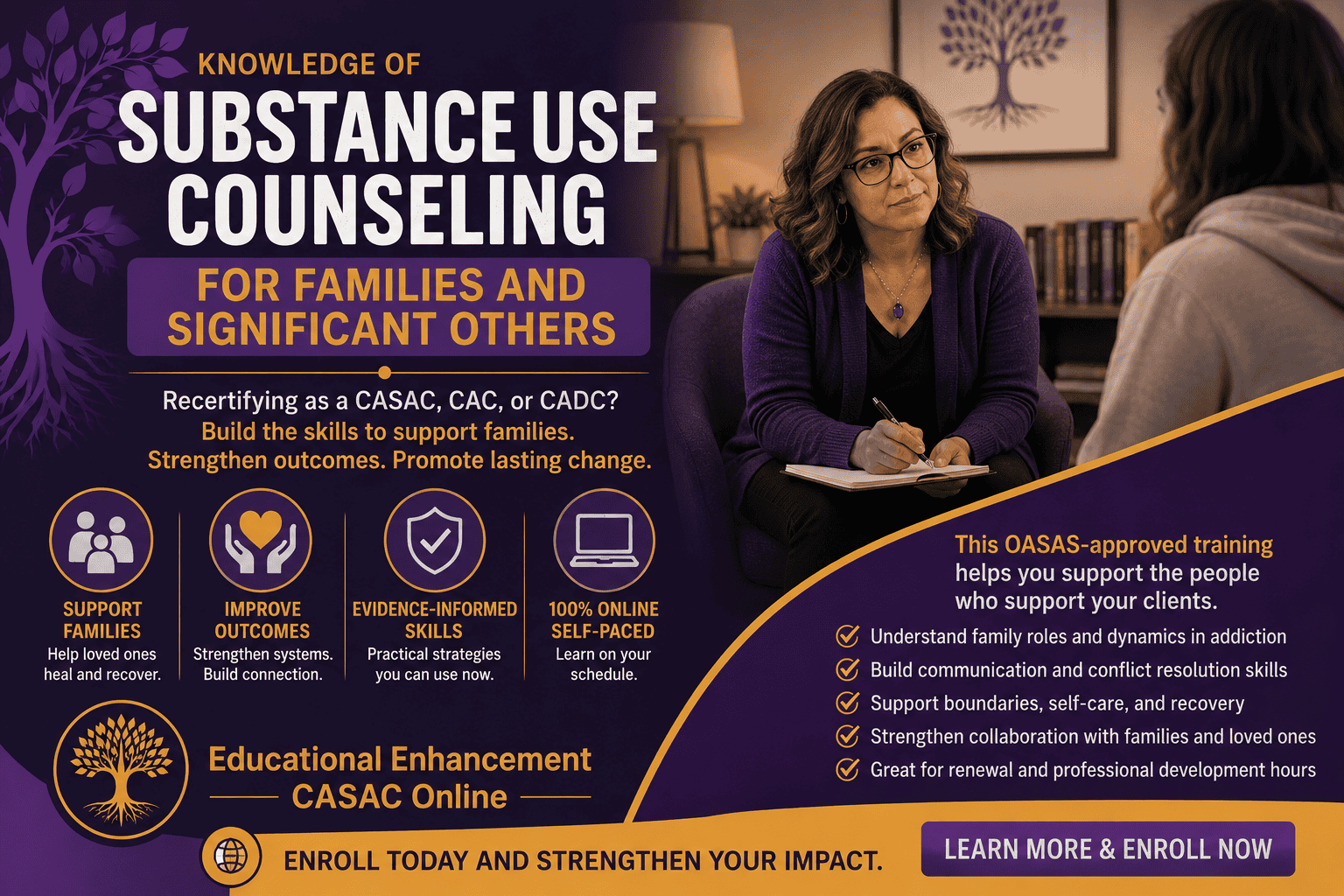
Knowledge of Substance Use Counseling for Families and Significant Others
Recertifying as a CASAC, CAC, or CADC? Learn How to Work With Families Without Getting Pulled Into the Chaos
Family systems can drive relapse risk or recovery momentum. This OASAS-approved training helps you work with loved ones in a clear, structured way, while protecting your client’s goals, confidentiality, and safety.
Perfect for CASAC, CAC, and CADC professionals, this course offers:
- Self-Paced, 100 Percent Online Learning
- Practical Skills For Family Roles, Boundaries, And Engagement
- Communication And Conflict Tools You Can Use In Sessions
- Stronger Support Planning For Loved Ones And Significant Others
- Strong Fit For Renewal And Professional Development Hours
Support the client. Guide the family. Keep the treatment plan steady.
What do you do as the substance use counselor
Your job is not to rip away the role. Your job is to loosen it safely.
Start with validation that does not reward overfunctioning.
• Validate the pressure and the hidden grief
• Help them separate identity from performance
• Teach boundaries and self-care that is real, not performative
• Address burnout and anger that gets buried
Family roles change when the person learns they can be safe without performing. That takes practice and repetition.
If you are a CASAC in NYS, keep your documentation behavioral. Write what the person is doing, how much it costs, and the next step.
The three questions that work in the session
Use direct questions. Ask them calmly. Then listen without rushing.
• What do you feel when you stop performing
• Who takes care of you
• What would happen if you were average for one week
Here is one question you can ask that stays practical. What does the hero role cost you this week? The answer is usually time, sleep, and emotional bandwidth.
Then move from insight to action.
Treatment planning moves that actually help
Substance use disorder treatment planning often ignores the hero, since the hero is “not the identified client.” That is a mistake. The hero role can drive stress that affects the entire household, including the person with substance use disorder.
Use treatment planning steps that target the role.
• Set one boundary the hero will practice this week
• Schedule one hour of non-responsibility time
• Identify one support person for the hero, not the family
• Create one script for saying no without apology
• Choose one stress signal the hero will track daily
Keep the steps small. Keep them trackable.
As a substance use counselor, you can pair this with a family session goal that reduces role pressure.
• One family agreement about who handles which task
• One limit on crisis texting after a set hour
• One plan for what happens when the person with substance use disorder misses a commitment
That is how family roles shift. You replace the old job with a shared plan.
A quick case example you can recognize
A parent calls you and says, “My daughter is the only one who keeps the house running. She is the reason we have not fallen apart.”
That is the hero role.
Your response should not be praise. Your response should be assessment and support.
As a CASAC in NYS, you can say, “She has been carrying a lot. Let’s build a plan that spreads responsibility, so she does not burn out.”
That one line moves the system.
Family systems theory supports you here, since you are naming the pattern without attacking anyone.
Common counselor mistakes with the hero role
These are the missteps that keep family roles locked in.
• Praising overfunctioning as resilience
• Using the hero as a second counselor
• Treating resentment as an attitude instead of a load
• Ignoring grief since the hero “looks fine”
Substance use disorder already creates enough pressure. Do not add more by turning the hero into unpaid staff.
As a substance use counselor, keep your role boundaries clean. Support the hero, but do not recruit them.
Conclusion
Family systems theory provides a clear explanation of why family roles form under chronic stress. In substance use disorder, the hero role often becomes the stabilizer, and that can hide burnout, grief, and resentment that later erupts. As a substance use counselor and a CASAC in NYS, your job is to name the pattern early, then build treatment planning steps that reduce overfunctioning and spread responsibility. When the hero role loosens safely, the system gets more honest, and change becomes easier to sustain.
Join Our Newsletter!
Join today. Stay current with news about addiction counselors, interventions, trends, and statistics.
STOP THE STIGMA