Trauma-informed care is more than a philosophy. Learn how to apply all six SAMHSA principles in everyday counseling practice within OASAS-certified substance use treatment programs.
You can recite all six SAMHSA principles. So can the intern who started Monday. Reciting was never the hard part. The hard part is applying trauma-informed care inside a program with productivity targets, a waiting list, group rooms with thin walls, and a chart that gets audited. The framework lives in a binder. Your clients live in the waiting room. Somebody has to close that distance. In a certified program, somebody is the substance use counselor.
This post picks up where the discussion of what trauma-informed care actually requires in an OASAS-certified setting left off. That piece covered the research, scope, and documentation standards. This one takes each principle out of the policy manual and puts it into the schedule, intake, group room, and note. By the end, you will know what each of the six principles of trauma-informed care asks of you on a Tuesday with six sessions booked and a treatment plan review due.
The vocabulary was never the standard
SAMHSA named the six principles of trauma-informed care in 2014: safety, trustworthiness and transparency, peer support, collaboration and mutuality, empowerment and choice, and cultural and historical awareness (SAMHSA, SMA14-4884). The framework was built for exactly the population you serve. In clinical SUD populations, 85% to 100% of patients report at least one adverse childhood experience (SAMHSA, TIP 57). That number means every person on your caseload gets trauma-informed SUD treatment, not just the ones who disclosed something at intake. If you want the full definitions before the application, the breakdown of the six trauma-informed principles every substance use counselor should know covers each one in depth.
OASAS offers certified programs that meet this standard through its person-centered and trauma-informed service expectations. The regulation does not ask whether your staff attended a training. It asks whether the client’s experience of your program reflects the six principles of trauma-informed care. That is an application question. So here is the application, one principle at a time.
Safety is a schedule, not a poster
Safety in an OASAS-certified setting starts before the first session does. Think about what a client with a trauma history meets in your building. A crowded waiting room. An intake worker asking about their use history within earshot of strangers. A hallway they have never walked, leading to a room they have never seen, with a person they have never met. None of that is neutral for someone whose nervous system is wired to scan for threat. Safety means you shrink the unknowns. Tell the client what happens next before it happens. Keep session times consistent. Hold intakes in a private space every time, even when the schedule is tight. Walk the client to the room instead of pointing.
Inside the session, safety is structured. Open the same way each time. Name how long you have. Flag transitions before you make them. A client who knows the shape of the hour stops spending energy bracing for it. That energy goes into the work instead. That is trauma-informed SUD treatment before a single intervention starts.
Trustworthiness means showing your paperwork
Trustworthiness and transparency get tested at the exact moment most counselors go quiet: documentation. Your client watches you write about them in a record they rarely see. In a substance use counselor relationship, that chart holds real power. It follows the client to the next provider, the court, or sometimes the child welfare worker. Applying trauma-informed care here costs you one sentence. Before you pick up the pen, say what you are writing and why. “I’m noting that we reviewed your safety plan and that you want to add your sister as a contact.” That sentence, repeated across sessions, builds more trust than any rapport technique.
The words inside the note matter just as much as the sentence before it. Describe behavior. Name clinical context. Skip character judgments. The full standard for that is covered in trauma-informed documentation language and what belongs in session notes, and it pairs with everything in this section.
Peer support is a staffing decision, not a suggestion box
Peer support in trauma-informed SUD treatment is structural. New York built the CRPA role for this reason, and OASAS-certified programs can bill for peer services. A peer professional with lived experience of recovery gives clients something no credentialed substance use counselor can manufacture: proof. Proof that people leave treatment and build lives. Proof that the person across the table once sat in the same plastic chair.
The application looks like this. Peers sit in on treatment team meetings with a voice, not a notepad. Warm handoffs happen in person, where you introduce the client to the peer instead of handing over a phone number. Peer-led groups run on the same schedule and have the same status as clinical groups. If your program treats its peers like drivers and paperwork runners, that is not a peer support program. That is a staffing shortage wearing a badge.
Collaboration is about who holds the pen
Collaboration and mutuality live or die in treatment planning. You already know the failure mode. The counselor writes four goals between sessions, the client signs the page, and OASAS gets a compliant document that changed nothing. A collaborative plan gets written in the room, out loud, with the client choosing the words. Ask what they want back in their life. Write that. Then attach the clinical steps to it. A client who recognizes their own language in the plan owns the plan. A client who owns the plan shows up for it.
This is the same ground covered in trauma-informed treatment plans for substance use counseling, which walks through how trauma history changes goal writing and review. The short version: a goal written about a client is data entry. A goal written with a client is treatment.
Empowerment and choice survive even a mandate
Here is the objection you are already thinking of.
Half your caseload is mandated. The court chose treatment, the program chose the level of care, and the schedule chose the group times. Where exactly does choice live? It lives in everything that is left, and more is left than you think. Which goal do we start with today? Morning group or evening group? Do you want your counselor referral to consider gender? Do you want to review your toxicology results at the start or the end of the session? Each choice is small. The pattern is not. A person whose history taught them that power is used against them is now practicing experiencing power used with them. That practice is trauma-informed SUD treatment, run at the level of a scheduling question.
In an OASAS-certified setting, empowerment and choice extend to saying the honest thing when options are limited. Three choices, none perfect, which feels most workable. That sentence respects the client’s intelligence and their circumstances at the same time. Pretending a mandate is a menu insults them. Naming the real choices inside the mandate levels with them.
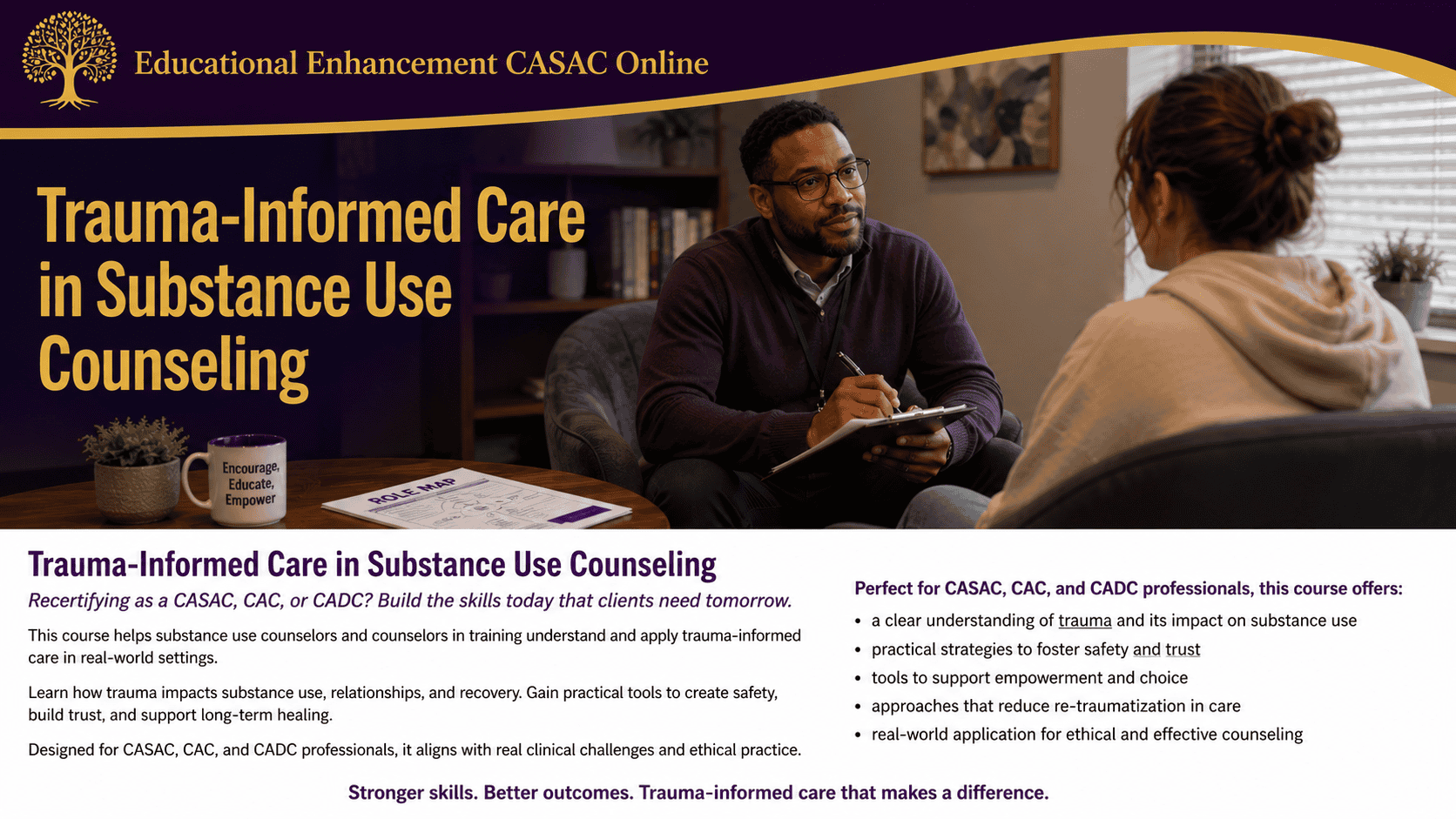
Trauma-Informed Care in Substance Use Counseling
Recertifying as a CASAC, CAC, or CADC? Learn How to Apply Trauma-Informed Care in Real Substance Use Counseling Settings
Many people entering treatment have experienced trauma, but trauma-informed care is more than understanding trauma. This training teaches you how to create safety, build trust, avoid re-traumatization, and support recovery while staying within your professional role.
You’ll learn practical strategies you can apply immediately in substance use counseling settings. The course focuses on real-world client interactions, ethical practice, engagement, documentation considerations, and the principles that support long-term recovery.
Perfect for CASAC, CAC, and CADC professionals, this course offers:
- Self-Paced, 100 Percent Online Learning
- Understanding Trauma And Its Impact On Substance Use And Recovery
- Practical Skills For Safety, Trust, Choice, Collaboration, And Empowerment
- Strategies To Reduce Re-Traumatization In Treatment Settings
- Strong Fit For Renewal Hours And Professional Development
Build safer relationships. Improve engagement. Strengthen recovery outcomes.
Cultural and historical awareness is a clinical variable
Cultural and historical awareness is the principal program most often reduced to a training slide, and it is the one that most changes behavioral interpretation. A client whose community has generations’ worth of reasons to distrust institutions walks into your program, carrying that history. Guarded answers at intake, reluctance to sign releases, and skepticism toward your motives can be read two ways. One reading writes “resistant to treatment.” The other reading asks about the client’s relationship to systems like yours and documents engagement in that context. The first reading is faster. The second one is accurate.
Applying trauma-informed care at this level means asking rather than assuming. Ask what treatment experiences the client has had before. Ask what worked and what harmed. Fold the answers into your assessment the same way you fold in a trauma screen. The trauma-informed approach to care in substance use counseling sits on this same foundation: context first, judgment later, if at all.
When the program pushes back
Every substance use counselor reading this knows the friction. You have fifteen minutes between sessions, an audit next month, and a supervisor who wants notes closed by Friday. The six principles of trauma-informed care can feel like one more demand stacked on a job that already takes more than it gives. Two things are true at once. The system you work in was not built for this, and applying trauma-informed care inside it is still possible. Nothing in this post requires a budget line. A sentence before the pen. A walk down the hallway. A goal written out loud. A second reading of a guarded intake. These are habits, not initiatives. Habits survive bad systems.
What to apply this week
- Before one intake, tell the client each step of the process before it starts, and watch what changes in their posture.
- Say one sentence about what you are documenting before you write it, in every session, for five days.
- Pull one treatment plan due for review and rewrite one goal in the client’s own words, in the room, with the client.
- Offer one mandated client a real choice inside the mandate and name it as a choice.
- Reread your last five notes and replace every character judgment with observed behavior plus clinical context.
That list is trauma-informed SUD treatment at ground level. No committee required.
The standard behind the standard
The six principles of trauma-informed care were never a vocabulary test. They describe what your program feels like from the client’s side of the desk. Safety is whether the building makes sense. Trustworthiness is whether the chart holds surprises. Peer support is whether recovery is visible among staff. Collaboration is where the words are in the plan. Empowerment is whether choice exists inside the mandate. Cultural and historical awareness is whether context beats assumption. An OASAS-certified setting that gets these right is not performing compliance. It is the treatment that people come back for.
Your clients will never quote SAMHSA at you. They will just keep showing up. That is the metric.
Build This Skill Set at EECO
The EECO trauma-informed care in substance use counseling course turns every section of this post into practice. You get session language, documentation templates, and application drills for each principle, built for the counselor applying trauma-informed care in a working OASAS-certified setting. The course counts toward renewal hours for CASAC, CAC, and CADC professionals. If this post matches what you deal with in session, the course goes deeper. Register and start today.
Join Our Newsletter!
Join today. Stay current with news about addiction counselors, interventions, trends, and statistics.
STOP THE STIGMA