
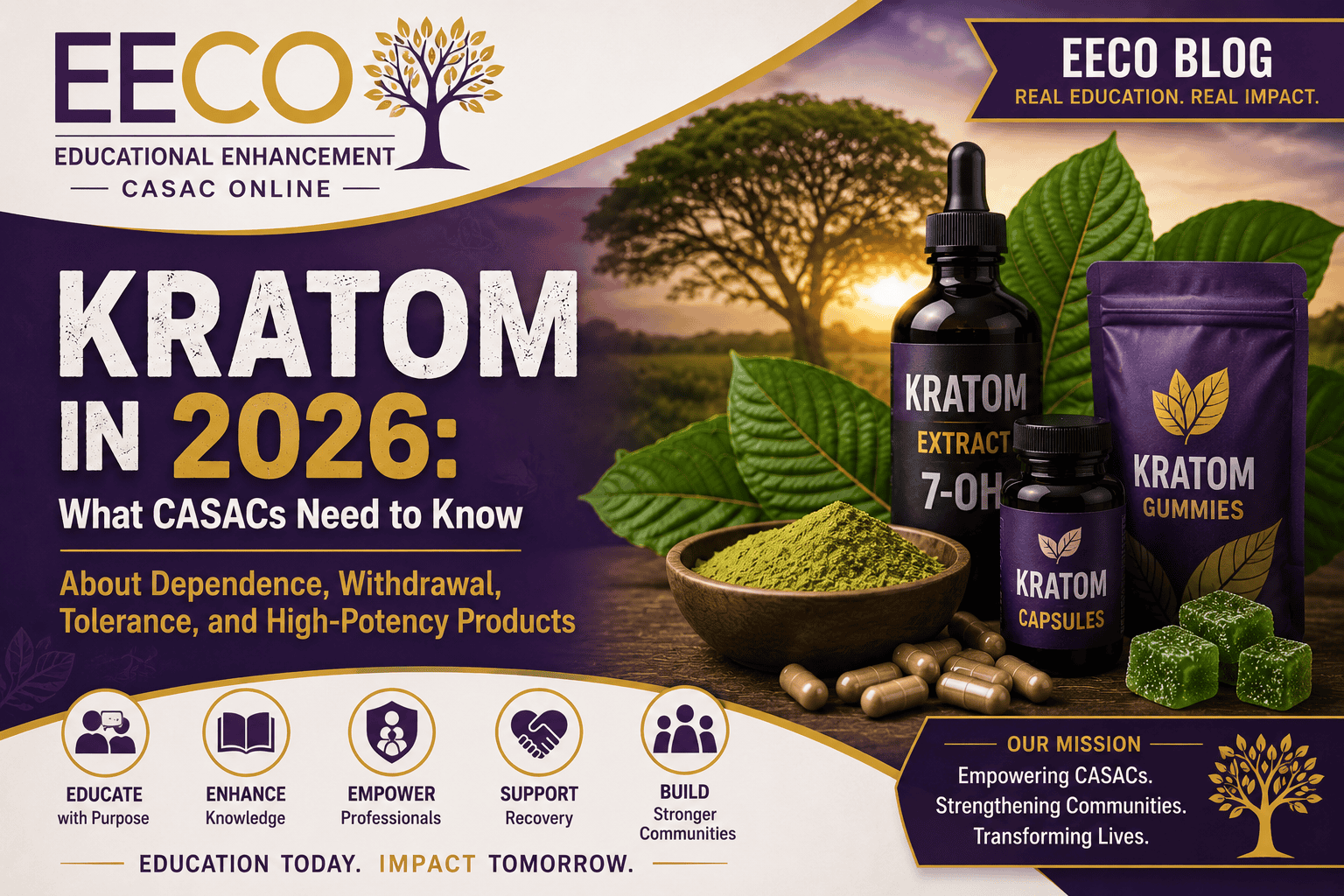
Kratom isn’t just an herbal substitute for pain. It has many physical and psychological health risks, including a high possibility of developing Kratom Use Disorder.
Introduction
Kratom use is becoming a growing concern for every substance use counselor working in today’s behavioral health system. More clients are entering treatment for Kratom use disorder, already using kratom products, and many do not realize how quickly tolerance and kratom withdrawal symptoms can develop with repeated exposure to high-potency products. For a CASAC in NYS, understanding the modern kratom market is no longer optional. Concentrated extracts, gummies, shots, and enhanced 7-OH products are changing the risk profile dramatically, and every substance use counselor needs accurate information to assess clients effectively and provide realistic harm reduction support before kratom withdrawal symptoms and dependence become severe.
Kratom in 2026: What Every Substance Use Counselor Needs to Understand About Dependence, Withdrawal, and High-Potency Products
Five years ago, many clinicians barely heard clients mention kratom use during assessment or counseling sessions. That has changed rapidly. Today, kratom products are sold openly in gas stations, vape stores, convenience shops, smoke shops, and online wellness marketplaces. Marketing campaigns promote kratom use as a “natural” solution for energy, mood, pain, focus, sleep, and opioid recovery support. Many people experimenting with kratom genuinely believe the product is safer because it is plant-based. However, this assumption is increasingly dangerous. For every CASAC in NYS and substance use counselor working with clients affected by polysubstance use, the reality is clear: the kratom market in 2026 is vastly different from even a few years ago. Products are more concentrated, potency is rising rapidly, and clients are developing kratom use disorder at an alarming rate, faster than many experts predicted. The surge in availability and marketing has created a landscape where risk awareness is more critical than ever. Clinicians must stay informed to help clients navigate this evolving terrain and prevent potential harm from unregulated, potent products.
Kratom Use Is Rising Rapidly
National data and treatment observations consistently indicate a growing trend: kratom use is on the rise across the United States, particularly among younger adults and individuals already engaged with other substances. This pattern aligns with current behavioral health challenges and demonstrates the shifting landscape of substance use. Substance use counselors, well-versed in these developments, should recognize this trend as a significant aspect of the evolving addiction landscape.
People are searching for:
- pain relief
- anxiety management
- emotional regulation
- increased energy
- alternatives to opioids
- relief from withdrawal
Kratom is marketed directly to those vulnerabilities, often exploiting perceptions of safety. The problem is that many people hear “natural” and automatically assume low risk, which is a misconception. This logic quickly falls apart when discussing substances that affect opioid receptors and the brain’s reward system, potentially leading to addiction. Kratom contains active alkaloids, including mitragynine and 7-hydroxymitragynine (commonly called 7-OH), which interact with opioid receptors. These compounds can produce stimulant-like effects at lower doses, such as increased alertness and energy, and sedating effects at higher doses, including relaxation and pain relief. This mixed pharmacology contributes to kratom’s unpredictable nature, making it difficult for users to anticipate its effects and increasing the risk of adverse reactions or dependence.
Some people initially report:
- increased focus
- mood improvement
- reduced pain
- relief from opioid cravings
But repeated kratom use can also produce tolerance, dependence, and kratom withdrawal symptoms that closely resemble opioid withdrawal patterns.
Tolerance Changes Everything
Tolerance changes everything, subtly impacting how our bodies respond to substances like kratom. Over time, as tolerance increases, individuals may need higher doses to achieve the desired effects, which can lead to dependence. This gradual shift often occurs quietly, marking the beginning of kratom use disorder without obvious warning signs.
At first, a client may use:
- one capsule
- one tea
- one gummy
- one shot
And it works.
Then the effects weaken.
Tolerance develops because the brain and body adapt to repeated kratom exposure over time. As this adaptation occurs, the same dosage no longer produces the initial level of relief, energy boost, or calming effect that it once did. This affects people who use kratom, requiring higher doses to achieve the same benefits, highlighting the importance of cautious use and monitoring.
A substance use counselor will often hear clients say:
- “It used to work better.”
- “I switched to stronger extracts.”
- “The regular powder doesn’t do anything anymore.”
This is not harmless experimentation anymore.
This is a physiological adaptation.
And the concentrated products currently flooding the market accelerate tolerance far faster than traditional kratom leaf products ever did.
For a CASAC in NYS, recognizing escalating kratom use early is critical because clients often minimize it until dependence becomes severe.

Basic Knowledge of Substance Use Disorder
Recertifying as a CASAC, CAC, or CADC? Strengthen your clinical foundation with practical substance use education built for today’s workforce.
This course helps substance use counselors understand the core foundations of substance use disorder, including brain chemistry, behavioral patterns, risk factors, and treatment approaches. It is designed for professionals who want stronger assessment skills, clearer clinical understanding, and updated knowledge for real-world counseling environments.
Whether you are new to the field or completing recertification hours, this training gives CASAC, CAC, and CADC professionals direct, practical education that can immediately support client care and treatment planning.
Perfect for CASAC, CAC, and CADC professionals, this course offers:
- Clear understanding of substance use disorder fundamentals
- Practical education for real-world counseling settings
- Updated information on risk factors and substance trends
- Support for professional development and recertification
- Flexible online access for busy professionals
Build stronger clinical knowledge to support clients with confidence.
Kratom Withdrawal Symptoms Are Real
One of the most persistent and damaging misconceptions circulating online is the belief that kratom does not have the potential to cause withdrawal symptoms. Many people wrongly assume that because kratom is a natural plant, it cannot lead to dependence or withdrawal issues. However, this myth overlooks the evidence that, like other substances, kratom can indeed produce withdrawal effects in some users.
That is false.
Clients experiencing kratom withdrawal symptoms may report:
- anxiety
- irritability
- insomnia
- sweating
- nausea
- muscle aches
- restlessness
- depression
- intense cravings
- emotional instability
Some individuals describe feeling unable to function normally without repeatedly using kratom throughout the day.
This issue is particularly important because many clients initially do not expect to experience withdrawal symptoms from products marketed as “legal,” “natural,” or “herbal.” When kratom withdrawal begins, there is a significant psychological shift: from thinking “I want this” to believing “I need this just to feel normal.” This shift forms the core of kratom use disorder.
Why 7-OH Products Changed the Entire Conversation
This is a crucial point that every substance use counselor must recognize. The kratom market has evolved significantly and is no longer dominated by traditional leaf powder products. Instead, it now includes a variety of newer formulations and products that can differ significantly in their effects and potency. Staying informed about these market changes is essential for effective counseling and ensuring the safety and well-being of those seeking help.
Now there are:
- concentrated extract shots
- enhanced capsules
- gummies
- liquid concentrates
- isolated 7-OH products
Some companies are specifically increasing concentrations of 7-hydroxymitragynine because it produces stronger opioid-like effects, which significantly alter the risk profile associated with its use. A person drinking multiple high-potency extract shots daily is not engaging in the same type of kratom use as someone casually drinking traditional kratom tea, highlighting the diversity in consumption patterns and potential health implications.
Higher potency means:
- faster tolerance
- stronger dependence
- more severe kratom withdrawal symptoms
- increased overdose risk
- greater polysubstance complications
Many products are poorly labeled, inconsistently manufactured, or marketed deceptively. Clients frequently underestimate how powerful these concentrated products actually are.
For a CASAC in NYS, this creates major assessment challenges because clients may not even realize what they are consuming.
What Substance Use Counselors Are Hearing in Sessions
Most substance use counselors are already hearing statements like:
- “It helps my anxiety.”
- “It keeps me off fentanyl.”
- “It’s legal.”
- “It’s safer.”
- “It helps me work.”
- “I only use extracts.”
The goal is not judgment. Instead, the focus is on assessment, education, and harm reduction. These approaches aim to understand individuals’ circumstances without criticism, fostering a supportive environment where learning and constructive change are prioritized. By emphasizing these principles, we can promote safety, awareness, and positive outcomes within the community.
A CASAC in NYS needs to explore:
- What type of kratom product does the client use
- frequency of kratom use
- escalation patterns
- signs of tolerance
- presence of kratom withdrawal symptoms
- mixing with alcohol or other substances
Because kratom rarely exists alone.
Many clients simultaneously use:
- alcohol
- cannabis
- benzodiazepines
- stimulants
- opioids
That combination significantly increases risk.
If you’re a CASAC in NY or CASAC T
Harm Reduction Conversations Matter
Clients deserve honest and informed conversations rather than fear tactics that manipulate or pressure them. Clear, transparent communication builds trust and helps clients make well-informed decisions. Providing factual, balanced information ensures they feel respected and empowered, fostering a healthier relationship and promoting genuine understanding instead of relying on fear to influence their choices.
A productive substance use counselor conversation may include:
- discussing tolerance openly
- identifying early dependence signs
- educating about high-potency extracts
- monitoring kratom withdrawal symptoms
- exploring safer coping skills
- discussing polysubstance risks
Some individuals genuinely report using kratom as an attempt to avoid fentanyl or heroin use. That reality should not be ignored, as it highlights a potential harm reduction strategy. However, harm reduction also involves recognizing and reducing the risks when kratom use becomes harmful or problematic in itself. This is where clinical skill and expertise are crucial, to assess the risks, provide guidance, and intervene appropriately if necessary.
Conclusion
Kratom is no longer a fringe issue affecting only isolated populations. The rapid expansion of concentrated extracts, gummies, enhanced shots, and 7-OH products means more clients are developing kratom use disorder, tolerance, and serious kratom withdrawal symptoms without fully understanding the risks involved. Every CASAC in NYS and every substance use counselor working in today’s fentanyl-era environment needs updated knowledge about modern kratom products, dependence patterns, and harm reduction strategies. The goal is not panic or misinformation. The goal is accurate assessment, informed conversations, and helping clients recognize when kratom use has shifted from experimentation into a substance use disorder requiring support and intervention.
Subscribe to Our Newsletter
Stay up-to-date with changes in the addiction recovery field, new illicit drug trends, treatment modalities, and new addiction counselor training opportunities.