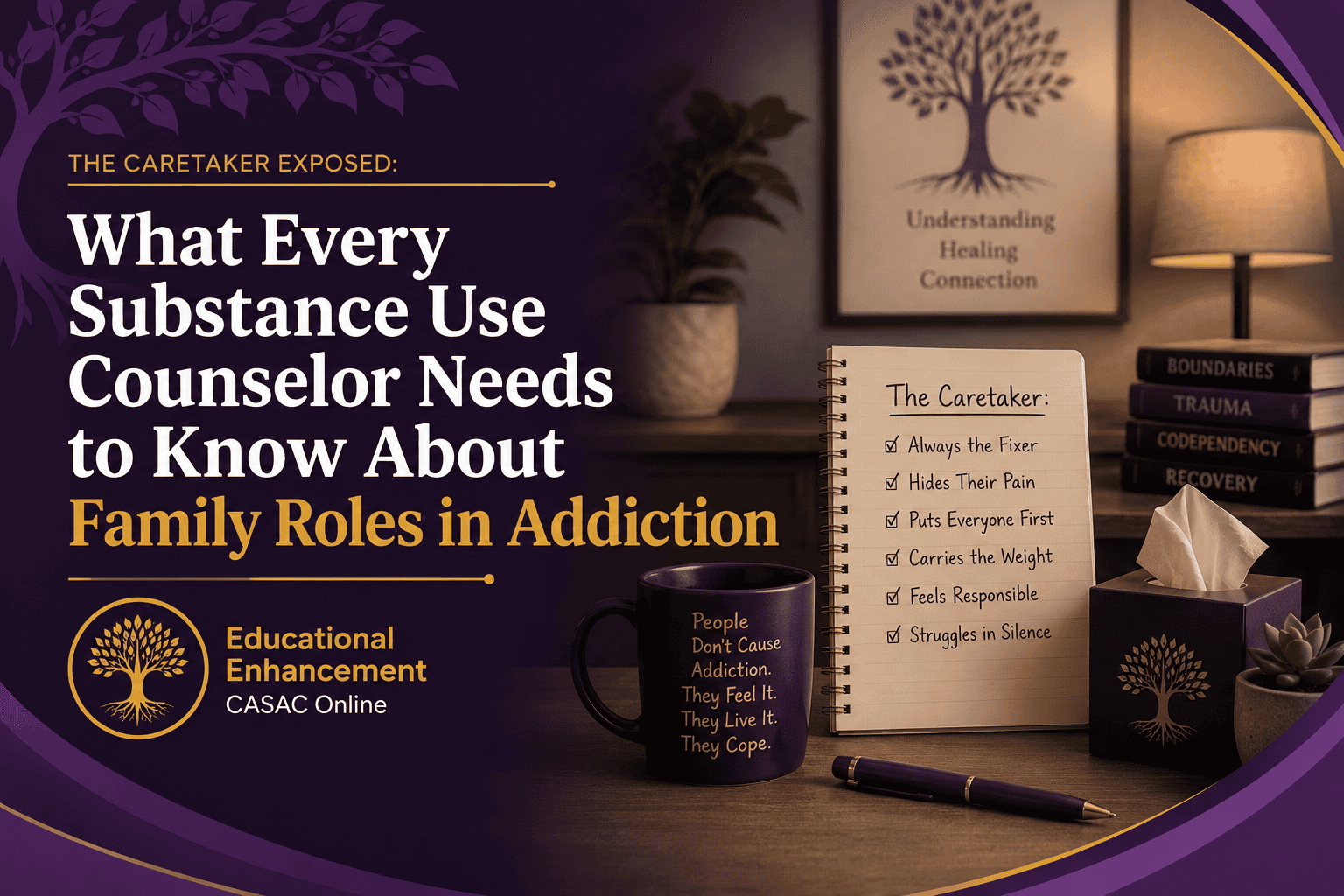
The caretaker may look like the glue holding the family together, but often they’re part of what keeps the cycle of addiction spinning.
Here’s what CASACs, CADCs, and CACs need to understand about this complex role.
The Caretaker Role in Addiction: What Every CASAC in NY Needs to Understand
If you work in addiction treatment, you’ve seen the caretaker role up close. Whether you’re pursuing CASAC Training Online, preparing for the IC & RC Exam, earning your CADC Certification, or already working as a Substance Use Counselor, understanding this role matters. Every CASAC in NY will eventually work with families where one person holds the entire system together while unknowingly helping the addiction continue.
The caretaker may look stable from the outside. Responsible. Selfless. Strong.
But underneath that role is fear, exhaustion, resentment, and survival behavior that can quietly keep substance use disorder alive for years.
As a Substance Use Counselor, your ability to recognize this pattern can completely change how you approach treatment, family engagement, and long-term recovery outcomes.
What Is the Caretaker Role?
Every CASAC in NY needs to understand that caretaking and helping are not always the same thing.
The caretaker is the family member who tries to keep everything functioning while addiction tears the household apart. They smooth over conflict, manage crises, cover mistakes, and absorb consequences that belong to the person using substances.
On the surface, they often look heroic.
But in many situations, their actions unintentionally protect the addiction.
This does not make them bad people. Most caretakers are operating from fear, trauma, guilt, or desperation. Many believe they are saving the family.
Unfortunately, their behavior often delays accountability, treatment engagement, and recovery progress.
That distinction matters whether you’re completing CASAC Training Online, preparing for the IC & RC Exam, or working toward CADC Certification.
Substance Use Disorder Family Roles
As a Substance Use Counselor, you need to recognize how family systems adapt to substance use disorder.
Family systems theory shows that people often fall into predictable survival roles when use disorder dominates a household. These roles are unconsciously adopted as individuals try to manage the chaos, emotional pain, and instability caused by substance use. Such roles may include the responsible one, the scapegoat, the victim, or the caretaker, each serving to maintain some sense of order amid dysfunction.
Common roles include:
- Person With Substance Use Disorder (PWUD)
- The Caretaker or Enabler
- The Hero
- The Scapegoat
- The Mascot
- The Lost Child
The caretaker becomes the crisis manager.
They pay bills.
They make excuses.
They lie to employers.
They cancel appointments.
They clean up emotional wreckage while telling themselves they are helping.
Every CASAC in NY has likely sat across from a caretaker who is doing more recovery work than the client themselves.
Common Caretaker Behaviors
Understanding these patterns is essential during CASAC Training Online and real clinical practice because they form the foundation for effective assessment, diagnosis, and intervention strategies. Recognizing them enhances the clinician’s ability to deliver targeted and personalized care, ultimately improving client outcomes.
Caretakers often:
- Ignore destructive behavior
- Provide financial support despite repeated misuse
- Lie to protect the person using substances
- Cover responsibilities the client refuses to handle
- Avoid confrontation
- Minimize the severity of addiction
- Neglect their own health and emotional needs
- Fail to enforce consequences
Many caretakers become trapped in constant crisis management.
They lose their identity.
They stop focusing on themselves.
Their entire world becomes organized around preventing collapse.
For a Substance Use Counselor, recognizing these signs early can dramatically improve treatment planning.
Recognizing the Caretaker in Treatment
A skilled Certified Alcohol and Substance Abuse Counselor (CASAC) practicing in New York State learns to quickly identify the primary caretaker or guardian involved in the individual’s recovery process. This ability allows the counselor to better understand the support system, address potential complications early, and coordinate effective treatment plans tailored to the patient’s unique needs.
You may see:
- A parent answering every question for their adult child
- A spouse constantly rescuing the client financially
- Someone minimizing overdoses, arrests, or relapses
- A family member is trying to control the entire treatment process
Imagine a husband covering rent after repeated pill binges.
Imagine a mother filling out treatment paperwork while her adult son stays silent.
These behaviors are common in addiction treatment settings.
Understanding them is critical for anyone pursuing CADC Certification or preparing for the IC & RC Exam.
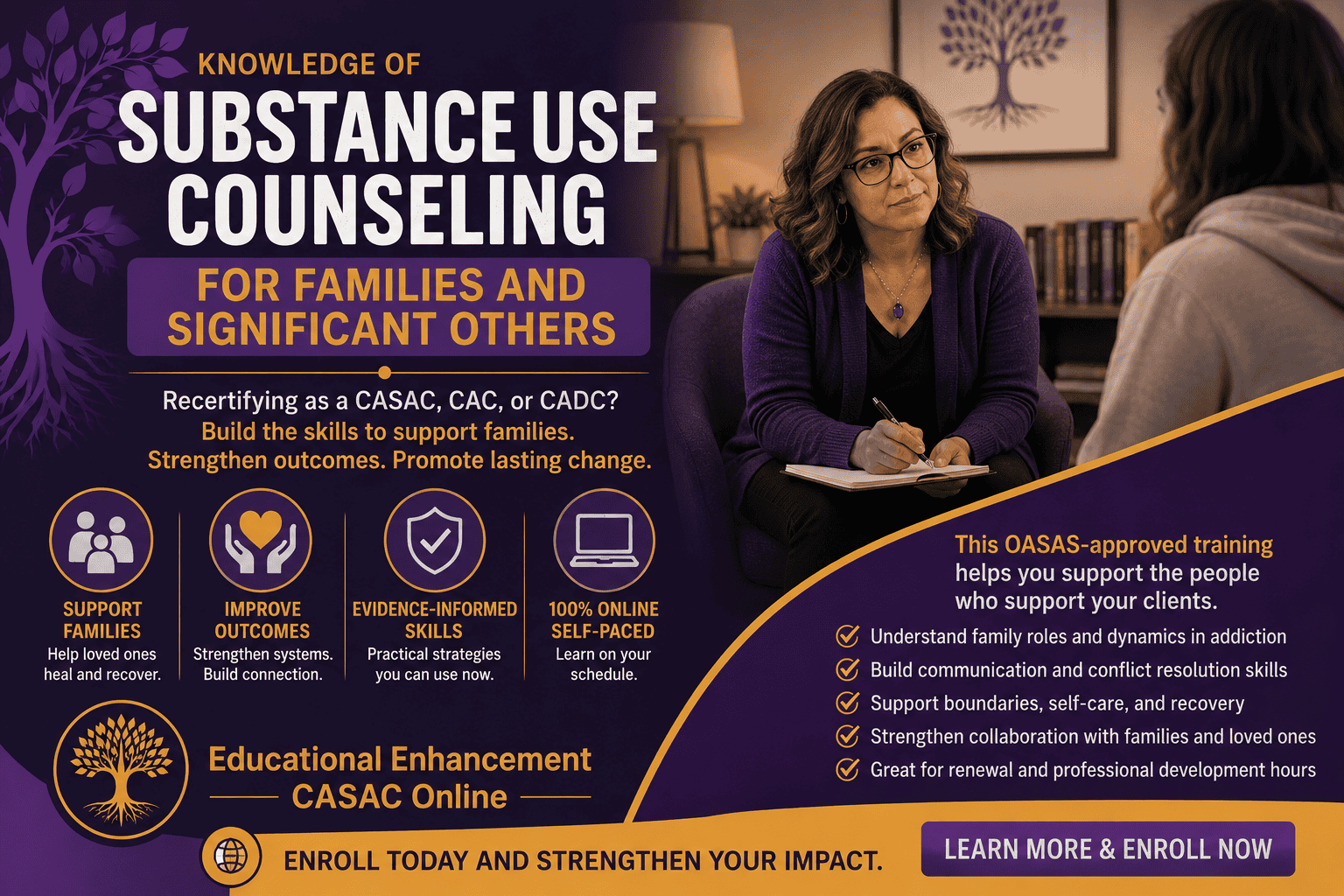
Knowledge of Substance Use Counseling for Families and Significant Others
Recertifying as a CASAC, CAC, or CADC? Learn How to Work With Families Without Getting Pulled Into the Chaos
Family systems can drive relapse risk or recovery momentum. This OASAS-approved training helps you work with loved ones in a clear, structured way, while protecting your client’s goals, confidentiality, and safety.
Perfect for CASAC, CAC, and CADC professionals, this course offers:
- Self-Paced, 100 Percent Online Learning
- Practical Skills For Family Roles, Boundaries, And Engagement
- Communication And Conflict Tools You Can Use In Sessions
- Stronger Support Planning For Loved Ones And Significant Others
- Strong Fit For Renewal And Professional Development Hours
Support the client. Guide the family. Keep the treatment plan steady.
What Drives the Caretaker?
What motivates the caretaker often stems from deep-seated emotions and past experiences. Typically, caretakers are driven by feelings of pain, fear, and unresolved trauma that influence their actions and decisions. These internal struggles can shape their behavior, prompting them to respond based on their emotions rather than on objective assessment. Understanding this underlying dynamic is crucial to addressing their needs and providing effective support.
Common motivations include:
- Fear of abandonment
- Shame about addiction in the family
- Need for control
- Desire to feel needed
- Guilt over past events
- Anxiety about conflict or rejection
Many caretakers learned early in life that love meant sacrifice.
They confuse exhaustion with loyalty.
They believe that if they stop helping, everything will collapse.
That’s why compassion matters when addressing these patterns as a Substance Use Counselor.
How Caretaking Can Block Recovery
This is one of the most important lessons taught in CASAC Training Online and clinical supervision.
When people never experience consequences, motivation for change often disappears.
Caretakers unintentionally create a safety net around the addiction by:
- Paying legal fines
- Covering debts
- Lying to employers
- Managing probation issues
- Providing housing without boundaries
- Preventing emotional discomfort
This shields the person using substances from reality.
It also teaches them that someone else will always absorb the damage.
A CASAC in NY must learn how to address this dynamic without shaming the family.
The Emotional Cost of Caretaking
Caretakers frequently encounter significant emotional exhaustion and physical fatigue as they dedicate extensive time and effort to support and care for others. This continuous strain can lead to burnout, impacting their overall well-being and ability to provide effective assistance.
Over time, many develop:
- Depression
- Anxiety
- Isolation
- Chronic stress
- Physical exhaustion
- Deep resentment
Eventually, the caretaker may become emotionally overwhelmed themselves.
Sometimes they enter treatment before the client ever does.
A skilled Substance Use Counselor recognizes that the caretaker also needs support, education, and healing.
What Substance Use Counselors Can Do
If you’re pursuing CADC Certification or studying for the IC & RC Exam, these interventions matter greatly. They can significantly impact your understanding, preparation, and success. Implementing these strategies thoughtfully can help you build confidence, address weak spots, and improve your chances of passing the exam and achieving your certification goals.
Effective approaches include:
- Validate Their Effort Without Reinforcing Enabling
Acknowledge how hard they’ve worked while gently exploring the impact of their behavior. - Separate Love From Rescue Behavior
Help them understand that boundaries are not a sign of abandonment. - Introduce Natural Consequences
Ask what would happen if the client handled their own responsibilities. - Encourage Family Education
Family groups and psychoeducation can reduce shame and increase awareness. - Address Resentment Directly
Many caretakers suppress anger until it explodes. - Help Build Identity Outside the Crisis
Many caretakers no longer know who they are outside of managing addiction.
This work takes patience.
A CASAC in NY cannot force insight, but they can create space for change.
When the Caretaker Resists Change
Resistance is common in SUD family systems.
Sometimes, the caretaker develops a stronger emotional attachment to their role than the client does to their own recovery process. This dynamic can create feelings of frustration and helplessness for the Substance Use Counselor, who may struggle to balance support and boundaries. It highlights the complex emotional challenges inherent in addiction counseling and the importance of maintaining professional detachment while providing compassionate care.
But resistance usually protects something deeper:
- Fear
- Identity
- Stability
- Emotional survival
Sometimes the breakthrough moment happens when the caretaker finally says:
“I don’t know who I am without taking care of them.”
That’s where real therapeutic work begins.
Final Thoughts
The caretaker role is not evil. It is human. But it can quietly keep addiction alive while destroying the mental and emotional health of the entire family system. Whether you are completing CASAC Training Online, preparing for the IC & RC Exam, pursuing CADC Certification, or already working as a Substance Use Counselor, understanding this role is essential clinical knowledge. Every CASAC in NY will encounter caretakers who believe they are saving the person they love while unknowingly protecting the addiction itself.
Your role is not to shame them.
Your role is to help them see the pattern, understand the cost, and begin building healthier boundaries.
That shift can change the entire recovery process.
And sometimes, it’s the moment real healing finally begins.
Subscribe to Our Newsletter
Stay up-to-date with changes in the addiction recovery field, new illicit drug trends, treatment modalities, and new addiction counselor training opportunities.