
Educational Enhancement
Addiction Counseling News and Blog
Be the CHANGE we need!
Join Our Newsletter!
Join today. Stay current with news about addiction counselors, interventions, trends, and statistics.
STOP THE STIGMA
Motivational Interviewing 4th Edition: What Substance Use Counselors Need to Know
MI-4 keeps the core method intact, but changes its language, expands its scope, and gives counselors clearer ways to support autonomy, change talk, and practical planning. A client says, “I know my substance use is causing problems. I am still not ready...
Counseling Clinical Skills Every Substance Use Counselor Should Master
Great counseling is built one clinical decision at a time. Learn the counseling clinical skills that strengthen trust, improve assessment, guide treatment, and keep clients engaged throughout recovery. A counseling session rarely succeeds because one question...
Cultural Humility and the Therapeutic Alliance: Building Trust Across Every Counseling Relationship
The strongest counseling relationships are not built by having all the answers. They are built by remaining curious, respecting each client’s lived experience, and allowing cultural humility to strengthen the therapeutic alliance from the very first conversation....

Don’t Enroll in Substance Use Counselor Online Training Until You Read This
Choosing the right online training can save months of frustration, prevent costly mistakes, and put you on the fastest path toward certification in New York, Florida, Georgia, North Carolina, and Tennessee. Search for substance use counselor online training,...
Triggers, Cues, and Cravings Explained: Understanding What Drives Substance Use
Cravings do not appear out of nowhere. Learn how triggers, conditioned cues, and brain learning shape substance use, and how counselors can teach practical craving management and relapse prevention strategies. A client says, “I was doing fine until I drove past...
A Counselor’s Guide to Substance Use Screening Tools: SBIRT, AUDIT, DAST-10, CAGE, CRAFFT, and TAPS
A Counselor's Guide to Substance Use Screening Tools: SBIRT, AUDIT, DAST 10, CAGE, CRAFFT, and TAPS: Understanding That a Positive Screen Is Not a Diagnosis A substance use counselor does not use screening tools to label people. They use them to start better...
Consultation and Scope of Practice: The Call That Protects Your Client and Your Credential
Know your scope of practice: when a case has crossed your training. Use consultation, supervision, referral, and clean documentation without abandoning the client. A client tells you that voices have started giving commands. Another asks you to process...
Conducting a Clinically Useful Intake | A Practical Guide for Substance Use Counselors
The most important part of an intake is not the paperwork. It is understanding who is sitting in front of you, recognizing immediate risks, and gathering the information that guides every clinical decision that follows. A new client sits across from you while...
Referral and Warm Handoffs: Connecting SUD Clients Without Losing Them
A referral should not end with a phone number. Learn how warm handoffs, thoughtful care coordination, and effective follow-through keep clients engaged and strengthen continuity of care. A client nods when you recommend counseling for trauma, psychiatric care,...
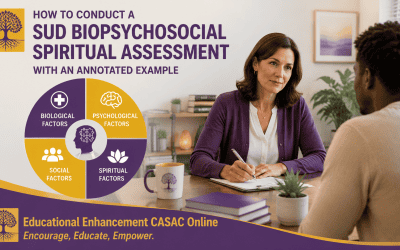
How To Conduct A SUD Biopsychosocial Spiritual Assessment With An Annotated Example
A biopsychosocial assessment is not a form. It is how you hear biology, psychology,social pressure, risk, and client strengths before you write the plan. A biopsychosocial assessment helps a substance use counselor see the full picture before writing a...
Using Person First Language Every Day: A Practical Guide for Substance Use Counselors
The words you use shape clinical judgment, documentation, trust, and treatment. Here is how to replace stigmatizing labels with language that accurately describes people and behavior. Most counselors never receive formal feedback about the words they...
The Therapeutic Alliance: Why the Relationship Often Matters More Than the Technique
Trust is not a bonus skill in substance use counseling. It is the foundation that allows every assessment, intervention, and treatment plan to work. Learn how to build a therapeutic alliance thatkeeps clients engaged from the very first conversation. A...
Case Conceptualization: Making Sense of Complex Client Stories
Assessment collects information. Case conceptualization explains what it means. Learn how strong clinical reasoning connects assessment findings to individualized treatment planning. A counselor completes a thorough assessment, gathers pages of notes, and finishes the...
Difficult Conversations During Clinical Supervision: The Conversations That Make Better Counselors
Difficult Conversations During Clinical Supervision:How Supervision Feedback Shapes Better Clinical Judgment You will not remember every supervision meeting. You will remember the ones that challenged your thinking. Difficult conversations during...
If Your Treatment Plan Could Fit Any Client, It Fits No One: A Practical Guide to Substance Use Treatment Planning
A strong treatment plan turns assessment findings into clear clinical priorities, measurable goals, and specific interventions that reflect the person sitting in front of you, not a template written for everyone else. A counselor can complete an excellent...
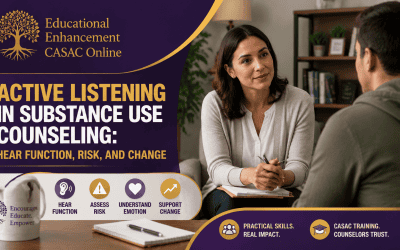
Active Listening In Substance Use Counseling: Hear Function, Risk, And Change
Your client is telling you more than the facts. Learn to hear emotion, ambivalence, discrepancies, risk,and the first clean signals of movement. For a substance use counselor, listening is not just a communication skill. It is a clinical skill that shapes...
Most Online CAC Programs in Florida Won’t Count Toward Your Credential. Here’s How to Tell Them Apart.
FCB approval, self-paced vs. supported, what a certificate actually gets you, and what Florida CAC training costs. Most people shopping for online CAC training in Florida start with price. That's the wrong starting point. An FCB-approved online CAC...
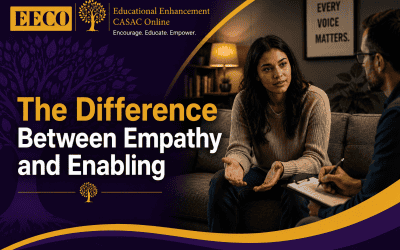
The Difference Between Empathy and Enabling: The Counseling Mistake That Can Stall Recovery
Understanding the Critical Difference Between Compassion and Codependency in Addiction Counseling Most people become counselors because they genuinely care about others. You want to reduce suffering. You want people to feel heard. You want to help someone who...
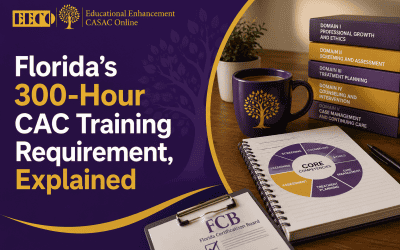
300 Hours. Four Domains. One Exam. Here’s What Florida’s CAC Training Requirement Actually Covers.
The FCB-approved CAC training topics, the 6-hour ethics floor, and what to look for in an online program before you enroll. Most people researching the 300-hour CAC training Florida requires know that 300 is the number. What they don't know is what's inside it....
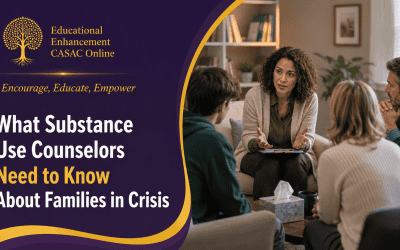
What Substance Use Counselors Need to Know About Families in Crisis
What Substance Use Counselors Need to Know About Families in Crisis: How Family Systems Theory, Developmental Changes, and Crisis Intervention Intersect in the Work of CASACs, CADCs, and CACs Families Are Never Just Background Information One of the biggest mistakes a...