
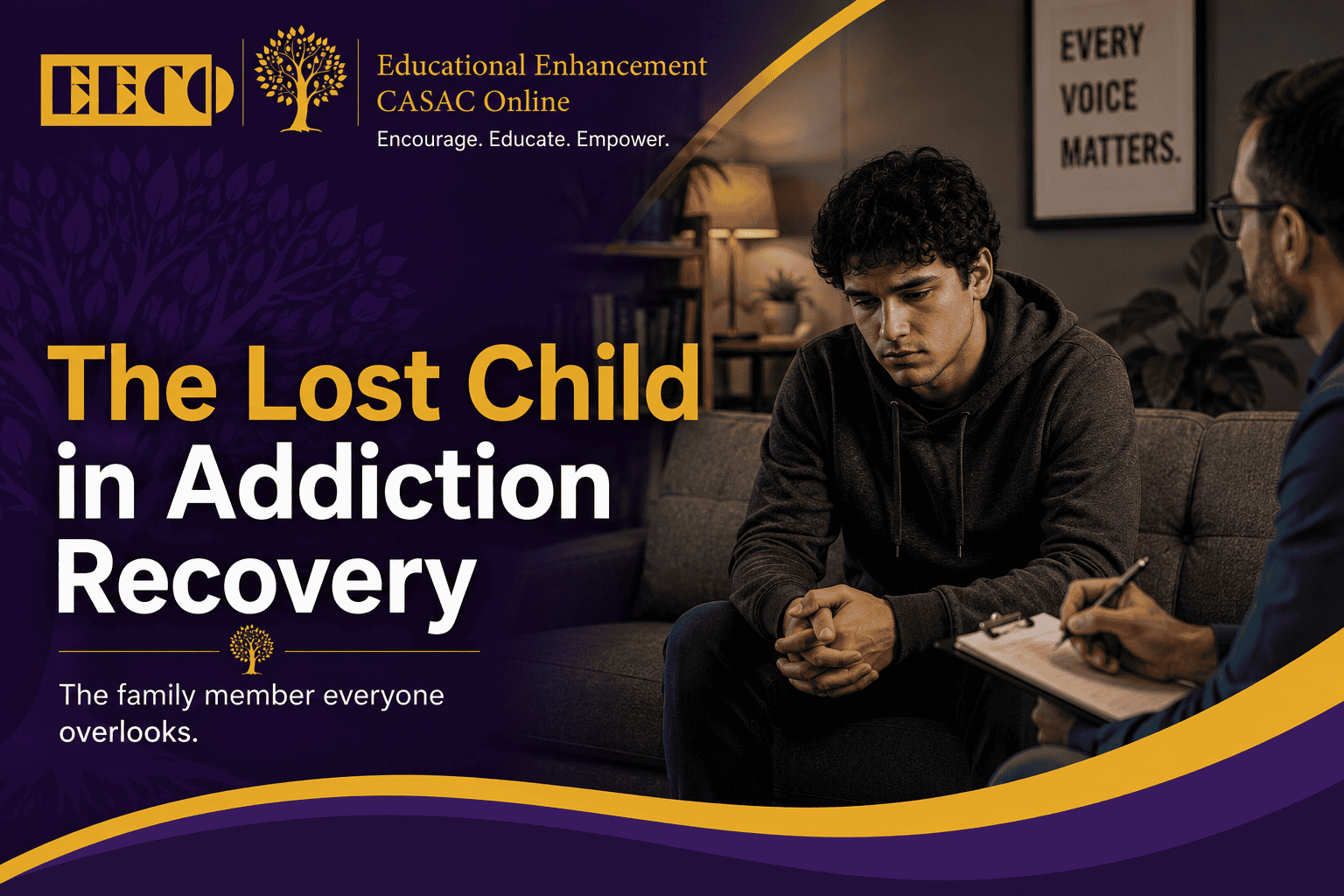
Learn how the lost child role develops through family systems theory and addiction, why emotional withdrawal often hides depression and anxiety, and how trauma-informed family counseling helps substance use counselors reconnect clients with their voice, safety, and recovery.
The Quietest Person in the Family May Be Carrying the Heaviest Burden
The lost child role in a dysfunctional family often leads to feelings of neglect, isolation, and emotional distancing from loved ones, which can significantly impact their development and future relationships.
Some become invisible.
While one sibling may become the hero, another the caretaker, another the mascot, and another the scapegoat, one family member often survives by disappearing emotionally. They stay out of the way. They ask for very little. They rarely complain. They become so quiet that everyone assumes they are doing fine.
They are often called the lost child.
For a substance use counselor, this role can be one of the easiest to miss and one of the most important to understand. The family-lost-child role rarely creates immediate crises. Instead, it quietly develops beneath years of chronic stress, unresolved trauma, emotional neglect, and family conflict. The absence of disruptive behavior can create the illusion that this individual is coping well when, in reality, they may be struggling with profound loneliness, depression, anxiety, or hopelessness.
This is one of the reasons family systems theory remains such an important framework for addiction treatment. Families naturally adapt to ongoing stress. Each person develops strategies that help them survive emotionally, even when those strategies become harmful over time.
For a CASAC in NYS, a CAC in Florida, a CADC in Georgia, or any substance use counselor working with individuals and families, recognizing the lost child in dysfunctional family systems is essential to providing effective trauma-informed family counseling.
When families are living with substance use disorder, the most obvious symptoms usually receive the most attention. Yet the person asking for the least help may actually need it the most.
What Is the Lost Child Role?
The family-lost-child role develops when someone learns that staying invisible feels safer than participating.
Within family systems theory, substance use disorder, every family member unconsciously adapts to reduce emotional danger. Some children attempt to restore order by becoming responsible. Others absorb blame. Some distract everyone with humor.
The lost child chooses distance.
Rather than competing for attention, they quietly withdraw from it.
They avoid conflict.
They stay in their room.
They keep their thoughts private.
They become emotionally self-sufficient because experience has taught them that expressing needs rarely changes anything.
This adaptation often begins during childhood but frequently continues well into adulthood. Many adults who grew up in homes affected by substance use still struggle to identify their own preferences, communicate boundaries, or ask for help because independence became their primary survival strategy.
The family’s lost-child role is not evidence of resilience.
It is evidence of adaptation.
Understanding this distinction changes the way a substance use counselor approaches assessment, engagement, and treatment planning.
The role also becomes much easier to recognize when viewed alongside the larger family system. In our article, Family Systems Theory: The Person with Substance Use Disorder and Family Pressure, we explain how entire families reorganize around addiction long before these individual roles become visible.
What the Lost Child Often Looks Like
The lost child in dysfunctional family systems rarely appears disruptive.
They often appear easy.
Teachers describe them as quiet.
Parents describe them as independent.
Counselors may describe them as cooperative.
Friends may describe them as shy.
These descriptions are not necessarily wrong.
They are simply incomplete.
The family lost child role often includes:
- Withdrawal from family activities
- Emotional isolation
- Quiet compliance
- Excessive independence
- Difficulty expressing needs
- Depression that goes unnoticed
- Anxiety hidden behind calm behavior
- Spending long periods alone
- Reading, gaming, sleeping, or escaping into solitary hobbies
- Few close relationships
- Believing they should never burden anyone else
Many people assume these clients are emotionally healthy because they rarely create conflict.
Unfortunately, substance use counselor family dynamics teaches us that quiet behavior is not the same as emotional wellness.
Sometimes silence is not peace.
Sometimes it is protection.
The lost child often becomes so skilled at disappearing emotionally that family members stop noticing them altogether. Years may pass before anyone realizes how isolated they have become.
That isolation can increase vulnerability to depression, anxiety disorders, substance use, and suicidal thinking if left unaddressed.
What the Lost Child Is Protecting
Every family role exists because it serves a purpose.
The family lost child role protects both the individual and the family system.
For the individual, withdrawal reduces emotional risk.
If they stay quiet, they are less likely to become involved in arguments.
If they need nothing, they cannot be disappointed.
If they remain invisible, they cannot become another source of conflict.
Within family systems theory, addiction becomes an understandable adaptation.
Children naturally learn from experience.
When emotional expression consistently leads to rejection, criticism, unpredictability, or disappointment, many eventually conclude that having needs is unsafe.
That belief often follows them into adulthood.
As adults, they may avoid relationships because vulnerability feels dangerous.
They may remain emotionally distant from partners.
They may struggle to ask supervisors for help.
They may refuse support during recovery because independence has become part of their identity.
The family also benefits from this role, even if unintentionally.
Every person who quietly disappears becomes one less emotional demand on an already overwhelmed system.
The family can continue focusing on the person using substances.
Or the hero.
The lost child quietly carries their pain alone.
This is why family roles in addiction recovery cannot be understood in isolation.
When one family member disappears emotionally, another often becomes responsible for everyone else. That pattern is explored in our article on the Caretaker role, which demonstrates how the most dependable family member may unknowingly perpetuate unhealthy family patterns.
Likewise, when one sibling quietly withdraws, another may absorb the family’s frustration and become the identified patient. That dynamic is explored in our discussion of the Scapegoat role, illustrating how different family members adapt to the very same environment in dramatically different ways.
For the substance use counselor, these connections matter.
The goal is never to identify one role.
The goal is to understand the entire family system.
Why Counselors Often Miss This Role
The lost child in a dysfunctional family system rarely asks for help.
That alone makes this role easy to overlook.
Behavioral health professionals naturally pay attention to crises.
We respond to substance use.
We respond to aggression.
We respond to suicidal statements.
We respond to legal problems.
We respond to family conflict.
The lost child in a dysfunctional family often presents with none of those concerns.
Instead, they quietly attend sessions.
They answer questions politely.
They say very little.
They report that everything is “fine.”
They rarely challenge the counselor.
Unfortunately, compliance can become mistaken for progress.
This is one of the greatest risks when assessing substance use and counselor family dynamics.
A client who speaks the least may receive the least clinical attention.
Yet they may also carry the highest levels of loneliness, emotional neglect, unresolved grief, or untreated depression.
Trauma-informed family counseling reminds us to assess what is missing, not only what is present.
Silence deserves exploration.
Withdrawal deserves curiosity.
Isolation deserves assessment.
A skilled substance use counselor does not assume that the absence of visible symptoms means the absence of suffering.
Sometimes the greatest clinical concern is the client who has become so accustomed to being overlooked that they no longer expect anyone to notice them.
That realization often becomes the beginning of meaningful therapeutic work.
What You Do
Recognizing the role of a family’s lost child is only the beginning.
The next step is to create enough emotional safety so that the client slowly begins to believe their thoughts, feelings, and needs matter.
Unlike the mascot or the scapegoat, the lost child often does not respond quickly to direct intervention. Years of emotional withdrawal cannot be reversed in a few sessions. Trust develops gradually through consistency, patience, and genuine curiosity.
For a substance use counselor, the goal is not to force engagement.
The goal is to make engagement feel safe.
Trauma-informed family counseling recognizes that many lost children learned early in life that asking for attention led to disappointment, rejection, or simply being ignored. They adapted by becoming self-reliant, emotionally quiet, and nearly invisible.
That adaptation deserves respect before it is challenged.
Clinical assessment should include direct but compassionate questions about depression, anxiety, loneliness, social support, trauma exposure, and emotional safety.
Do not assume that a quiet client is emotionally stable simply because they are cooperative.
Ask directly about:
- Current mood
- Feelings of hopelessness
- Anxiety symptoms
- Social isolation
- Self-worth
- Thoughts of self-harm
- Suicidal thinking when clinically indicated
- Available supports
- Sense of belonging
Many individuals in the family lost child role have never been asked these questions with genuine concern.
Sometimes the assessment itself becomes the first experience of feeling emotionally seen.
Within substance use counselor family dynamics, one thoughtful conversation can begin changing beliefs that have existed for decades.

Knowledge of Substance Use Counseling for Families and Significant Others
Recertifying as a CASAC, CAC, or CADC? Learn How to Work With Families Without Getting Pulled Into the Chaos
Family systems can drive relapse risk or recovery momentum. This OASAS-approved training helps you work with loved ones in a clear, structured way, while protecting your client’s goals, confidentiality, and safety.
Perfect for CASAC, CAC, and CADC professionals, this course offers:
- Self-Paced, 100 Percent Online Learning
- Practical Skills For Family Roles, Boundaries, And Engagement
- Communication And Conflict Tools You Can Use In Sessions
- Stronger Support Planning For Loved Ones And Significant Others
- Strong Fit For Renewal And Professional Development Hours
Support the client. Guide the family. Keep the treatment plan steady.
Questions That Open the Conversation
Clients living within the family-lost-child role often answer questions with one or two words.
“I’m okay.”
“It doesn’t matter.”
“I’m used to it.”
Those responses are rarely resistant.
More often, they are survival.
Family systems theory of addiction reminds us that this individual has frequently learned to minimize themselves in order to reduce emotional risk. Open-ended questions, delivered with patience rather than urgency, help create space for deeper reflection.
Consider asking:
- Who knows you are hurting?
- What do you need that you do not ask for?
- What feels unsafe about being seen?
- When did you first learn to keep things to yourself?
- What happens when you tell people you need help?
- If someone truly understood you, what would they know?
These questions often lead to silence.
Do not rush to fill it.
Silence is frequently the moment the client begins searching for emotions they have spent years ignoring.
Trauma-informed family counseling teaches us that insight cannot be forced.
It emerges when clients have enough emotional safety to remain present with uncomfortable feelings rather than escape them.
For the substance use counselor, learning to tolerate silence is every bit as important as asking good questions.
Some of the most meaningful clinical breakthroughs begin with thirty seconds of quiet reflection.
The family-lost-child role develops through emotional invisibility.
Recovery begins when someone finally feels visible.
Building Skills, Structure, and Support
Insight alone rarely changes lifelong family patterns.
Clients also need practical skills that support emotional growth.
Many individuals who identify with the family lost child role have spent years focusing on everyone else’s needs while disconnecting from their own internal experience.
Part of recovery involves helping them rediscover themselves.
Treatment goals may include:
- Identifying personal values
- Naming emotions accurately
- Developing assertive communication
- Building healthy boundaries
- Learning to ask for support
- Increasing social connection
- Practicing emotional regulation
- Developing healthy routines
- Strengthening self-confidence
- Participating in meaningful activities
Behavioral activation can be especially valuable for clients experiencing depression or emotional withdrawal.
Encouraging small, achievable goals helps rebuild confidence while reducing isolation.
These interventions are not simply counseling techniques.
They are long-term recovery skills.
For a CASAC in NYS, CAC in Florida, CADC in Georgia, or any substance use counselor, helping clients reconnect with their own identity often becomes just as important as addressing substance use itself.
Recovery is not only about removing unhealthy behaviors.
It is also about helping people discover who they are when survival is no longer their primary goal.
Helping the Family Change Its Part
The family lost child role cannot fully heal if the family continues treating the individual as invisible.
Family systems theory of addiction reminds us that lasting change occurs when the entire system begins functioning differently.
Families often overlook the lost child because they appear independent.
“They never complain.”
“They’re easy.”
“They’ve always taken care of themselves.”
While these statements sound positive, they often reveal emotional neglect that has gone unnoticed for years.
Substance use counselor family dynamics should include helping families recognize these patterns with compassion rather than blame.
Encourage family members to:
- Ask meaningful questions instead of making assumptions.
- Notice emotional withdrawal rather than rewarding silence.
- Validate feelings without immediately trying to solve them.
- Invite participation without pressure.
- Create consistent opportunities for honest conversation.
- Make room for every family member’s emotional experience.
Families frequently discover that the lost child has been struggling much longer than anyone realized.
This is why understanding family roles in addiction recovery is so important.
The quietest family member often carries enormous emotional pain without anyone noticing.
When one family member disappears emotionally, another frequently overfunctions to maintain stability. That dynamic is explored in our discussion of the Hero role, demonstrating how responsibility and emotional withdrawal often develop side by side within the same household.
Likewise, enabling patterns rarely begin with the individual using substances. They often begin with someone trying to protect the family from additional pain. The Caretaker role explains why the family member who appears the most dependable may unintentionally keep unhealthy patterns alive.
Recognizing family roles in addiction recovery enables families to move beyond merely responding to symptoms and start healing the system itself.
What Should Counselors Remember?
The lost child in a dysfunctional family is not emotionally healthy simply because they are quiet.
The lost child is not resilient simply because they appear independent.
The lost child is not free from pain because they never ask for help.
Many have simply learned that their needs are less important than everyone else’s.
Over time, invisibility becomes identity.
Trauma-informed family counseling gently challenges that belief.
The counselor becomes someone who notices.
Someone who listens.
Someone who remains present.
Someone who communicates that the client’s voice deserves space.
Family systems theory of addiction teaches us that every family role once served a protective purpose.
Healing does not begin by criticizing the adaptation.
Healing begins by understanding why it became necessary.
That understanding creates compassion.
Compassion creates trust.
Trust creates change.
Final Clinical Takeaway
The family lost a child in a dysfunctional family reminds us that the absence of visible problems is not evidence of emotional wellness.
Some of the deepest pain exists beneath silence.
For every CASAC in NYS, CAC in Florida, CADC in Georgia, and every substance use counselor seeking to strengthen substance use counselor family dynamics, learning to recognize emotional withdrawal is an essential clinical skill.
Family systems theory of addiction teaches us that families adapt in predictable ways when living with chronic stress, trauma, and substance use. Understanding those adaptations allows counselors to move beyond symptom management and begin treating the emotional patterns that keep families stuck.
Trauma-informed family counseling asks us to notice the client who speaks the least, withdraws the most, and asks for nothing.
Because that individual may be carrying years of loneliness that no one has ever acknowledged.
Throughout this family systems series, we have explored how different family members survive the same environment in remarkably different ways. The Hero accepts responsibility. The Caretaker protects everyone else. The Mascot uses humor to reduce tension. The Scapegoat absorbs blame. The Lost Child quietly disappears. Recognizing these family system roles can enhance our understanding of the various ways individuals navigate familial dynamics in addiction recovery.
Together, these patterns reveal one powerful truth.
Family roles in addiction recovery are not personality traits.
They are survival strategies.
And once survival is no longer the only goal, healing can finally begin.
Join Our Newsletter!
Join today. Stay current with news about addiction counselors, interventions, trends, and statistics.
STOP THE STIGMA